Text to imageLandscapeStyle guide
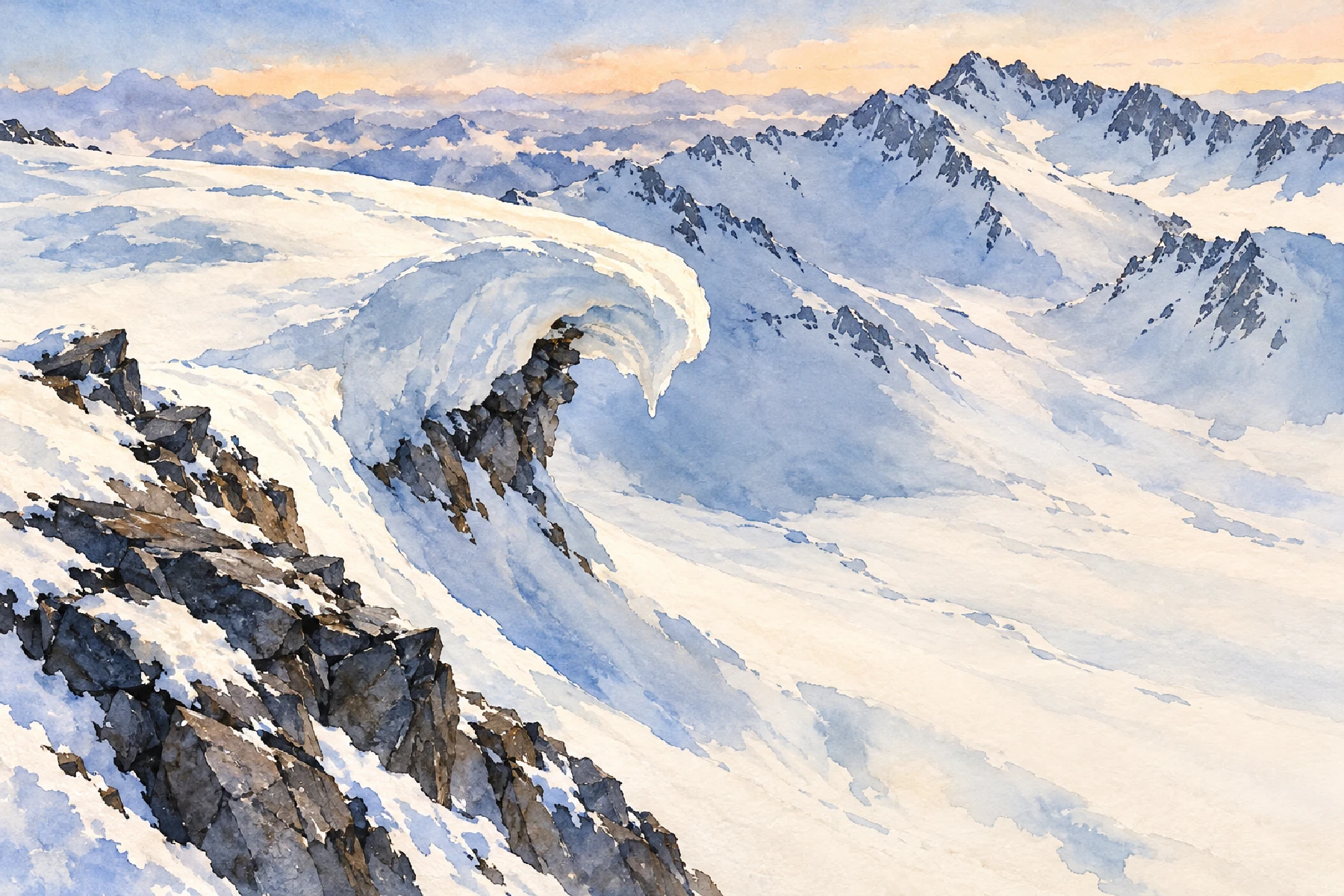
Snow Cornice Above the Cirque
A hooked snow cornice overlooks a spacious mountain bowl. Blooming watercolor and broken edges contrast the exposed ridge with the quiet openness of the snowfield.
Remix this referenceSnow Cornice Above the Cirque
- Form language
- Reduce complex terrain to sweeping masses interrupted by a few angular fractures; allow local shapes to vary naturally.
- Contour
- Alternate crisp reserved edges with lost, feathered boundaries; let occasional dry-brush breaks interrupt the silhouette.
- Mark-making
- Use broad wet watercolor strokes, irregular backruns, and a few dragged brush marks; keep their rhythm loose and unequal.
- Surface rendering
- Let transparent washes pool into blooms and pigment rims, with untouched paper opening through thin, luminous passages.
Priority
Make wet watercolor blooms and broken edges visibly essential to the image.
What to avoid & what to check
Exact prompt for this example
MODULE OWNERSHIP
subject: Subject count, type, stable proportions and landmarks, resting face geometry, hair shape, physical materials, garment construction and permanent marks. No emotion, movement, color assignment or rendering recipe.
expression: Facial soft-tissue displacement and pupil direction, muscle coordination, regional intensity, asymmetry and onset/peak/release. No head/body pose, stable appearance, skin color or rendering.
gesture: Head/neck/body/limb orientation, joint movement, support, contact and pose-caused occlusion using existing anatomy. No eye/pupil movement, emotion, identity, props inventory or camera.
props: Prop count, type, construction, physical material and scale relative to the subject. Holding/contact belongs to gesture, position to composition, color to palette.
scene: Environment elements, terrain, backdrop/floor presence and structural detail. No canvas positions, camera, lighting, assigned colors or render texture.
camera: Projection, focal-length impression, camera elevation/yaw/roll, viewing distance and crop. No actor pose, world placement, lighting or canvas aspect ratio.
composition: Normalized 0-100% canvas positions, scale in frame, depth/overlap, focal hierarchy and margins. No joint pose, camera projection, rendering, subject/prop inventory or emotion.
palette: Color anchors, hue/saturation/value ranges, colors assigned to parts and approximate color coverage. No illumination direction, shading algorithm, physical material or layout.
lighting: Light-source direction/softness/intensity, ambient illumination, physical shadow direction/length and highlight position. Absence of directional illumination is allowed. No shading technique, palette or material changes.
style: Reusable form abstraction, contour weight/taper/edge quality, medium and mark scale/density/direction, surface rendering and tonal transition technique. No fixed subject proportions, anatomy, identity, expression, pose, palette, light-source direction, camera or layout.
output: Image count, aspect ratio, size, file/alpha requirements and global lettering/logo/watermark restrictions. No background scenery, crop, style, identity or pose.

SUBJECT
inventory: One continuous snow cornice attached to an exposed shale crest; no people or animals.
geometry: A broad snow shelf ends in a hooked overhang, with a narrow, irregular rock band beneath its undercut lip.
resting-face: No facial anatomy applies.
appearance: Wind-packed snow has a hardened crust; the exposed shale consists of thin, fractured plates.

PRIORITY


AVOID


CHECK


PROPS
inventory: No separate props.
construction: No prop construction applies.

PRIORITY


AVOID


CHECK


SCENE
inventory: A snow-filled mountain cirque, a serrated ridge, and an open sky.
structure: The basin forms a broad concave slope with a few shallow wind-scoured channels and no built structures.

PRIORITY


AVOID


CHECK


CAMERA
projection: Natural perspective with a moderately long-lens impression and gently compressed mountain depth.
viewpoint: Look obliquely down from an opposite ridge, high enough to reveal both the overhang and the basin.
crop: A broad landscape view includes the complete hooked tip, while the attached crest continues beyond the frame.

PRIORITY


AVOID


CHECK


COMPOSITION
placement: Place the hooked tip near 35% width and 40% height; the ridge enters diagonally from the lower left.
depth: The cornice is the primary focus, the basin opens beneath it, and the distant ridge remains subordinate.
spacing: Reserve most of the right half for spacious, minimally interrupted snowfield; keep ample air around the hooked tip.

PRIORITY


AVOID


CHECK


PALETTE
colors: Use paper ivory, diluted glacier blue, slate indigo, and a restrained apricot accent.
assignment: Ivory and glacier blue belong to snow, slate indigo to shale, and faint apricot to the distant sky.
balance: Very pale values dominate; compact dark rock accents give the restrained palette its strongest contrast.

PRIORITY


AVOID


CHECK


LIGHTING
sources: Broad, softly diffused daylight arrives from the upper left, with gentle ambient light throughout the basin.
shadows: A soft shadow beneath the lip extends down and right across the basin slope.
highlights: The upper rim receives the brightest light, with no sharp glints.

PRIORITY


AVOID


CHECK


STYLE GUIDE
form-language: Reduce complex terrain to sweeping masses interrupted by a few angular fractures; allow local shapes to vary naturally.
contour: Alternate crisp reserved edges with lost, feathered boundaries; let occasional dry-brush breaks interrupt the silhouette.
mark-making: Use broad wet watercolor strokes, irregular backruns, and a few dragged brush marks; keep their rhythm loose and unequal.
surface-rendering: Let transparent washes pool into blooms and pigment rims, with untouched paper opening through thin, luminous passages.

PRIORITY
Make wet watercolor blooms and broken edges visibly essential to the image.

AVOID


CHECK


OUTPUT
format: One finished image, 3:2 landscape, 1800 × 1200 pixels, opaque PNG.
restrictions: No lettering, logos, signatures, or watermarks.

PRIORITY


AVOID


CHECK


FINAL INTEGRATION
composition + style: Vary edge definition without filling the deliberately spacious areas with extra marks.
Model information comes from image provenance. The same prompt may produce a different result.