Text to imageLandscapeStyle guide
Grassy Hill · Cloud-Shadow Value Pattern
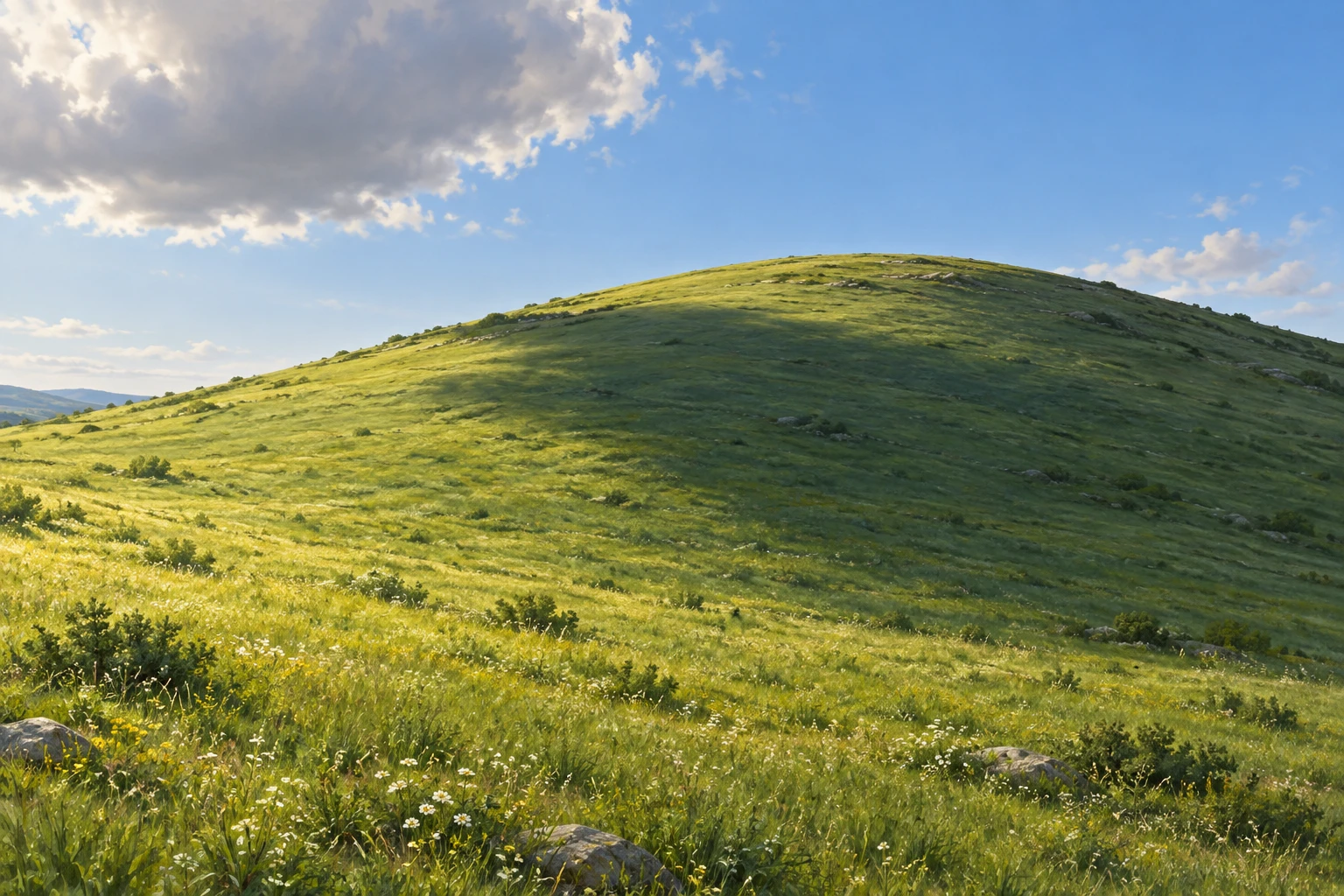
A broad, soft cloud shadow reveals the curvature of a grassy hill and the changing distribution of sunlight.
Grassy Hill · Cloud-Shadow Value Pattern
- Shape & line
- Build the hill with a long convex skyline and a few broad changes of slope. Bend the cloud shadow’s boundary across those changes so its shape stretches over the rounded ground instead of appearing as a flat rectangle pasted onto the image.
- Color & light
- Light the image-left foreground with warm yellow-green sunlight and lower the center-right shadow to cooler, muted green. Keep the shadowed grass visibly green and readable; soften the transition into a broad, irregular edge while preserving a clear difference between lit and shaded ground.
- Texture & material
- Describe the meadow with short, broken brush marks grouped into grass tufts near the bottom edge, then merge them into quieter patches uphill. Continue the same grass texture through the shadow boundary, changing its brightness rather than replacing it with a smooth dark surface.
- Composition
- Let the shadow occupy a broad center-right portion of the slope, leaving a generous sunlit wedge at image left and a narrow lit strip near the summit. Keep the cloud near the upper-left edge and the sky simple so the eye can compare illuminated and shadowed portions of one continuous landform.
Priority
Prioritize a continuous grassy landform whose curvature remains legible across the cloud shadow.
What to avoid & what to check
Avoid a hard geometric shadow, blackened grass, or a shadow boundary that reads as a change of ground material.
Check that the center-right shadow changes illumination while the hill’s form and grass texture continue through it.
Exact prompt for this example
SUBJECT
One rounded grassy hill beneath one broad cloud partly cropped by the upper-left image edge. The cloud interrupts sunlight arriving from the upper left, casting a broad shadow across the hill’s center-right slope while the left foreground remains sunlit.

COMPOSITION
Use a wide landscape view from the foot of the hill, with the grassy slope occupying the lower two-thirds and a quiet sky above. Place the rounded summit slightly right of center and keep the sunlit foreground connected visibly to the shadowed slope.

STYLE GUIDE
1. Shape & line
Build the hill with a long convex skyline and a few broad changes of slope. Bend the cloud shadow’s boundary across those changes so its shape stretches over the rounded ground instead of appearing as a flat rectangle pasted onto the image.

2. Color & light
Light the image-left foreground with warm yellow-green sunlight and lower the center-right shadow to cooler, muted green. Keep the shadowed grass visibly green and readable; soften the transition into a broad, irregular edge while preserving a clear difference between lit and shaded ground.

3. Texture & material
Describe the meadow with short, broken brush marks grouped into grass tufts near the bottom edge, then merge them into quieter patches uphill. Continue the same grass texture through the shadow boundary, changing its brightness rather than replacing it with a smooth dark surface.

4. Composition
Let the shadow occupy a broad center-right portion of the slope, leaving a generous sunlit wedge at image left and a narrow lit strip near the summit. Keep the cloud near the upper-left edge and the sky simple so the eye can compare illuminated and shadowed portions of one continuous landform.

PRIORITY
Preserve the requested identity, count, action, composition and output settings. Apply the style rules within those constraints; a style reference must not replace the subject or layout. Within the style: Prioritize a continuous grassy landform whose curvature remains legible across the cloud shadow.

AVOID
Avoid a hard geometric shadow, blackened grass, or a shadow boundary that reads as a change of ground material.

OUTPUT
Create one landscape image in a 3:2 aspect ratio, rendered as a naturalistic digital landscape painting, with no text, labels, border, or watermark.

SELF-CHECK
Check that the center-right shadow changes illumination while the hill’s form and grass texture continue through it.
Model information comes from image provenance. The same prompt may produce a different result.