Text to imageArt stylesStyle guide
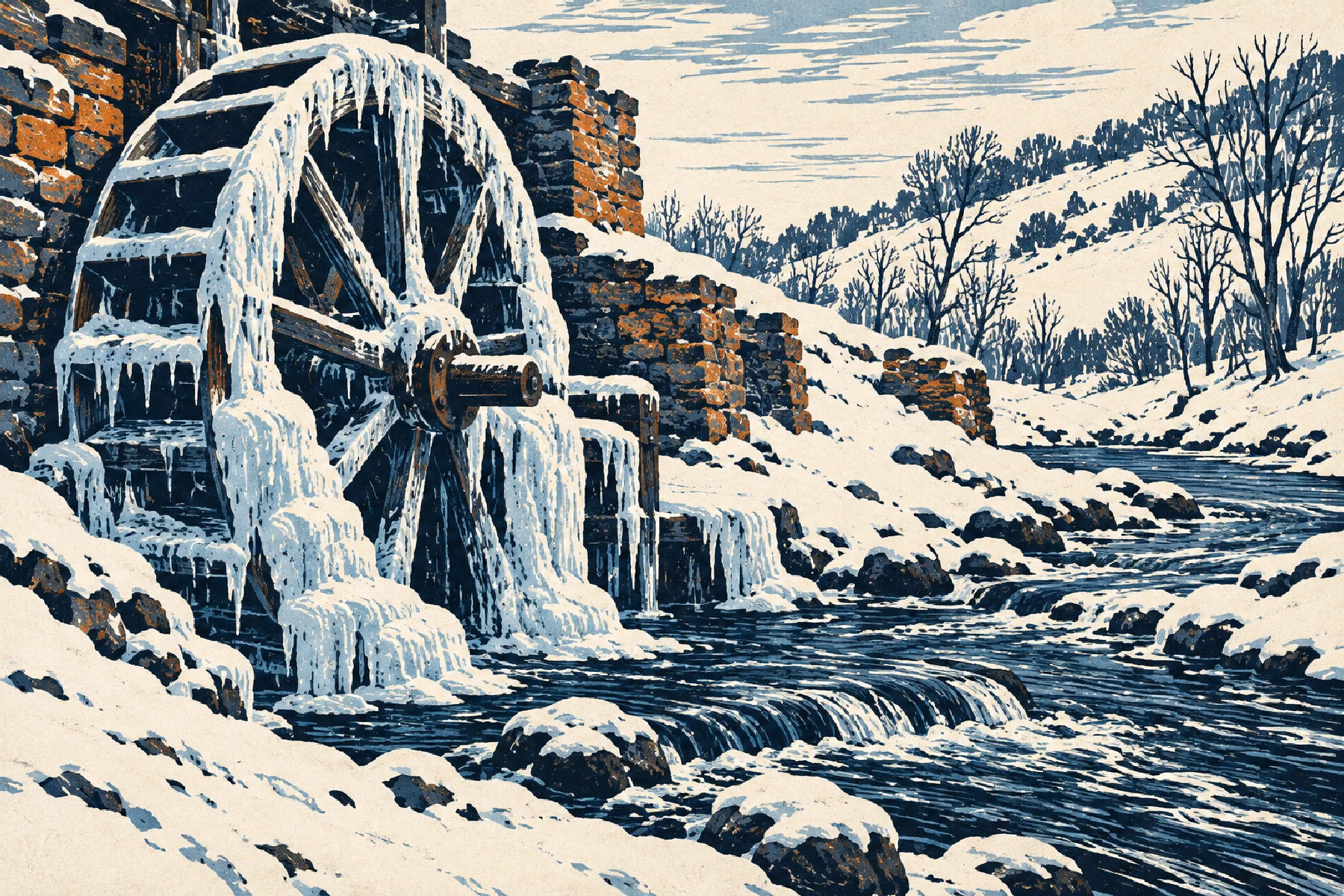
Ice Around the Mill Wheel
An icebound mill wheel hangs above an open millrace. Bold linocut shapes, rhythmic carved curves and spacious intervals give the winter scene its pulse.
Remix this referenceIce Around the Mill Wheel
- Form language
- Reduce forms to broad hooked masses and splintered wedges, keeping small details as selective interruptions.
- Contour
- Use bold relief-print edges with blunt starts, tapered exits and occasional chipped breaks; avoid uniform outlining.
- Mark-making
- Carve crescent gouges and sweeping channels in uneven rhythmic groups; let their width and spacing change naturally.
- Surface rendering
- Build tone from solid ink, exposed paper and clustered cuts; slight pressure variation and imperfect overprints reveal the hand-pulled linocut.
Priority
Let carved negative marks construct the forms, rather than merely decorate their surfaces.
What to avoid & what to check
Exact prompt for this example
MODULE OWNERSHIP
subject: Subject count, type, stable proportions and landmarks, resting face geometry, hair shape, physical materials, garment construction and permanent marks. No emotion, movement, color assignment or rendering recipe.
expression: Facial soft-tissue displacement and pupil direction, muscle coordination, regional intensity, asymmetry and onset/peak/release. No head/body pose, stable appearance, skin color or rendering.
gesture: Head/neck/body/limb orientation, joint movement, support, contact and pose-caused occlusion using existing anatomy. No eye/pupil movement, emotion, identity, props inventory or camera.
props: Prop count, type, construction, physical material and scale relative to the subject. Holding/contact belongs to gesture, position to composition, color to palette.
scene: Environment elements, terrain, backdrop/floor presence and structural detail. No canvas positions, camera, lighting, assigned colors or render texture.
camera: Projection, focal-length impression, camera elevation/yaw/roll, viewing distance and crop. No actor pose, world placement, lighting or canvas aspect ratio.
composition: Normalized 0-100% canvas positions, scale in frame, depth/overlap, focal hierarchy and margins. No joint pose, camera projection, rendering, subject/prop inventory or emotion.
palette: Color anchors, hue/saturation/value ranges, colors assigned to parts and approximate color coverage. No illumination direction, shading algorithm, physical material or layout.
lighting: Light-source direction/softness/intensity, ambient illumination, physical shadow direction/length and highlight position. Absence of directional illumination is allowed. No shading technique, palette or material changes.
style: Reusable form abstraction, contour weight/taper/edge quality, medium and mark scale/density/direction, surface rendering and tonal transition technique. No fixed subject proportions, anatomy, identity, expression, pose, palette, light-source direction, camera or layout.
output: Image count, aspect ratio, size, file/alpha requirements and global lettering/logo/watermark restrictions. No background scenery, crop, style, identity or pose.

SUBJECT
inventory: One old mill wheel, partly encased in ice; no people or animals.
geometry: A broad rim, open radial spokes and deep paddles remain recognizable beneath irregular ice collars.
resting-face: No face or facial landmarks apply.
appearance: Weathered timber, iron axle fittings and thick ice sheets; small chips and ice contours may vary naturally.

PRIORITY


AVOID


CHECK


PROPS
inventory: No separate props.
construction: No prop construction applies.

PRIORITY


AVOID


CHECK


SCENE
inventory: An open millrace, a broken stone mill foundation, snowbanks and a bare hillside.
structure: The race narrows between masonry walls before widening into a winding stream; snow softens the ruined foundation.

PRIORITY


AVOID


CHECK


CAMERA
projection: Natural perspective with a moderate wide-angle impression.
viewpoint: View from the stream bank, slightly below the axle, oblique to the wheel face; keep the camera level.
crop: A wide environmental view includes the complete wheel; the nearest bank continues beyond the lower edge.

PRIORITY


AVOID


CHECK


COMPOSITION
placement: The wheel anchors the left third with its center near mid-height; the stream opens across the right half.
depth: The near bank overlaps the wheel's lowest edge; the millrace leads toward the distant hillside.
spacing: Make the wheel the first read, the watercourse second; leave broad intervals between the bank and hill.

PRIORITY


AVOID


CHECK


PALETTE
colors: Deep indigo, glacial blue, warm ivory and a restrained rusty orange; keep saturation mostly subdued.
assignment: Indigo defines timber and open water; blue belongs to ice, ivory to snow and sky, orange to exposed masonry.
balance: Ivory occupies the largest area, indigo provides substantial weight, and orange stays a small accent.

PRIORITY


AVOID


CHECK


LIGHTING
sources: Broad winter daylight enters from the upper right, with soft ambient light filling the recesses.
shadows: Soft-edged shadows extend leftward beneath the wheel and along the masonry ledges.
highlights: Broad highlights catch the upper-right ice edges; only a few water ripples carry bright glints.

PRIORITY


AVOID


CHECK


STYLE GUIDE
form-language: Reduce forms to broad hooked masses and splintered wedges, keeping small details as selective interruptions.
contour: Use bold relief-print edges with blunt starts, tapered exits and occasional chipped breaks; avoid uniform outlining.
mark-making: Carve crescent gouges and sweeping channels in uneven rhythmic groups; let their width and spacing change naturally.
surface-rendering: Build tone from solid ink, exposed paper and clustered cuts; slight pressure variation and imperfect overprints reveal the hand-pulled linocut.

PRIORITY
Let carved negative marks construct the forms, rather than merely decorate their surfaces.

AVOID


CHECK


OUTPUT
format: One finished image, 3:2 landscape, 1800 × 1200 pixels, opaque PNG.
restrictions: No lettering, logos, signatures or watermarks.

PRIORITY


AVOID


CHECK
Model information comes from image provenance. The same prompt may produce a different result.