Text to imageAnimationStyle guide
Tipping Rain from the Awning
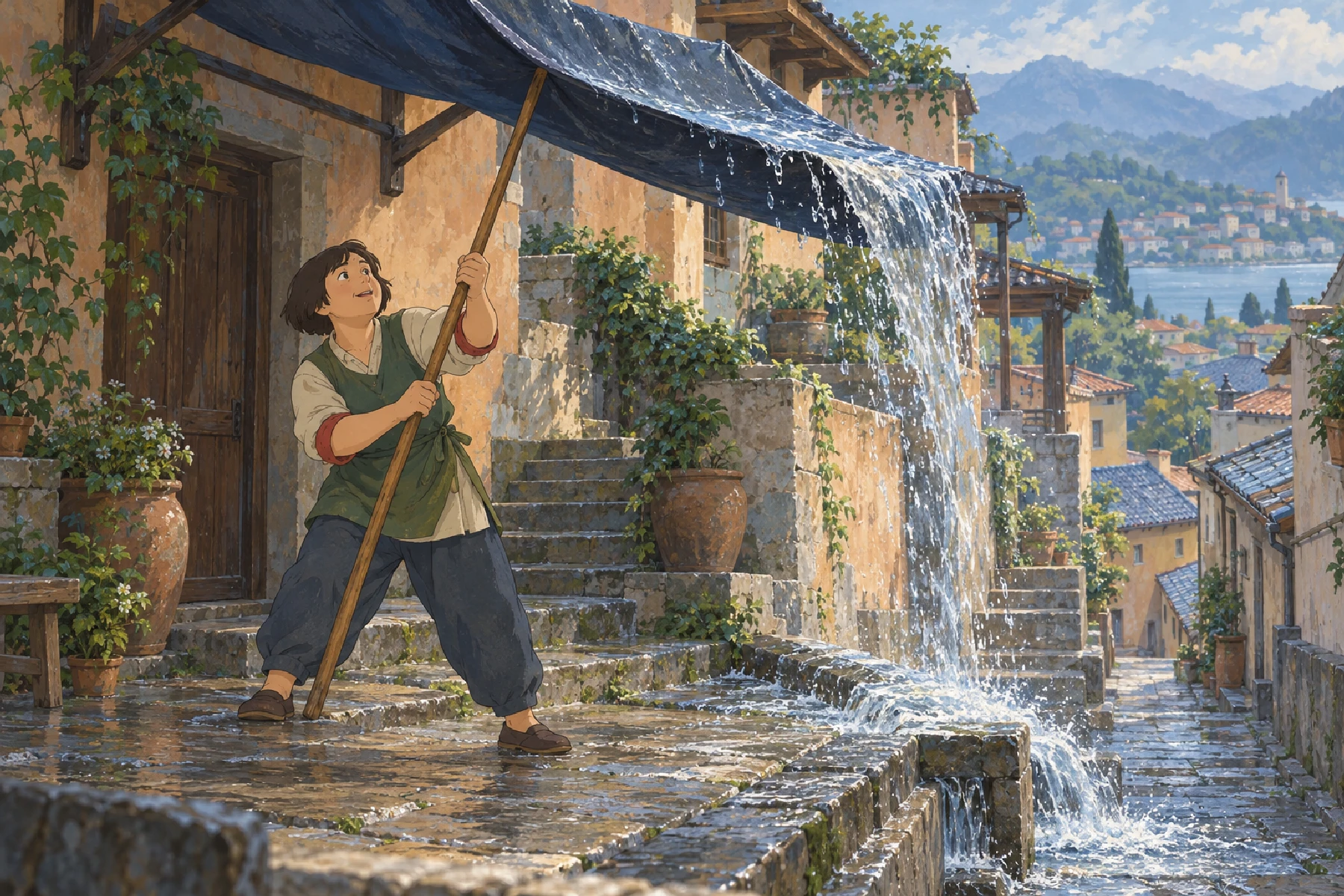
In a hillside lane after rain, a woman lifts a sagging awning with a pole. Beyond the spilling water, wet roofs and narrow stairs recede into the neighborhood.
Remix this referenceTipping Rain from the Awning
- Form language
- Establish broad, interlocking painted planes before adding smaller descriptive patches; simplify incidental detail while allowing gently irregular shapes.
- Contour
- Build contours from alternating firm and softened paint boundaries; use sparse tapered line accents only where adjacent forms need separation.
- Mark-making
- Layer visible brush traces along each plane, interrupted by occasional dry-brush skips; vary stroke length and density naturally.
- Surface rendering
- Use opaque painted passages with shallow paper-and-pigment texture, uneven pigment deposits and softly blended tonal transitions; retain selective rough edges.
Priority
Rendering medium: 2D hand-painted animated-film background illustration; formal rendering reference: Studio Ghibli · 2020s · The Boy and the Heron (2023), background art
What to avoid & what to check
Exact prompt for this example
MODULE OWNERSHIP
subject: Subject count, type, stable proportions and landmarks, resting face geometry, hair shape, physical materials, garment construction and permanent marks. No emotion, movement, color assignment or rendering recipe.
expression: Facial soft-tissue displacement and pupil direction, muscle coordination, regional intensity, asymmetry and onset/peak/release. No head/body pose, stable appearance, skin color or rendering.
gesture: Head/neck/body/limb orientation, joint movement, support, contact and pose-caused occlusion using existing anatomy. No eye/pupil movement, emotion, identity, props inventory or camera.
props: Prop count, type, construction, physical material and scale relative to the subject. Holding/contact belongs to gesture, position to composition, color to palette.
scene: Environment elements, terrain, backdrop/floor presence and structural detail. No canvas positions, camera, lighting, assigned colors or render texture.
camera: Projection, focal-length impression, camera elevation/yaw/roll, viewing distance and crop. No actor pose, world placement, lighting or canvas aspect ratio.
composition: Normalized 0-100% canvas positions, scale in frame, depth/overlap, focal hierarchy and margins. No joint pose, camera projection, rendering, subject/prop inventory or emotion.
palette: Color anchors, hue/saturation/value ranges, colors assigned to parts and approximate color coverage. No illumination direction, shading algorithm, physical material or layout.
lighting: Light-source direction/softness/intensity, ambient illumination, physical shadow direction/length and highlight position. Absence of directional illumination is allowed. No shading technique, palette or material changes.
style: Reusable form abstraction, contour weight/taper/edge quality, medium and mark scale/density/direction, surface rendering and tonal transition technique. No fixed subject proportions, anatomy, identity, expression, pose, palette, light-source direction, camera or layout.
output: Image count, aspect ratio, size, file/alpha requirements and global lettering/logo/watermark restrictions. No background scenery, crop, style, identity or pose.

SUBJECT
inventory: One original adult woman, a resident tending the shared courtyard.
geometry: A sturdy build with a long torso, broad hands and a compact, rounded head; retain ordinary human proportions.
resting-face: An oval face with widely spaced eyes, a straight nose, a broad mouth and a short, rounded chin.
appearance: Short hair forms a blunt rounded cap; a woven cotton tunic has rolled cuffs beneath a side-tied vest and loose trousers.

PRIORITY


AVOID


CHECK


EXPRESSION — ACTOR A
brows: One brow rises slightly while the other stays near rest.
lids: The lids narrow gently, with a little more compression on one side.
cheeks: A small cheek lift gathers beneath the more narrowed eye.
nose: The nose remains relaxed, without a wrinkle or nostril flare.
mouth: The lips part into a small, uneven smile, one corner lifting first.
jaw: The jaw releases slightly, without a broad mouth opening.
gaze: Pupils track the edge where the pooled water begins to spill.
coordination: Coordinate the cheek lift and mouth corner on the same side; keep the reaction understated.
timing: Catch the onset of the smile, just before it spreads across the face.

PRIORITY


AVOID


CHECK


GESTURE
head: Tip the head back slightly and turn it toward the awning's draining edge; keep the neck comfortably extended.
torso: Lean the torso away from the spill while rotating through the waist to continue the upward push.
limbs: Raise both arms along the pole, one hand above the other; bend the forward knee and brace through the rear foot.
contact: Both hands grip the pole; its tip presses beneath the awning, and both soles remain supported by the paving.

PRIORITY


AVOID


CHECK


PROPS
inventory: One wooden pole, somewhat longer than the woman's height.
construction: A plain, gently tapered shaft with a rounded end and a worn gripping surface; no attached mechanism.

PRIORITY


AVOID


CHECK


SCENE
inventory: A stepped hillside courtyard with a fixed fabric awning, plaster houses, tiled roofs, a stone drain and a narrow descending lane.
structure: The awning sags between wall brackets; pooled rain escapes in a broad broken sheet into the drain. Stairs connect successive roof terraces.

PRIORITY


AVOID


CHECK


CAMERA
projection: Natural perspective with a moderately wide lens impression and restrained edge distortion.
viewpoint: View from an opposite stair landing, slightly above the woman's eye level, with a three-quarter view and level horizon.
crop: Use an environmental full-figure view, including the awning supports above and the drainage paving below.

PRIORITY


AVOID


CHECK


COMPOSITION
placement: Set the woman in the lower-left third beneath the broad awning; make the lifted edge and released water the primary focus, then her face.
depth: Overlap the near awning with the courtyard architecture; let the descending lane open through successive, smaller roof layers.
spacing: Keep the figure under half the frame height, preserve air around her face, and leave a generous opening beyond the falling water.

PRIORITY


AVOID


CHECK


PALETTE
colors: Anchor the image in smoky indigo, warm apricot, muted moss green and pale blue-gray, with a small vermilion accent.
assignment: Use indigo for the awning, apricot for plaster, moss green for the vest, blue-gray for roofs and water, and vermilion for the cuffs; skin is warm ochre.
balance: Let subdued middle values dominate; reserve the palest notes for water and small warm accents for the figure.

PRIORITY


AVOID


CHECK


LIGHTING
sources: Broad, soft daylight enters from the upper right, with ample ambient illumination beneath the awning.
shadows: Short, soft shadows fall toward the lower left; the awning casts a broad, gently edged shadow across the wall.
highlights: Place broken highlights on the upper-right-facing water edges and a restrained glint along the pole's exposed side.

PRIORITY


AVOID


CHECK


STYLE GUIDE
form-language: Establish broad, interlocking painted planes before adding smaller descriptive patches; simplify incidental detail while allowing gently irregular shapes.
contour: Build contours from alternating firm and softened paint boundaries; use sparse tapered line accents only where adjacent forms need separation.
mark-making: Layer visible brush traces along each plane, interrupted by occasional dry-brush skips; vary stroke length and density naturally.
surface-rendering: Use opaque painted passages with shallow paper-and-pigment texture, uneven pigment deposits and softly blended tonal transitions; retain selective rough edges.

PRIORITY
Rendering medium: 2D hand-painted animated-film background illustration; formal rendering reference: Studio Ghibli · 2020s · The Boy and the Heron (2023), background art

AVOID


CHECK


OUTPUT
format: One finished image, landscape 3:2, 1800 × 1200 pixels, opaque PNG.
restrictions: No lettering, logos or watermarks.

PRIORITY


AVOID


CHECK
Art direction
스튜디오 지브리 / Studio Ghibli · 2020s · 그대들은 어떻게 살 것인가(2023)의 배경 미술 / The Boy and the Heron (2023), background art ↗- Establish broad form planes before describing smaller surface variations with painted patches
- Use hard and soft painted boundaries rather than strong continuous outlines
- Overlapping brush traces following the plane direction with sparse dry-brush marks
- Shallow paper-and-pigment texture, uneven painted planes and blended tonal transitions
Model information comes from image provenance. The same prompt may produce a different result.