Text to imageArt stylesStyle guide
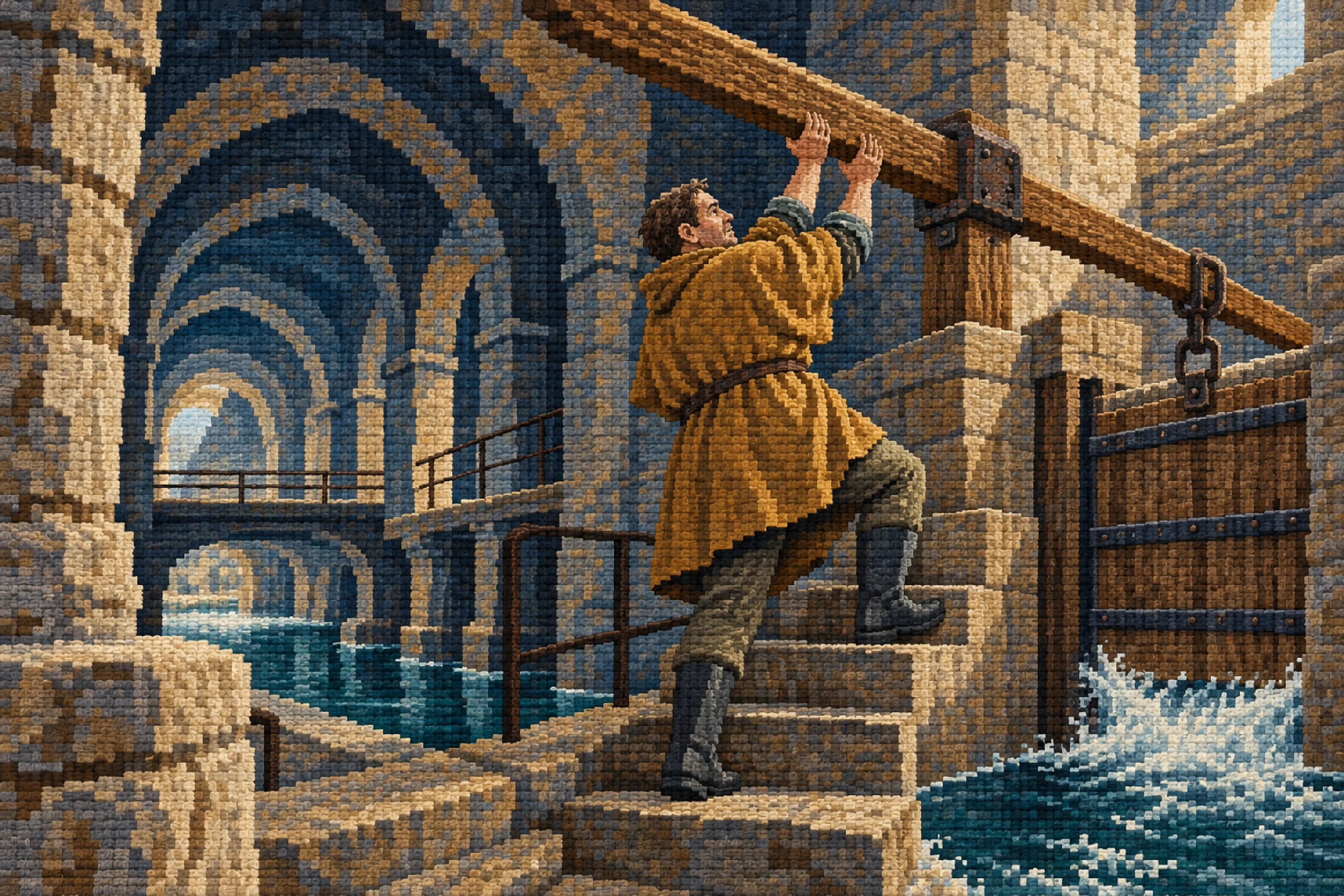
Keeper Raising the Reservoir Gate
Inside a reservoir chamber of overlapping arches, a keeper pushes a long lever upward. Stepped pixel edges and interlaced thread marks weave the deep setting into a single tactile image.
Remix this referenceKeeper Raising the Reservoir Gate
- Form language
- Translate forms into interlocking rectangular clusters with deliberate low-resolution stair steps; reserve small clusters for essential distinctions.
- Contour
- Use stepped, unoutlined edges with uneven block runs; occasional short thread ends soften corners without erasing the pixel structure.
- Mark-making
- Build a woven face from horizontal weft bars interrupted by vertical warp ticks; vary thread thickness and allow occasional slubs.
- Surface rendering
- Make tonal transitions through adjacent thread-color blocks and sparse checker interleaving, retaining shallow textile relief throughout.
Priority
Make woven construction and deliberate low-resolution edges equally visible.
What to avoid & what to check
Exact prompt for this example
MODULE OWNERSHIP
subject: Subject count, type, stable proportions and landmarks, resting face geometry, hair shape, physical materials, garment construction and permanent marks. No emotion, movement, color assignment or rendering recipe.
expression: Facial soft-tissue displacement and pupil direction, muscle coordination, regional intensity, asymmetry and onset/peak/release. No head/body pose, stable appearance, skin color or rendering.
gesture: Head/neck/body/limb orientation, joint movement, support, contact and pose-caused occlusion using existing anatomy. No eye/pupil movement, emotion, identity, props inventory or camera.
props: Prop count, type, construction, physical material and scale relative to the subject. Holding/contact belongs to gesture, position to composition, color to palette.
scene: Environment elements, terrain, backdrop/floor presence and structural detail. No canvas positions, camera, lighting, assigned colors or render texture.
camera: Projection, focal-length impression, camera elevation/yaw/roll, viewing distance and crop. No actor pose, world placement, lighting or canvas aspect ratio.
composition: Normalized 0-100% canvas positions, scale in frame, depth/overlap, focal hierarchy and margins. No joint pose, camera projection, rendering, subject/prop inventory or emotion.
palette: Color anchors, hue/saturation/value ranges, colors assigned to parts and approximate color coverage. No illumination direction, shading algorithm, physical material or layout.
lighting: Light-source direction/softness/intensity, ambient illumination, physical shadow direction/length and highlight position. Absence of directional illumination is allowed. No shading technique, palette or material changes.
style: Reusable form abstraction, contour weight/taper/edge quality, medium and mark scale/density/direction, surface rendering and tonal transition technique. No fixed subject proportions, anatomy, identity, expression, pose, palette, light-source direction, camera or layout.
output: Image count, aspect ratio, size, file/alpha requirements and global lettering/logo/watermark restrictions. No background scenery, crop, style, identity or pose.

SUBJECT
inventory: One original adult reservoir keeper, A; no other people.
geometry: An ordinary adult build with a compact head and sturdy hands; a broad cape gives a bell-shaped outline.
resting-face: A shallow brow ridge, straight nose, and short mouth above a broad chin define the compact face.
appearance: Short cropped hair, a belted waxed-cotton rain cape with arm openings, plain trousers, and rubber work boots.

PRIORITY


AVOID


CHECK


EXPRESSION — ACTOR A
brows: The visible brow draws slightly inward and down.
lids: The visible lower lid firms; the upper lid remains open.
cheeks: The visible cheek tightens subtly without lifting into a smile.
nose: The visible nostril widens slightly; the bridge stays unwrinkled.
mouth: Lips press into a short firm line with level corners.
jaw: The jaw sets gently without a pronounced clench.
gaze: The visible pupil points upward toward the lever's rising end.
coordination: A restrained brow and firm mouth carry the effort; hidden facial regions remain unprescribed.
timing: Hold the apex of quiet determination throughout the sustained effort.

PRIORITY


AVOID


CHECK


GESTURE
head: A tips the head upward and turns it left enough to expose a readable profile while the body faces away.
torso: The torso stretches upward with a slight backward lean beneath the raised arms.
limbs: Both arms press upward with bent elbows; one knee bends on a higher step while the rear leg braces below.
contact: Both palms push the underside of the lever; the boots grip separate stair treads.

PRIORITY


AVOID


CHECK


PROPS
inventory: One floodgate mechanism: a timber lever longer than A is tall, a plank gate, and an iron lifting link.
construction: An iron collar forms the lever pivot; a lifting link joins the gate to the long end beyond the handgrip.

PRIORITY


AVOID


CHECK


SCENE
inventory: An old underground reservoir chamber with masonry arches, stair landings, a sluice opening, water channels, and an opening high in the wall.
structure: Successive vaulted bays enclose raised maintenance walks; water passes through the sluice into a lower channel.

PRIORITY


AVOID


CHECK


CAMERA
projection: Use moderately wide perspective with clearly receding architectural bays.
viewpoint: View from a lower maintenance landing behind and to the left of A, with a slight upward look.
crop: A wide environmental view includes the whole keeper and mechanism; nearby architecture crosses the image edges.

PRIORITY


AVOID


CHECK


COMPOSITION
placement: A occupies the right third; the lever climbs toward the upper middle, making the raised hands the first focal point.
depth: A cropped foreground pier overlaps the lower left; the platform leads through nested arches into distant water.
spacing: Leave clear intervals around the hands, lever and facial profile; gather denser overlaps along the outer edges.

PRIORITY


AVOID


CHECK


PALETTE
colors: Anchor the image in midnight indigo, mineral teal, ochre, and pale flax.
assignment: Use indigo for recesses, teal for water, ochre for cape and lever, and flax for face, hands, stone faces and foam.
balance: Deep cool colors dominate; a compact warm passage and sparse pale accents provide contrast.

PRIORITY


AVOID


CHECK


LIGHTING
sources: Soft daylight enters from upper right; weak ambient light reaches the rear vaults.
shadows: Broad shadows extend leftward from piers and steps, with the deepest shade beneath the maintenance walks.
highlights: Light catches the raised hands, upper lever edge, and broken crests beneath the gate.

PRIORITY


AVOID


CHECK


STYLE GUIDE
form-language: Translate forms into interlocking rectangular clusters with deliberate low-resolution stair steps; reserve small clusters for essential distinctions.
contour: Use stepped, unoutlined edges with uneven block runs; occasional short thread ends soften corners without erasing the pixel structure.
mark-making: Build a woven face from horizontal weft bars interrupted by vertical warp ticks; vary thread thickness and allow occasional slubs.
surface-rendering: Make tonal transitions through adjacent thread-color blocks and sparse checker interleaving, retaining shallow textile relief throughout.

PRIORITY
Make woven construction and deliberate low-resolution edges equally visible.

AVOID


CHECK


OUTPUT
format: One finished image, landscape 3:2, 2700 × 1800 pixels, opaque PNG.
restrictions: One finished image, landscape 3:2, 2700 × 1800 pixels, opaque PNG. No lettering, logos, signatures, or watermarks.

PRIORITY


AVOID


CHECK


FINAL INTEGRATION
expression + gesture + composition: Facial acting complements the larger working gesture while the arrangement keeps both readable within the chamber.
style + scene + lighting: Architectural repetition and illumination changes give the woven treatment several scales of detail to interpret.
Model information comes from image provenance. The same prompt may produce a different result.