Text to imageAnimationStyle guide
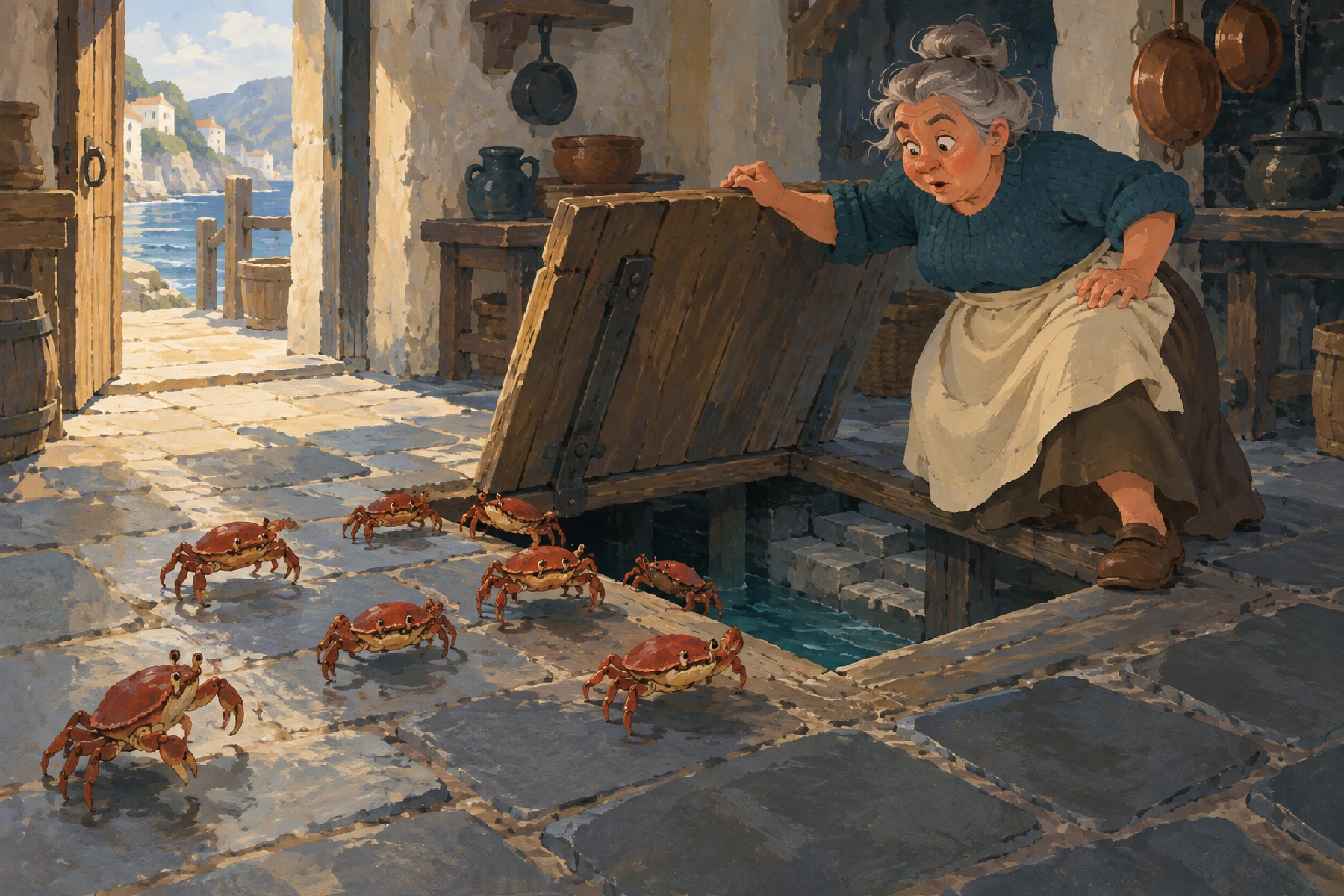
Crabs Through the Floor Hatch
A coastal innkeeper opens a floor hatch and discovers crabs spilling into her kitchen. Overlapping shells, the lifted hatch and her recoiling figure interlock through broad passages of opaque gouache.
Remix this referenceCrabs Through the Floor Hatch
- Form language
- Reduce forms to broad interlocking planes, alternating simple curved masses with angular facets; let minor shapes vary naturally.
- Contour
- Define boundaries with opaque brush edges, alternating firm cuts and softly broken margins; reserve thin drawn accents for brief separations.
- Mark-making
- Leave broad directional brush traces inside planes and occasional dry-brush skips at their edges, with lively variation in pressure.
- Surface rendering
- Build matte opaque gouache passages over shallow paper tooth, using a few stepped tonal planes and occasional scumbled transitions.
Priority
Rendering medium: 2D opaque-gouache animated-film concept illustration; formal rendering reference: Walt Disney Studios · 1950s · Peter Pan concept art (1953)
What to avoid & what to check
Exact prompt for this example
MODULE OWNERSHIP
subject: Subject count, type, stable proportions and landmarks, resting face geometry, hair shape, physical materials, garment construction and permanent marks. No emotion, movement, color assignment or rendering recipe.
expression: Facial soft-tissue displacement and pupil direction, muscle coordination, regional intensity, asymmetry and onset/peak/release. No head/body pose, stable appearance, skin color or rendering.
gesture: Head/neck/body/limb orientation, joint movement, support, contact and pose-caused occlusion using existing anatomy. No eye/pupil movement, emotion, identity, props inventory or camera.
props: Prop count, type, construction, physical material and scale relative to the subject. Holding/contact belongs to gesture, position to composition, color to palette.
scene: Environment elements, terrain, backdrop/floor presence and structural detail. No canvas positions, camera, lighting, assigned colors or render texture.
camera: Projection, focal-length impression, camera elevation/yaw/roll, viewing distance and crop. No actor pose, world placement, lighting or canvas aspect ratio.
composition: Normalized 0-100% canvas positions, scale in frame, depth/overlap, focal hierarchy and margins. No joint pose, camera projection, rendering, subject/prop inventory or emotion.
palette: Color anchors, hue/saturation/value ranges, colors assigned to parts and approximate color coverage. No illumination direction, shading algorithm, physical material or layout.
lighting: Light-source direction/softness/intensity, ambient illumination, physical shadow direction/length and highlight position. Absence of directional illumination is allowed. No shading technique, palette or material changes.
style: Reusable form abstraction, contour weight/taper/edge quality, medium and mark scale/density/direction, surface rendering and tonal transition technique. No fixed subject proportions, anatomy, identity, expression, pose, palette, light-source direction, camera or layout.
output: Image count, aspect ratio, size, file/alpha requirements and global lettering/logo/watermark restrictions. No background scenery, crop, style, identity or pose.

SUBJECT
inventory: A is one older female innkeeper; seven small shore crabs are also present.
geometry: A has a sturdy torso, broad hands and a rounded chin; the crabs have squat, wide shells and small claws.
resting-face: A's resting face has hooded eyes, a broad nose and a wide mouth with level corners.
appearance: A has a loose hair bun, a knitted pullover, a wrap apron and leather shoes; crab shells are hard chitin.

PRIORITY


AVOID


CHECK


EXPRESSION — ACTOR A
brows: Both brows lift, with the nearer brow slightly higher.
lids: Upper lids rise while lower lids remain gently supported.
cheeks: Cheeks remain mostly relaxed, with a slight lift near the mouth.
nose: Nostrils stay relaxed without a nose wrinkle.
mouth: Lips part into a small, uneven oval.
jaw: The jaw drops slightly rather than stretching wide.
gaze: Pupils converge downward toward the nearest emerging crab.
coordination: The lifted upper face leads; the smaller mouth opening keeps the reaction momentary.
timing: Freeze the apex immediately after she notices the first crab.

PRIORITY


AVOID


CHECK


GESTURE
head: A bends her neck and turns her head down toward the hatch.
torso: From a low crouch, her torso withdraws backward while her hips remain near the floor.
limbs: Her left arm reaches to the raised hatch; her right hand braces on her thigh. Crabs scuttle outward in varied low stances.
contact: Her left hand grips the hatch edge and both shoes support her crouch; crab feet meet the hatch lip and floor.

PRIORITY


AVOID


CHECK


PROPS
inventory: No separate props.
construction: No prop construction applies.

PRIORITY


AVOID


CHECK


SCENE
inventory: A coastal inn kitchen has a slate floor, an open floor hatch, thick plaster walls and an open exterior doorway.
structure: The hinged timber hatch opens above a tidal channel beneath the building; worn stone steps descend toward the water.

PRIORITY


AVOID


CHECK


CAMERA
projection: Use natural perspective with a moderately wide focal-length impression.
viewpoint: Look diagonally across the kitchen from slightly above standing eye level, with no roll.
crop: A medium-wide view includes A's whole figure, the complete hatch opening and part of the exterior doorway.

PRIORITY


AVOID


CHECK


COMPOSITION
placement: A fills the right third; the hatch crosses the lower middle, and the doorway occupies the upper-left region.
depth: Foreground crabs overlap the hatch lip; the raised panel overlaps A's lower silhouette, with the doorway receding behind.
spacing: The face and nearest crab form the focal exchange; leave a broad open floor interval along the crabs' outward path.

PRIORITY


AVOID


CHECK


PALETTE
colors: Anchor the image in deep petrol teal, chalk cream, smoked ochre and small paprika accents.
assignment: Use teal for the pullover and channel, cream for plaster and apron, ochre for timber, paprika for crabs, and copper-brown skin with gray hair.
balance: Broad subdued teal and cream areas carry the image; warmer accents remain concentrated and distinct.

PRIORITY


AVOID


CHECK


LIGHTING
sources: Soft morning light enters from the open doorway at left, with weak ambient fill beneath the hatch.
shadows: Broad shadows fall rightward across the floor; the hatch opening remains substantially darker.
highlights: Gentle highlights touch left-facing cheeks, knuckles, shell ridges and the hatch edge.

PRIORITY


AVOID


CHECK


STYLE GUIDE
form-language: Reduce forms to broad interlocking planes, alternating simple curved masses with angular facets; let minor shapes vary naturally.
contour: Define boundaries with opaque brush edges, alternating firm cuts and softly broken margins; reserve thin drawn accents for brief separations.
mark-making: Leave broad directional brush traces inside planes and occasional dry-brush skips at their edges, with lively variation in pressure.
surface-rendering: Build matte opaque gouache passages over shallow paper tooth, using a few stepped tonal planes and occasional scumbled transitions.

PRIORITY
Rendering medium: 2D opaque-gouache animated-film concept illustration; formal rendering reference: Walt Disney Studios · 1950s · Peter Pan concept art (1953)

AVOID


CHECK


OUTPUT
format: Produce one finished 3:2 image at 1800 × 1200 pixels, as an opaque PNG.
restrictions: No lettering, logos or watermarks.

PRIORITY


AVOID


CHECK


FINAL INTEGRATION
expression + gesture + composition: Let the facial reaction, withdrawing body and open interval work together to make the encounter readable.
style + lighting + palette: Translate illumination and color relationships through the painted planes while retaining irregular brush edges.
Art direction
디즈니 / Walt Disney Studios · 1950s · 피터 팬 콘셉트 아트(1953) / Peter Pan concept art (1953) ↗- Render forms as broad planar masses with simplified curved and angular facets
- Separate forms primarily through opaque painted boundaries rather than continuous outlines
- Broad brush traces within planes and small dry-brush interruptions at their edges
- Matte opaque gouache planes, shallow paper texture and a small set of tonal levels
Model information comes from image provenance. The same prompt may produce a different result.