Text to imageIllustrationStyle guide
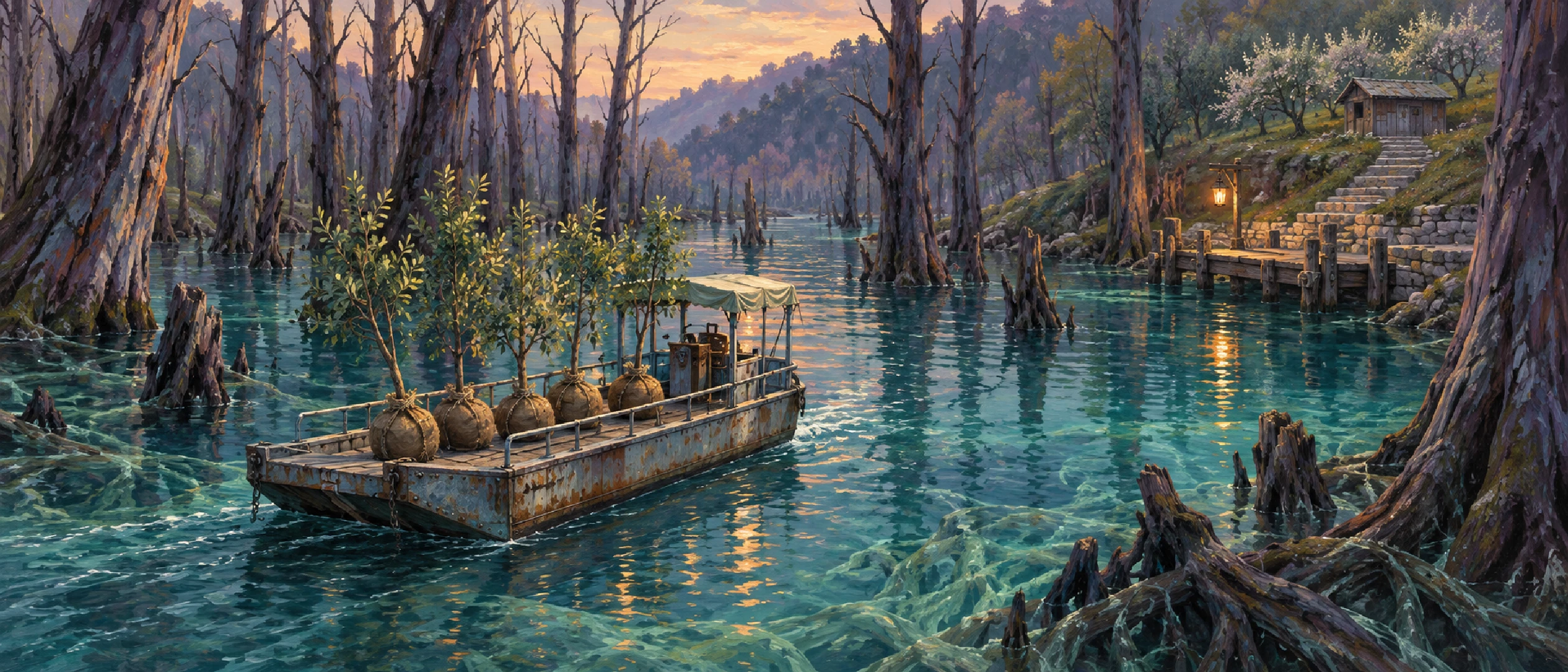
Sapling Ferry in the Drowned Forest
A small ferry carries saplings through a drowned forest toward a hillside landing. Luminous painting traces a journey from submerged roots to a distant stairway.
Remix this referenceSapling Ferry in the Drowned Forest
- Form language
- Simplify complex forms into broad interlocking masses, allowing smaller irregular shapes to emerge where description is useful.
- Contour
- Use painted edges without uniform outlines: firm edges break into soft or lost passages, with occasional tapered brush accents.
- Mark-making
- Let broad oil-brush sweeps remain visible beneath selective scumbles and small dragged strokes; vary pressure and leave imperfect joins.
- Surface rendering
- Blend translucent paint layers into luminous continuous tones, interrupted by opaque touches and softly feathered transitions rather than flat value bands.
Priority
Keep luminous continuous-tone painting visibly present through layered pigment and varied painted edges.
What to avoid & what to check
Exact prompt for this example
MODULE OWNERSHIP
subject: Subject count, type, stable proportions and landmarks, resting face geometry, hair shape, physical materials, garment construction and permanent marks. No emotion, movement, color assignment or rendering recipe.
expression: Facial soft-tissue displacement and pupil direction, muscle coordination, regional intensity, asymmetry and onset/peak/release. No head/body pose, stable appearance, skin color or rendering.
gesture: Head/neck/body/limb orientation, joint movement, support, contact and pose-caused occlusion using existing anatomy. No eye/pupil movement, emotion, identity, props inventory or camera.
props: Prop count, type, construction, physical material and scale relative to the subject. Holding/contact belongs to gesture, position to composition, color to palette.
scene: Environment elements, terrain, backdrop/floor presence and structural detail. No canvas positions, camera, lighting, assigned colors or render texture.
camera: Projection, focal-length impression, camera elevation/yaw/roll, viewing distance and crop. No actor pose, world placement, lighting or canvas aspect ratio.
composition: Normalized 0-100% canvas positions, scale in frame, depth/overlap, focal hierarchy and margins. No joint pose, camera projection, rendering, subject/prop inventory or emotion.
palette: Color anchors, hue/saturation/value ranges, colors assigned to parts and approximate color coverage. No illumination direction, shading algorithm, physical material or layout.
lighting: Light-source direction/softness/intensity, ambient illumination, physical shadow direction/length and highlight position. Absence of directional illumination is allowed. No shading technique, palette or material changes.
style: Reusable form abstraction, contour weight/taper/edge quality, medium and mark scale/density/direction, surface rendering and tonal transition technique. No fixed subject proportions, anatomy, identity, expression, pose, palette, light-source direction, camera or layout.
output: Image count, aspect ratio, size, file/alpha requirements and global lettering/logo/watermark restrictions. No background scenery, crop, style, identity or pose.

SUBJECT
inventory: One small, uncrewed working ferry is the principal subject; no people or animals are visible.
geometry: A broad, shallow hull supports an open deck, a low perimeter rail and a compact roofed steering shelter.
resting-face: No face or facial geometry applies to this inanimate subject.
appearance: Use a riveted metal hull, worn timber decking and a canvas shelter roof; minor fittings may vary naturally.

PRIORITY


AVOID


CHECK


PROPS
inventory: Five young fruit trees with wrapped root balls form the cargo; each tree is taller than the ferry rail. One lamp is also present.
construction: Slender branching trunks carry sparse leaves; coarse jute encloses irregular root balls tied with simple cord. The lamp has a protective cover.

PRIORITY


AVOID


CHECK


SCENE
inventory: A drowned forest surrounds an open-water channel, with submerged roots, a hillside landing, stone steps and a small orchard shed.
structure: Bare trunks emerge from deep water; the channel reaches a timber landing where steps climb above the flood line into an orchard.

PRIORITY


AVOID


CHECK


CAMERA
projection: Use natural perspective with a moderately wide focal-length impression and gentle distance compression.
viewpoint: Look obliquely down the channel from an elevated bank, high enough to reveal the deck and underwater roots.
crop: Take an expansive environmental view; retain the complete ferry while nearby trunks and roots extend beyond the frame.

PRIORITY


AVOID


CHECK


COMPOSITION
placement: Place the ferry near 35% across and 65% down, occupying roughly a fifth of the width; the landing sits near 80% across, with the lamp on it.
depth: Foreground roots lead beneath the ferry toward the distant landing; overlapping trunks divide the journey into successive openings.
spacing: Make the ferry and its clustered saplings the first focus, the landing the second; preserve a generous winding interval of open water.

PRIORITY


AVOID


CHECK


PALETTE
colors: Build around petrol teal, muted plum, pale celadon and a restrained apricot accent, with deep blue-green darks.
assignment: Give water petrol teal, forest trunks muted plum, submerged roots celadon and the landing apricot; use moss green for sapling leaves.
balance: Cool middle values occupy most of the image; pale underwater passages and small warm accents interrupt the deeper forest values.

PRIORITY


AVOID


CHECK


LIGHTING
sources: Broad, soft evening light enters from the upper left; lamplight adds a small local glow.
shadows: Trunk shadows stretch softly toward the lower right; diffuse ambient light keeps the submerged root structures visible.
highlights: Soft highlights gather on upper-left hull edges and water ridges; the lamp leaves a short broken reflection.

PRIORITY


AVOID


CHECK


STYLE GUIDE
form-language: Simplify complex forms into broad interlocking masses, allowing smaller irregular shapes to emerge where description is useful.
contour: Use painted edges without uniform outlines: firm edges break into soft or lost passages, with occasional tapered brush accents.
mark-making: Let broad oil-brush sweeps remain visible beneath selective scumbles and small dragged strokes; vary pressure and leave imperfect joins.
surface-rendering: Blend translucent paint layers into luminous continuous tones, interrupted by opaque touches and softly feathered transitions rather than flat value bands.

PRIORITY
Keep luminous continuous-tone painting visibly present through layered pigment and varied painted edges.

AVOID


CHECK


OUTPUT
format: Deliver one finished illustration as an opaque PNG, 2520 × 1080 pixels, with a 21:9 aspect ratio.
restrictions: No lettering, logos, signatures or watermarks.

PRIORITY


AVOID


CHECK
Model information comes from image provenance. The same prompt may produce a different result.