Text to imageSpace & architectureStyle guide
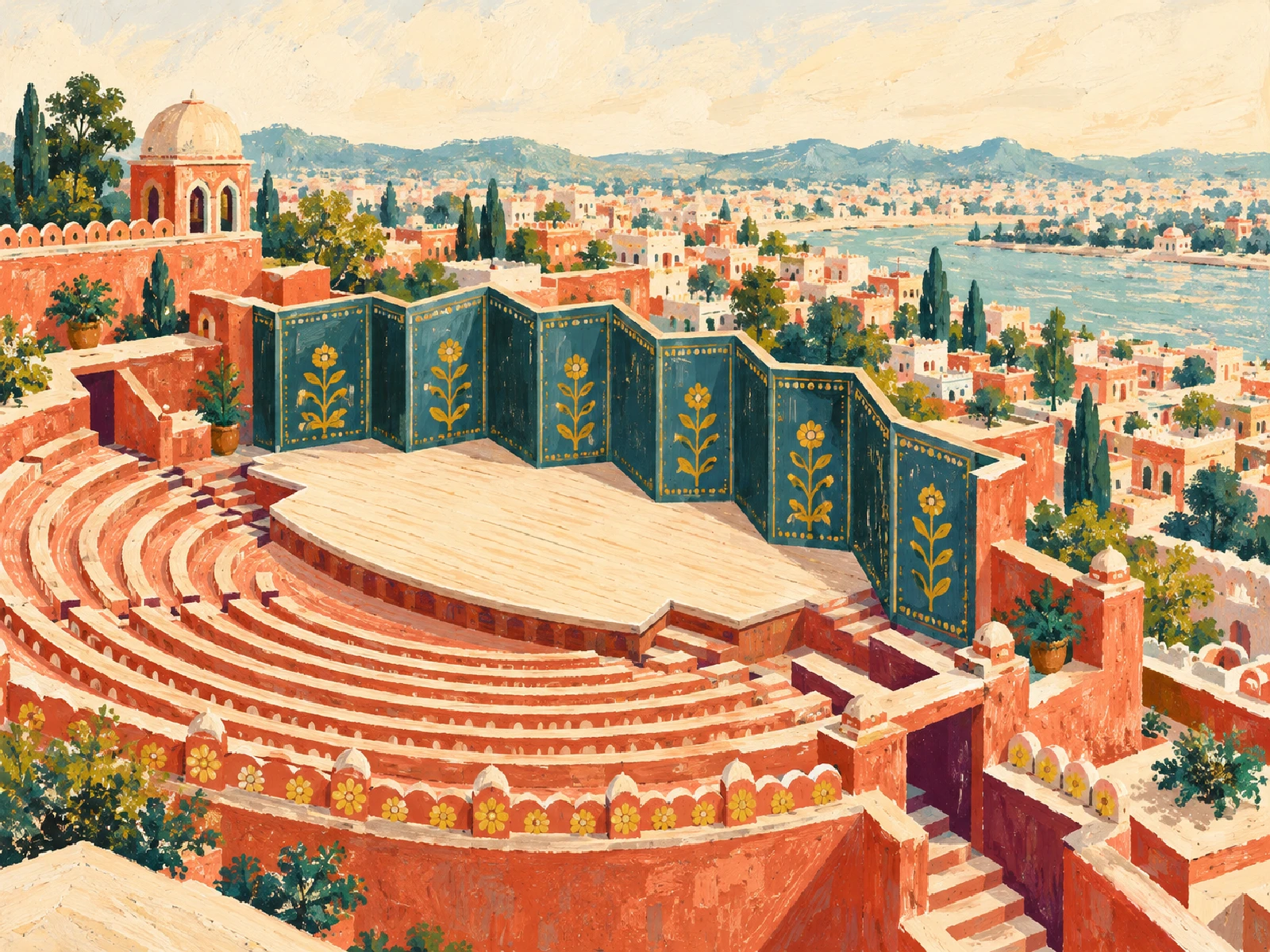
A Rooftop Theatre with Folding Walls
A small rooftop theatre opens its folding acoustic walls beside stepped seating. Naive folk brushwork and generous open sky turn its architecture into a lively painted arrangement.
Remix this referenceA Rooftop Theatre with Folding Walls
- Form language
- Simplify forms into companionable blocks, scallops, and zigzags; let repeated shapes vary within a coherent folk vocabulary.
- Contour
- Use slightly wavering opaque brush edges, with occasional blunt outlines that stop and restart rather than enclosing every shape.
- Mark-making
- Lay short bristle strokes beside loose dots and dashes; decorative repetitions should retain the uneven pace of the hand.
- Surface rendering
- Layer matte gouache in broad patches, allowing dry scumbles and glimpses of underpaint to interrupt otherwise simple tonal steps.
Priority
Keep naive folk painting visibly handmade through lively simplification and irregular decorative brushwork.
What to avoid & what to check
Exact prompt for this example
MODULE OWNERSHIP
subject: Subject count, type, stable proportions and landmarks, resting face geometry, hair shape, physical materials, garment construction and permanent marks. No emotion, movement, color assignment or rendering recipe.
expression: Facial soft-tissue displacement and pupil direction, muscle coordination, regional intensity, asymmetry and onset/peak/release. No head/body pose, stable appearance, skin color or rendering.
gesture: Head/neck/body/limb orientation, joint movement, support, contact and pose-caused occlusion using existing anatomy. No eye/pupil movement, emotion, identity, props inventory or camera.
props: Prop count, type, construction, physical material and scale relative to the subject. Holding/contact belongs to gesture, position to composition, color to palette.
scene: Environment elements, terrain, backdrop/floor presence and structural detail. No canvas positions, camera, lighting, assigned colors or render texture.
camera: Projection, focal-length impression, camera elevation/yaw/roll, viewing distance and crop. No actor pose, world placement, lighting or canvas aspect ratio.
composition: Normalized 0-100% canvas positions, scale in frame, depth/overlap, focal hierarchy and margins. No joint pose, camera projection, rendering, subject/prop inventory or emotion.
palette: Color anchors, hue/saturation/value ranges, colors assigned to parts and approximate color coverage. No illumination direction, shading algorithm, physical material or layout.
lighting: Light-source direction/softness/intensity, ambient illumination, physical shadow direction/length and highlight position. Absence of directional illumination is allowed. No shading technique, palette or material changes.
style: Reusable form abstraction, contour weight/taper/edge quality, medium and mark scale/density/direction, surface rendering and tonal transition technique. No fixed subject proportions, anatomy, identity, expression, pose, palette, light-source direction, camera or layout.
output: Image count, aspect ratio, size, file/alpha requirements and global lettering/logo/watermark restrictions. No background scenery, crop, style, identity or pose.

SUBJECT
inventory: No figures, animals, or independent object subjects.
geometry: No independent subject geometry applies.
resting-face: No faces are present.
appearance: No independent subject appearance applies.

PRIORITY


AVOID


CHECK


PROPS
inventory: No separate props.
construction: No prop construction applies.

PRIORITY


AVOID


CHECK


SCENE
inventory: An open rooftop theatre has stepped masonry seating, a timber stage, hinged acoustic walls, and a stair entrance.
structure: The seating curves around the stage; unfolded wall panels form a zigzag enclosure, with flower reliefs along the parapet.

PRIORITY


AVOID


CHECK


CAMERA
projection: Use a shallow perspective with a mild wide-angle impression and readable architectural depth.
viewpoint: Look diagonally down from above parapet height, with no camera roll.
crop: Include the whole theatre and enough supporting building to establish its rooftop setting.

PRIORITY


AVOID


CHECK


COMPOSITION
placement: Gather the theatre across the lower-left portion, leaving a broad uninterrupted opening toward the upper right.
depth: The seating overlaps the near stage edge; the zigzag walls overlap one another behind it.
spacing: Make the open stage the focal pause between busier seating and wall rhythms; preserve breathing room above the roofline.

PRIORITY


AVOID


CHECK


PALETTE
colors: Use chalk cream, brick coral, deep teal, and mustard, with a small amount of plum.
assignment: Assign cream to sky and stage, coral to masonry, teal to wall panels, mustard to reliefs, and plum to stair recesses.
balance: Let cream occupy the broadest area, with substantial coral and teal passages and restrained warm accents.

PRIORITY


AVOID


CHECK


LIGHTING
sources: Soft afternoon light enters from the upper right with generous ambient fill.
shadows: Short, soft shadows extend leftward beneath seating lips and folded wall edges.
highlights: Upward-facing ledges and the right edges of the wall panels receive gentle highlights.

PRIORITY


AVOID


CHECK


STYLE GUIDE
form-language: Simplify forms into companionable blocks, scallops, and zigzags; let repeated shapes vary within a coherent folk vocabulary.
contour: Use slightly wavering opaque brush edges, with occasional blunt outlines that stop and restart rather than enclosing every shape.
mark-making: Lay short bristle strokes beside loose dots and dashes; decorative repetitions should retain the uneven pace of the hand.
surface-rendering: Layer matte gouache in broad patches, allowing dry scumbles and glimpses of underpaint to interrupt otherwise simple tonal steps.

PRIORITY
Keep naive folk painting visibly handmade through lively simplification and irregular decorative brushwork.

AVOID


CHECK


OUTPUT
format: One finished image, 4:3 landscape, 1600 × 1200 pixels, opaque PNG; no lettering, logos, or watermarks.
restrictions: One finished image, 4:3 landscape, 1600 × 1200 pixels, opaque PNG; no lettering, logos, or watermarks.

PRIORITY


AVOID


CHECK
Model information comes from image provenance. The same prompt may produce a different result.