Text to imageLandscapeStyle guide
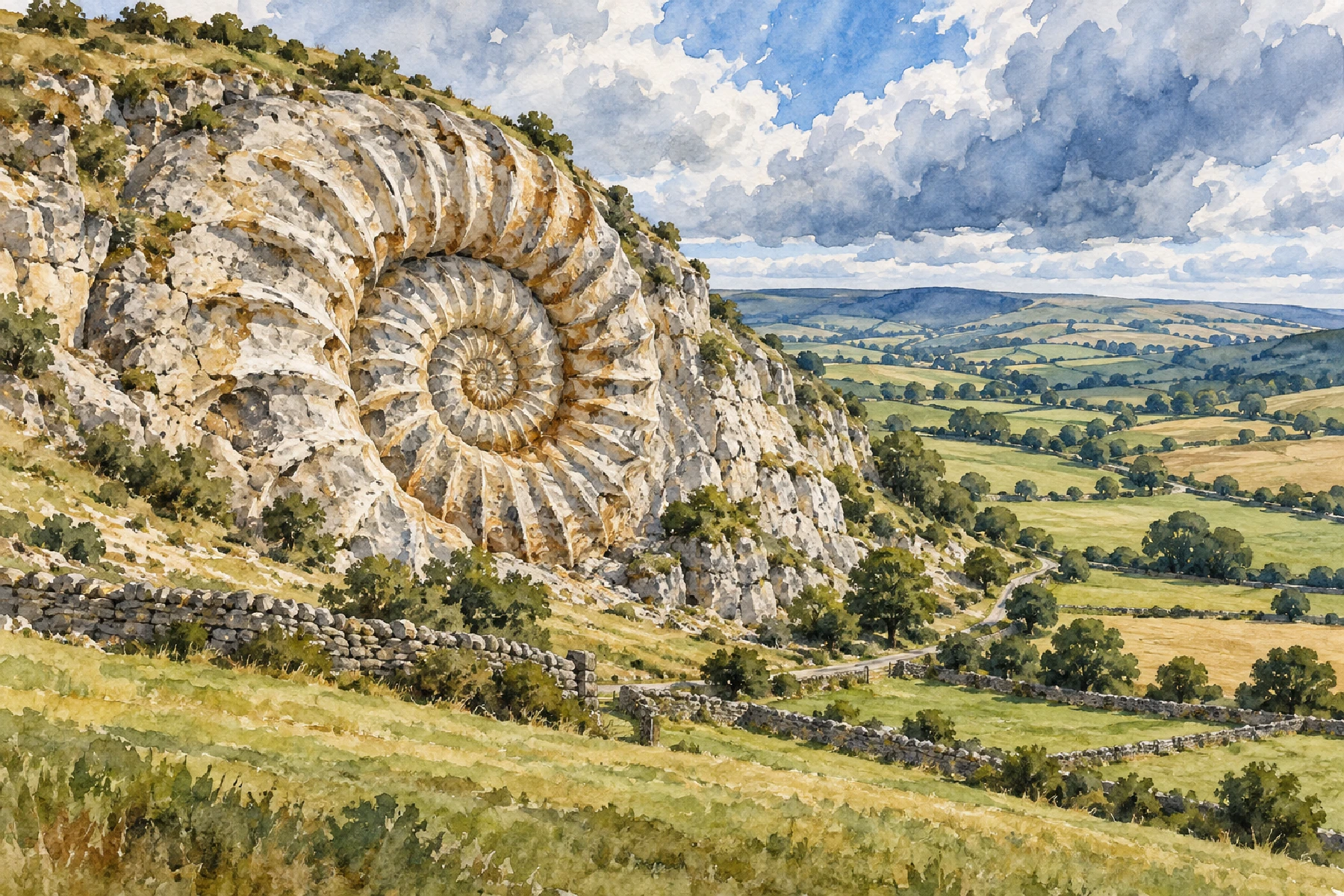
A Giant Ammonite Above the Fields
Rain has exposed a field-sized ammonite in a pastoral hillside. Blooming watercolor and broken edges turn the familiar valley into an unexpected geological landscape.
Remix this referenceA Giant Ammonite Above the Fields
- Form language
- Gather complex forms into generous connected masses, using a few interrupted internal rhythms instead of uniform detail.
- Contour
- Alternate dissolved wet edges with dry, broken contours; allow selected boundaries to disappear into adjacent washes.
- Mark-making
- Use broad loaded brush sweeps with occasional dry scrubbing; vary stroke width and interruption naturally.
- Surface rendering
- Let wet watercolor bloom and pool into irregular tide marks, preserving exposed paper between translucent tonal passages.
Priority
Expressive watercolor blooms and broken edges must remain visibly active.
What to avoid & what to check
Exact prompt for this example
MODULE OWNERSHIP
subject: Subject count, type, stable proportions and landmarks, resting face geometry, hair shape, physical materials, garment construction and permanent marks. No emotion, movement, color assignment or rendering recipe.
expression: Facial soft-tissue displacement and pupil direction, muscle coordination, regional intensity, asymmetry and onset/peak/release. No head/body pose, stable appearance, skin color or rendering.
gesture: Head/neck/body/limb orientation, joint movement, support, contact and pose-caused occlusion using existing anatomy. No eye/pupil movement, emotion, identity, props inventory or camera.
props: Prop count, type, construction, physical material and scale relative to the subject. Holding/contact belongs to gesture, position to composition, color to palette.
scene: Environment elements, terrain, backdrop/floor presence and structural detail. No canvas positions, camera, lighting, assigned colors or render texture.
camera: Projection, focal-length impression, camera elevation/yaw/roll, viewing distance and crop. No actor pose, world placement, lighting or canvas aspect ratio.
composition: Normalized 0-100% canvas positions, scale in frame, depth/overlap, focal hierarchy and margins. No joint pose, camera projection, rendering, subject/prop inventory or emotion.
palette: Color anchors, hue/saturation/value ranges, colors assigned to parts and approximate color coverage. No illumination direction, shading algorithm, physical material or layout.
lighting: Light-source direction/softness/intensity, ambient illumination, physical shadow direction/length and highlight position. Absence of directional illumination is allowed. No shading technique, palette or material changes.
style: Reusable form abstraction, contour weight/taper/edge quality, medium and mark scale/density/direction, surface rendering and tonal transition technique. No fixed subject proportions, anatomy, identity, expression, pose, palette, light-source direction, camera or layout.
output: Image count, aspect ratio, size, file/alpha requirements and global lettering/logo/watermark restrictions. No background scenery, crop, style, identity or pose.

SUBJECT
inventory: One monumental ammonite fossil; no people or animals.
geometry: A broad spiral shell has a tight central whorl and radiating ribs.
resting-face: No face or facial landmarks.
appearance: Mineralized shell and limestone matrix have chipped ribs, worn cavities and occasional mineral-filled cracks.

PRIORITY


AVOID


CHECK


PROPS
inventory: No separate props.
construction: No prop construction applies.

PRIORITY


AVOID


CHECK


SCENE
inventory: Harvested hay fields, hedgerows, a farm lane, an eroded limestone hillside and open sky.
structure: Low field walls skirt the rock exposure; rain gullies descend into a grassy ditch beside the lane.

PRIORITY


AVOID


CHECK


CAMERA
projection: Moderately wide perspective with gentle distance compression and no exaggerated near-field distortion.
viewpoint: View from the opposite hillside, looking slightly downward across the valley with a level horizon.
crop: Include the complete fossil and a generous valley extent; let the nearest field continue beyond the lower edge.

PRIORITY


AVOID


CHECK


COMPOSITION
placement: The fossil fills the left half; fields spread toward the right, with a spare wedge of sky above.
depth: Near field walls overlap the fossil's lower rim; successively smaller enclosures carry depth into the valley.
spacing: Read the spiral first, the ordinary field boundaries second; keep open intervals between the distant hedgerows.

PRIORITY


AVOID


CHECK


PALETTE
colors: Chalk white, muted sage, storm blue and restrained burnt sienna form a low-saturation palette.
assignment: Chalk white belongs to the fossil and rock, sage to fields, storm blue to sky, and sienna to rib recesses.
balance: Pale mineral tones and sage dominate; blue provides a broad counterweight and sienna remains a small accent.

PRIORITY


AVOID


CHECK


LIGHTING
sources: Broad cloud-filtered daylight arrives from the upper left with abundant ambient fill.
shadows: Soft, short shadows fall toward the lower right; deeper rib cavities retain gentle local shade.
highlights: Broad highlights skim the upper-left rib shoulders without sharp glints.

PRIORITY


AVOID


CHECK


STYLE GUIDE
form-language: Gather complex forms into generous connected masses, using a few interrupted internal rhythms instead of uniform detail.
contour: Alternate dissolved wet edges with dry, broken contours; allow selected boundaries to disappear into adjacent washes.
mark-making: Use broad loaded brush sweeps with occasional dry scrubbing; vary stroke width and interruption naturally.
surface-rendering: Let wet watercolor bloom and pool into irregular tide marks, preserving exposed paper between translucent tonal passages.

PRIORITY
Expressive watercolor blooms and broken edges must remain visibly active.

AVOID


CHECK


OUTPUT
format: One opaque PNG image, landscape 3:2 aspect ratio, 1800 × 1200 pixels.
restrictions: No lettering, logos, signatures or watermarks.

PRIORITY


AVOID


CHECK


FINAL INTEGRATION
subject + scene + composition: Embed the fossil in the exposed limestone hillside, with its diameter exceeding several field widths.
Model information comes from image provenance. The same prompt may produce a different result.