Text to imageComicsStyle guide
Reading to the Library Cat
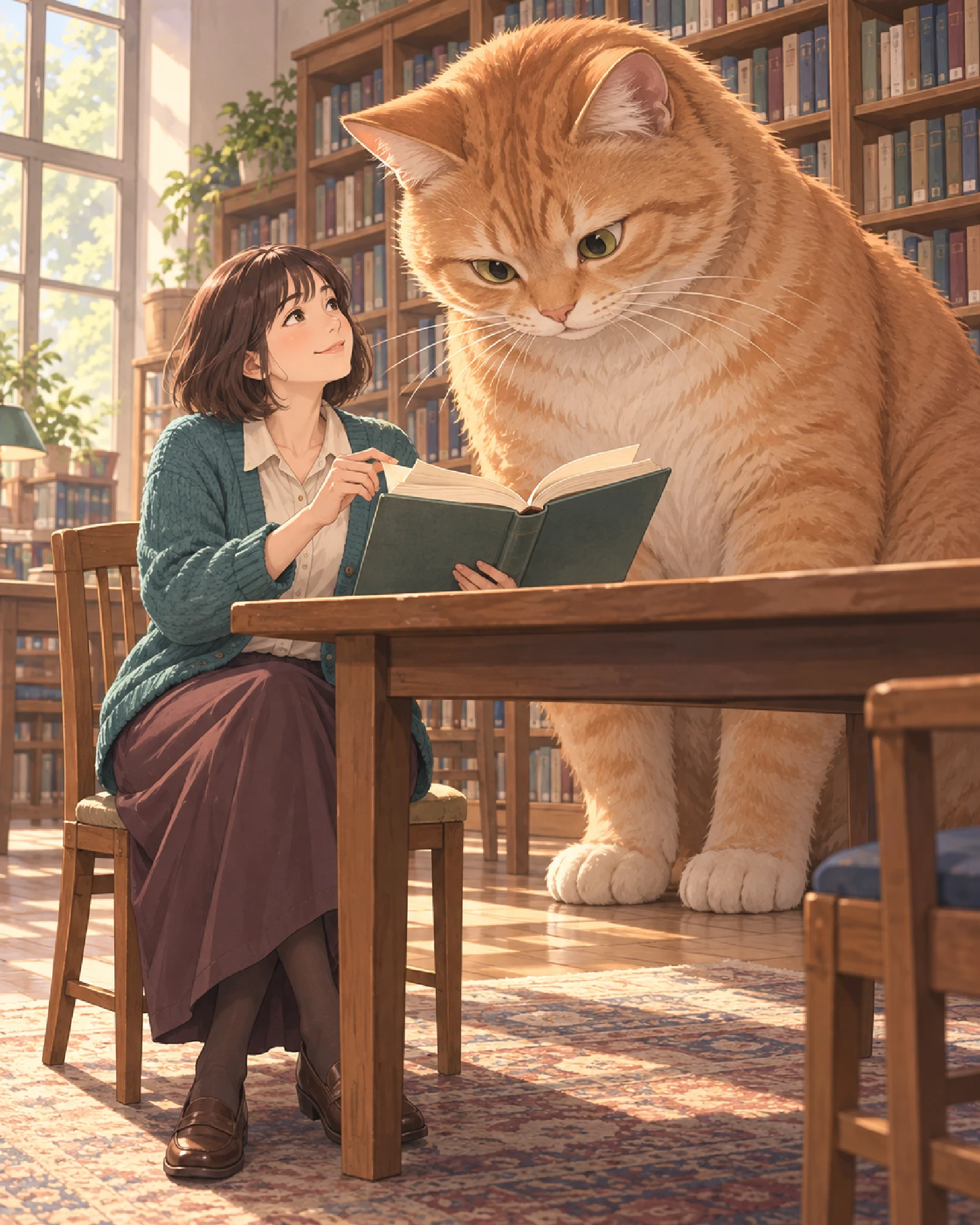
A cat as tall as the bookshelves peers into a librarian’s little book. Supple lines and softly continuous color make an unexpected encounter feel tender and familiar.
Remix this referenceReading to the Library Cat
- Form language
- Simplify forms into supple connected curves and broad readable planes; let minor shapes vary within the same gently rounded vocabulary.
- Contour
- Use fine, pressure-tapered contours with occasional open joins; reinforce selected overlaps without enclosing every tonal change.
- Mark-making
- Keep digital brush marks sparse and directional: a few curved strokes suggest surface flow, with naturally varied lengths and tapered ends.
- Surface rendering
- Build continuous color with softly blended midtones and selective firmer edges; retain subtle brush modulation rather than uniform airbrushed smoothness.
Priority
Rendering medium: soft continuous-color digital webtoon comic illustration.
What to avoid & what to check
Exact prompt for this example
MODULE OWNERSHIP
subject: Subject count, type, stable proportions and landmarks, resting face geometry, hair shape, physical materials, garment construction and permanent marks. No emotion, movement, color assignment or rendering recipe.
expression: Facial soft-tissue displacement and pupil direction, muscle coordination, regional intensity, asymmetry and onset/peak/release. No head/body pose, stable appearance, skin color or rendering.
gesture: Head/neck/body/limb orientation, joint movement, support, contact and pose-caused occlusion using existing anatomy. No eye/pupil movement, emotion, identity, props inventory or camera.
props: Prop count, type, construction, physical material and scale relative to the subject. Holding/contact belongs to gesture, position to composition, color to palette.
scene: Environment elements, terrain, backdrop/floor presence and structural detail. No canvas positions, camera, lighting, assigned colors or render texture.
camera: Projection, focal-length impression, camera elevation/yaw/roll, viewing distance and crop. No actor pose, world placement, lighting or canvas aspect ratio.
composition: Normalized 0-100% canvas positions, scale in frame, depth/overlap, focal hierarchy and margins. No joint pose, camera projection, rendering, subject/prop inventory or emotion.
palette: Color anchors, hue/saturation/value ranges, colors assigned to parts and approximate color coverage. No illumination direction, shading algorithm, physical material or layout.
lighting: Light-source direction/softness/intensity, ambient illumination, physical shadow direction/length and highlight position. Absence of directional illumination is allowed. No shading technique, palette or material changes.
style: Reusable form abstraction, contour weight/taper/edge quality, medium and mark scale/density/direction, surface rendering and tonal transition technique. No fixed subject proportions, anatomy, identity, expression, pose, palette, light-source direction, camera or layout.
output: Image count, aspect ratio, size, file/alpha requirements and global lettering/logo/watermark restrictions. No background scenery, crop, style, identity or pose.

SUBJECT
inventory: Two subjects: A, an adult woman librarian; B, an enormous domestic shorthair cat.
geometry: A has an ordinary adult build and a long oval face. B retains familiar domestic-cat proportions and a broad muzzle.
resting-face: A has straight brows and a softly rounded nose. B has almond-shaped eye openings, full whisker pads and a small triangular nose.
appearance: A wears a knitted cardigan over a collared blouse and has a blunt chin-length bob. B has short fur and long whiskers.

PRIORITY


AVOID


CHECK


EXPRESSION — ACTOR A
brows: One brow lifts slightly while the other stays relaxed.
lids: Lower lids rise gently without closing the eyes.
cheeks: Cheeks lift modestly, a little more on the smiling side.
nose: Nostrils remain relaxed with no nose wrinkle.
mouth: Closed lips curl into a small, uneven smile.
jaw: The jaw stays loose with no visible drop.
gaze: Pupils turn upward toward the cat’s near eye.
coordination: The lifted cheek and mouth corner align; the upper face stays quieter.
timing: Hold the settled peak of a private, amused smile.

PRIORITY


AVOID


CHECK


EXPRESSION — ACTOR B
brows: Fur above the eyes stays smooth, without human eyebrow arches.
lids: Upper lids lift slightly from a relaxed resting opening.
cheeks: Whisker pads ease forward slightly without bunching.
nose: The nose remains still, with relaxed nostrils.
mouth: The mouth remains softly closed without a human smile.
jaw: The lower jaw remains at rest.
gaze: Both pupils aim down toward the open pages.
coordination: Slightly opening lids carry the interest while the muzzle stays quiet.
timing: Catch the onset of attention, before a fully alert stare develops.

PRIORITY


AVOID


CHECK


GESTURE
head: A tips her head back toward B. B bends its neck to bring its muzzle above the book.
torso: A sits upright with her torso turned toward B. B sits on its haunches with a gently rounded back.
limbs: A supports the book with one hand and lifts a naturally curling page with the other. B keeps both forelegs extended to the floor.
contact: A’s feet rest on the floor and her seat supports her weight. B’s forepaws bear on the floor; neither subject touches the other.

PRIORITY


AVOID


CHECK


PROPS
inventory: One open clothbound reading book, comfortably sized for A’s hands.
construction: Flexible paper leaves join a firm spine and plain fabric-covered boards.

PRIORITY


AVOID


CHECK


SCENE
inventory: A neighborhood library with filled bookshelves, a communal reading table, a wooden chair, a tall window and a floor.
structure: Open shelf bays and a clear aisle establish the everyday room; varied book spines and simple furniture details may vary naturally.

PRIORITY


AVOID


CHECK


CAMERA
projection: Natural perspective with a moderate wide-lens impression and restrained edge distortion.
viewpoint: View from seated human eye level, obliquely across the reading table, with no camera roll.
crop: Use a room-scale view that includes A from head to feet and B’s face; let B’s rear body continue beyond the right edge.

PRIORITY


AVOID


CHECK


COMPOSITION
placement: Place A in the lower-left third and B across the upper right; the small open book bridges their unequal masses.
depth: A table edge crosses the foreground; B overlaps the rear shelves, its head spanning roughly the table’s width.
spacing: Make the face-to-book relationship primary, the shelf-scale comparison secondary; preserve open breathing room beside A.

PRIORITY
Keep one uninterrupted illustration without dialogue balloons or panel borders.

AVOID


CHECK


PALETTE
colors: Anchor the image in muted apricot, dusty teal, warm ivory and plum-brown, with restrained saturation.
assignment: Give B apricot fur, A a teal cardigan and warm beige skin, pages ivory, and hair and contours plum-brown.
balance: Apricot forms the largest color mass; quiet ivory surroundings temper it, with teal providing a smaller answering accent.

PRIORITY


AVOID


CHECK


LIGHTING
sources: Broad, soft window light enters from the upper left, supported by gentle room ambient light.
shadows: Soft shadows fall rightward beneath the table and cat; contact shadows stay modest and localized.
highlights: Broad highlights touch the cat’s upper-left forehead and A’s window-facing cheek and knuckles.

PRIORITY


AVOID


CHECK


STYLE GUIDE
form-language: Simplify forms into supple connected curves and broad readable planes; let minor shapes vary within the same gently rounded vocabulary.
contour: Use fine, pressure-tapered contours with occasional open joins; reinforce selected overlaps without enclosing every tonal change.
mark-making: Keep digital brush marks sparse and directional: a few curved strokes suggest surface flow, with naturally varied lengths and tapered ends.
surface-rendering: Build continuous color with softly blended midtones and selective firmer edges; retain subtle brush modulation rather than uniform airbrushed smoothness.

PRIORITY
Rendering medium: soft continuous-color digital webtoon comic illustration.

AVOID


CHECK


OUTPUT
format: One finished image, portrait 4:5, 1600 × 2000 pixels, opaque PNG.
restrictions: No lettering, logos or watermarks; book pages and spines carry no readable text.

PRIORITY


AVOID


CHECK
Model information comes from image provenance. The same prompt may produce a different result.