Text to imageLandscapeStyle guide
Dry Gully · Tributary Convergence
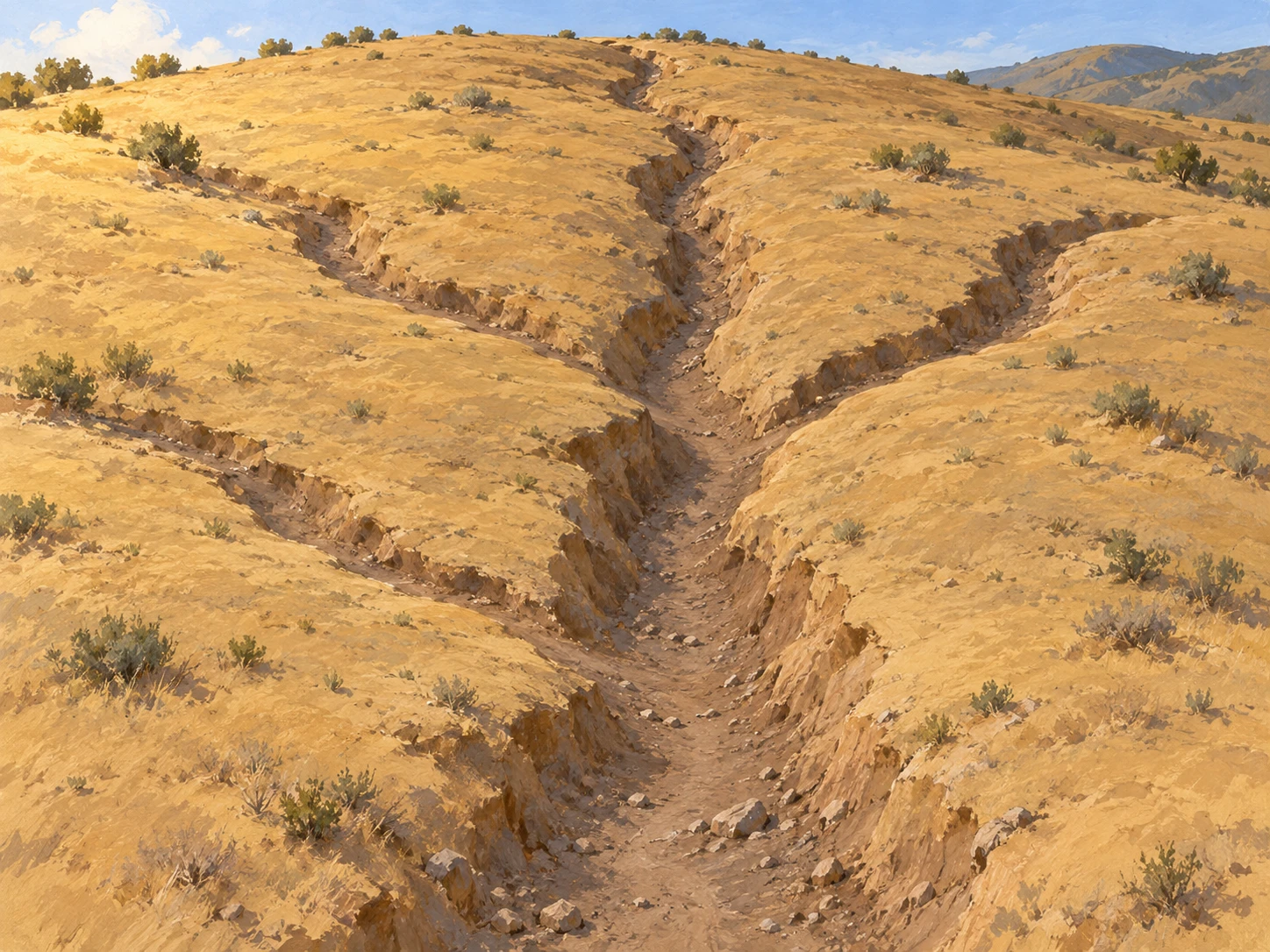
A gouache landscape showing drainage direction and terrain depth through three tributaries joining one main dry gully.
Dry Gully · Tributary Convergence
- Shape & line
- Draw the main gully as a continuous irregular trough that widens toward the bottom of the image. Curve the three narrower tributaries into it at acute angles pointing downstream toward the lower edge, opening their channel floors into the main floor without a dividing line across each junction.
- Color & light
- Place warm sunlight at image upper-left. Paint exposed hillside planes pale ochre, the channel floors muted warm brown, and the recessed banks facing away from the light cooler umber; repeat this light-to-shadow transition along each tributary so every branch reads as a depression.
- Texture & material
- Use opaque matte gouache with broad quiet strokes on the hillside. Add sparse broken dry-brush marks along eroded banks and a few small angular stones on the lower channel floor, keeping the junction floors smooth enough that their connections remain readable.
- Composition
- Keep the main channel slightly off-center as it crosses the middle of the frame, leaving broad areas of hillside between the branches. Separate the three junctions vertically and preserve an unobstructed route from the upper channel to the lower edge, making the converging network the dominant visual structure.
Priority
Prioritize continuous channel floors and clearly separated downstream junctions.
What to avoid & what to check
Avoid disconnected branches, raised channel shapes, and texture that conceals the junctions.
Confirm that exactly three tributaries visibly merge into one recessed main gully leading to the lower edge.
Exact prompt for this example
SUBJECT
One bare ochre hillside containing one main dry erosion gully and exactly three smaller tributary gullies. Each tributary joins the main channel at a separate junction; the main channel continues toward the bottom edge of the image.

COMPOSITION
Use an elevated oblique view looking uphill, with the main gully entering at the lower center and narrowing toward the upper center. Arrange two tributaries on image-left and one on image-right, keeping all three junctions visible.

STYLE GUIDE
1. Shape & line
Draw the main gully as a continuous irregular trough that widens toward the bottom of the image. Curve the three narrower tributaries into it at acute angles pointing downstream toward the lower edge, opening their channel floors into the main floor without a dividing line across each junction.

2. Color & light
Place warm sunlight at image upper-left. Paint exposed hillside planes pale ochre, the channel floors muted warm brown, and the recessed banks facing away from the light cooler umber; repeat this light-to-shadow transition along each tributary so every branch reads as a depression.

3. Texture & material
Use opaque matte gouache with broad quiet strokes on the hillside. Add sparse broken dry-brush marks along eroded banks and a few small angular stones on the lower channel floor, keeping the junction floors smooth enough that their connections remain readable.

4. Composition
Keep the main channel slightly off-center as it crosses the middle of the frame, leaving broad areas of hillside between the branches. Separate the three junctions vertically and preserve an unobstructed route from the upper channel to the lower edge, making the converging network the dominant visual structure.

PRIORITY
Preserve the requested identity, count, action, composition and output settings. Apply the style rules within those constraints; a style reference must not replace the subject or layout. Within the style: Prioritize continuous channel floors and clearly separated downstream junctions.

AVOID
Avoid disconnected branches, raised channel shapes, and texture that conceals the junctions.

OUTPUT
Create one landscape-format 4:3 gouache image with no text, labels, border, or watermark.

SELF-CHECK
Confirm that exactly three tributaries visibly merge into one recessed main gully leading to the lower edge.
Model information comes from image provenance. The same prompt may produce a different result.