Text to imageIllustrationStyle guide
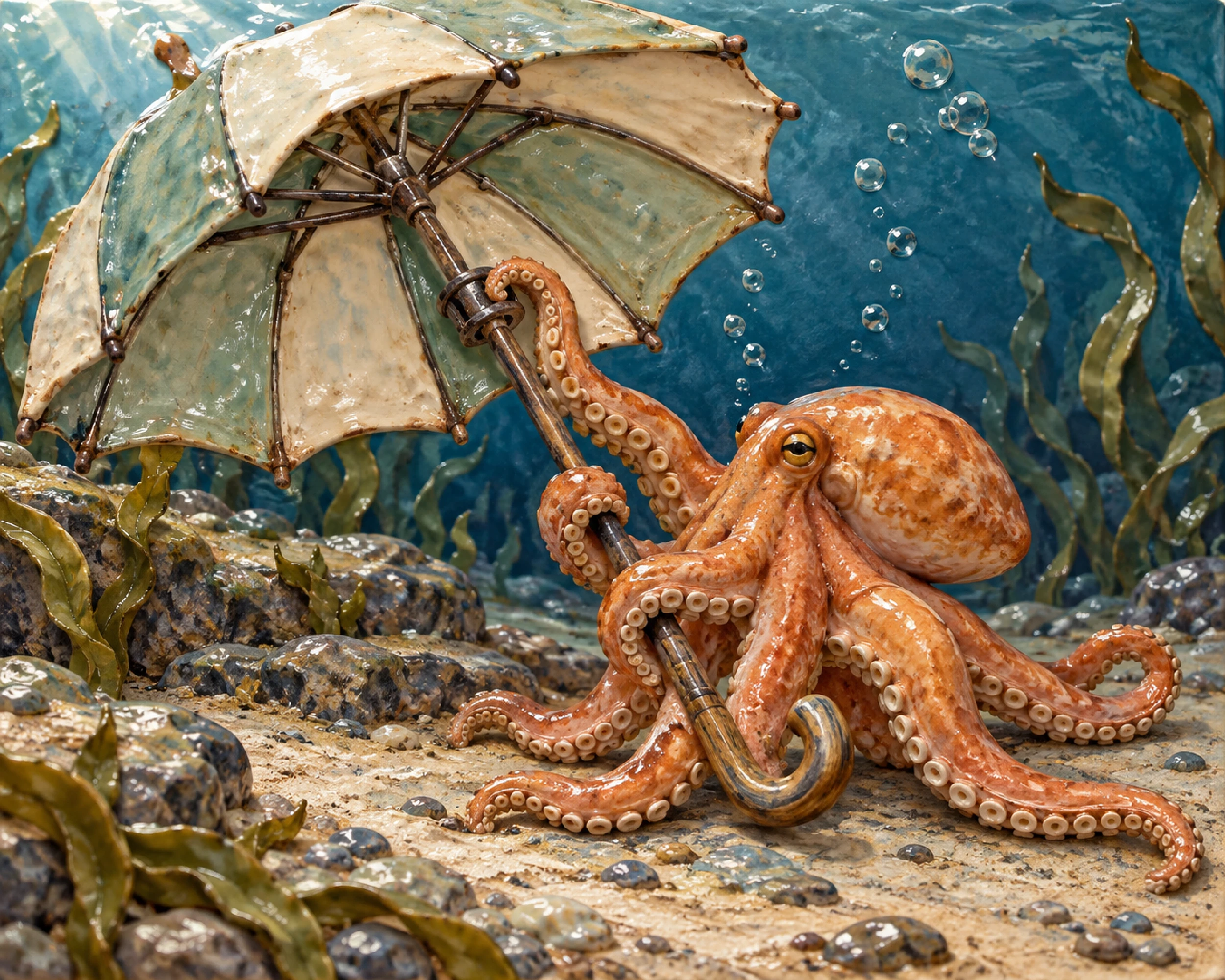
Octopus Opening a Sunken Umbrella
An octopus opens a sunken umbrella, releasing bubbles from its folded fabric. Overlapping arms and ribs, pressed edges, and pooled glaze create a lively ceramic relief.
Remix this referenceOctopus Opening a Sunken Umbrella
- Form language
- Translate forms into shallow convex slabs and supple raised coils; incised recesses separate interlocking masses.
- Contour
- Softly rolled relief edges carry the contours, with occasional pinched irregularities instead of uniform ink outlines.
- Mark-making
- Retain broad thumb-pressed hollows and sparse dragged-tool grooves; allow their rhythm and incidental details to vary naturally.
- Surface rendering
- Model fired glaze pooling in recesses and thinning over crests, with soft tonal transitions between satin fields and glassy patches.
Priority
The finished illustration must visibly read as a modeled, glazed ceramic relief.
What to avoid & what to check
Exact prompt for this example
MODULE OWNERSHIP
subject: Subject count, type, stable proportions and landmarks, resting face geometry, hair shape, physical materials, garment construction and permanent marks. No emotion, movement, color assignment or rendering recipe.
expression: Facial soft-tissue displacement and pupil direction, muscle coordination, regional intensity, asymmetry and onset/peak/release. No head/body pose, stable appearance, skin color or rendering.
gesture: Head/neck/body/limb orientation, joint movement, support, contact and pose-caused occlusion using existing anatomy. No eye/pupil movement, emotion, identity, props inventory or camera.
props: Prop count, type, construction, physical material and scale relative to the subject. Holding/contact belongs to gesture, position to composition, color to palette.
scene: Environment elements, terrain, backdrop/floor presence and structural detail. No canvas positions, camera, lighting, assigned colors or render texture.
camera: Projection, focal-length impression, camera elevation/yaw/roll, viewing distance and crop. No actor pose, world placement, lighting or canvas aspect ratio.
composition: Normalized 0-100% canvas positions, scale in frame, depth/overlap, focal hierarchy and margins. No joint pose, camera projection, rendering, subject/prop inventory or emotion.
palette: Color anchors, hue/saturation/value ranges, colors assigned to parts and approximate color coverage. No illumination direction, shading algorithm, physical material or layout.
lighting: Light-source direction/softness/intensity, ambient illumination, physical shadow direction/length and highlight position. Absence of directional illumination is allowed. No shading technique, palette or material changes.
style: Reusable form abstraction, contour weight/taper/edge quality, medium and mark scale/density/direction, surface rendering and tonal transition technique. No fixed subject proportions, anatomy, identity, expression, pose, palette, light-source direction, camera or layout.
output: Image count, aspect ratio, size, file/alpha requirements and global lettering/logo/watermark restrictions. No background scenery, crop, style, identity or pose.

SUBJECT
inventory: One octopus, actor A; no other creatures.
geometry: A rounded mantle joins a compact central body without a distinct neck; eight tapering arms have paired sucker rows.
resting-face: Small eyes sit beneath the mantle rim; the beak is concealed among the arm bases.
appearance: Soft, flexible skin has a few natural folds; no garments or permanent decorative marks.

PRIORITY


AVOID


CHECK


EXPRESSION — ACTOR A
brows: No eyebrow action applies; do not add human brow folds.
lids: Keep the visible eye margins relaxed, without a squint.
cheeks: No distinct cheek action applies; surrounding tissue stays relaxed.
nose: No nasal expression channel applies.
mouth: The concealed mouth has no prescribed visible expression.
jaw: No visible jaw action is prescribed.
gaze: Direct the visible pupils toward the umbrella's sliding runner.
coordination: The directed gaze works with relaxed eye margins, without a human smile.
timing: Hold this quiet neutral state at the captured instant.

PRIORITY


AVOID


CHECK


GESTURE
head: A's mantle tips toward the opening canopy.
torso: The central body lifts from the seabed as the lower arms brace beneath it.
limbs: One arm curls around the shaft, another pushes the runner upward; the others brace or unfurl.
contact: Suckers grip the shaft and runner; bracing arms press against the seabed.

PRIORITY


AVOID


CHECK


PROPS
inventory: One weathered umbrella, its canopy about as broad as A's relaxed arm spread.
construction: A cloth canopy has exposed metal ribs, a sliding runner, and a hooked wooden handle.

PRIORITY


AVOID


CHECK


SCENE
inventory: A shallow seabed with scattered pebbles, ribbon kelp, open water, and escaping air bubbles.
structure: A low rock shelf interrupts the sandy floor; long kelp blades rise from its cracks.

PRIORITY


AVOID


CHECK


CAMERA
projection: Use gently flattened perspective, preserving depth without strong foreshortening.
viewpoint: Look slightly downward from a three-quarter side view, with no camera roll.
crop: A medium-wide view includes the entire octopus and umbrella; peripheral kelp may leave the frame.

PRIORITY


AVOID


CHECK


COMPOSITION
placement: The canopy fills the upper left, A anchors the lower right, and their meeting point forms the focal knot.
depth: Foreground arms overlap the shaft; canopy ribs overlap distant kelp in an interlocked sequence.
spacing: Leave open water above the bubble trail and breathing room around the outer arm tips.

PRIORITY


AVOID


CHECK


PALETTE
colors: Use petrol blue, warm apricot, pale celadon, chalk cream, and restrained iron brown.
assignment: Water is petrol blue, A is apricot, the canopy alternates celadon and cream, and ribs are iron brown.
balance: Cool hues dominate; apricot supplies the strongest warm accent, while cream stays pale and quiet.

PRIORITY


AVOID


CHECK


LIGHTING
sources: Broad, soft light enters from the upper left, supported by gentle ambient illumination.
shadows: Short shadows fall toward the lower right and deepen beneath overlapping edges.
highlights: Small highlights catch upper-left-facing crests; the canopy's broad reflection stays subdued.

PRIORITY


AVOID


CHECK


STYLE GUIDE
form-language: Translate forms into shallow convex slabs and supple raised coils; incised recesses separate interlocking masses.
contour: Softly rolled relief edges carry the contours, with occasional pinched irregularities instead of uniform ink outlines.
mark-making: Retain broad thumb-pressed hollows and sparse dragged-tool grooves; allow their rhythm and incidental details to vary naturally.
surface-rendering: Model fired glaze pooling in recesses and thinning over crests, with soft tonal transitions between satin fields and glassy patches.

PRIORITY
The finished illustration must visibly read as a modeled, glazed ceramic relief.

AVOID


CHECK


OUTPUT
format: One finished illustration, landscape 5:4, 2500 × 2000 pixels, opaque PNG.
restrictions: No lettering, logos, signatures, or watermarks.

PRIORITY


AVOID


CHECK


FINAL INTEGRATION
gesture + composition: Keep the opening action readable within the layered overlaps, allowing incidental arm curves to vary.
style + lighting: Let illumination reveal the modeled surface while preserving its handmade irregularities.
Model information comes from image provenance. The same prompt may produce a different result.