Text to imageLandscapeStyle guide
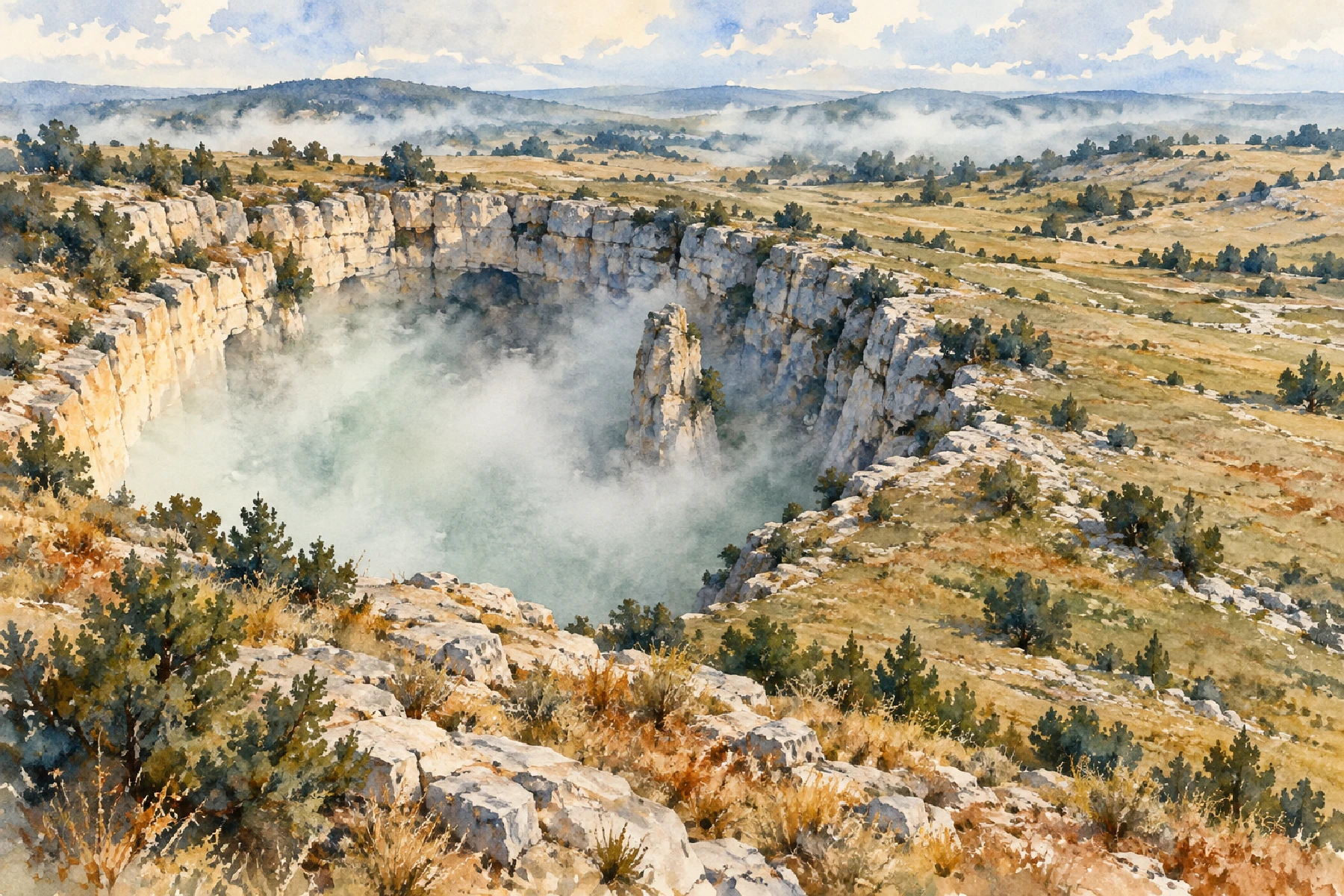
Clouds in the Sinkhole
Fog pools inside a limestone sinkhole among low uplands. Blooming watercolor and broken brushwork describe an expansive landscape of asymmetric cliffs and scattered junipers.
Remix this referenceClouds in the Sinkhole
- Form language
- Reduce complex forms into unequal interlocking masses, allowing small shapes to merge or disappear naturally.
- Contour
- Alternate lost wet edges with broken dry-brush boundaries; use only occasional short, decisive contour accents.
- Mark-making
- Use broad tilted washes, irregular pigment blooms and sparse dragging strokes; vary marks rather than repeating a texture.
- Surface rendering
- Let transparent watercolor layers mingle through backruns and granulation, with paper reserves interrupting soft tonal transitions.
Priority
Make watercolor blooms and broken edges visibly shape the image.
What to avoid & what to check
Exact prompt for this example
MODULE OWNERSHIP
subject: Subject count, type, stable proportions and landmarks, resting face geometry, hair shape, physical materials, garment construction and permanent marks. No emotion, movement, color assignment or rendering recipe.
expression: Facial soft-tissue displacement and pupil direction, muscle coordination, regional intensity, asymmetry and onset/peak/release. No head/body pose, stable appearance, skin color or rendering.
gesture: Head/neck/body/limb orientation, joint movement, support, contact and pose-caused occlusion using existing anatomy. No eye/pupil movement, emotion, identity, props inventory or camera.
props: Prop count, type, construction, physical material and scale relative to the subject. Holding/contact belongs to gesture, position to composition, color to palette.
scene: Environment elements, terrain, backdrop/floor presence and structural detail. No canvas positions, camera, lighting, assigned colors or render texture.
camera: Projection, focal-length impression, camera elevation/yaw/roll, viewing distance and crop. No actor pose, world placement, lighting or canvas aspect ratio.
composition: Normalized 0-100% canvas positions, scale in frame, depth/overlap, focal hierarchy and margins. No joint pose, camera projection, rendering, subject/prop inventory or emotion.
palette: Color anchors, hue/saturation/value ranges, colors assigned to parts and approximate color coverage. No illumination direction, shading algorithm, physical material or layout.
lighting: Light-source direction/softness/intensity, ambient illumination, physical shadow direction/length and highlight position. Absence of directional illumination is allowed. No shading technique, palette or material changes.
style: Reusable form abstraction, contour weight/taper/edge quality, medium and mark scale/density/direction, surface rendering and tonal transition technique. No fixed subject proportions, anatomy, identity, expression, pose, palette, light-source direction, camera or layout.
output: Image count, aspect ratio, size, file/alpha requirements and global lettering/logo/watermark restrictions. No background scenery, crop, style, identity or pose.

SUBJECT
inventory: One limestone sinkhole is the principal geological subject; no people or animals.
geometry: A broad, bowl-shaped depression has an interrupted rim and a slender rock fin rising from its inner wall.
resting-face: No facial anatomy applies.
appearance: Exposed limestone carries irregular bedding, weather-rounded ledges and occasional deep fissures.

PRIORITY


AVOID


CHECK


PROPS
inventory: No separate props.
construction: No prop construction applies.

PRIORITY


AVOID


CHECK


SCENE
inventory: Open grassy uplands, scattered junipers, loose scree and a bank of fog surround and enter the depression.
structure: Fog conceals the basin floor; rough grassland continues beyond the rim toward a low, uninterrupted horizon.

PRIORITY


AVOID


CHECK


CAMERA
projection: Use natural perspective with a moderately wide lens impression and restrained peripheral expansion.
viewpoint: Look obliquely into the depression from an elevated neighboring slope, with a level camera roll.
crop: Show the entire main depression and ample surrounding upland; allow the nearest slope to continue beyond the frame.

PRIORITY


AVOID


CHECK


COMPOSITION
placement: Place the sinkhole left of center, balancing its irregular opening with a spacious sweep of upland on the right.
depth: A cropped foreground slope overlaps the near rim; the rock fin interrupts the fog before the distant uplands recede.
spacing: Make the fog-filled opening the first read, the rock fin the second; keep broad breathing room between sparse accents.

PRIORITY


AVOID


CHECK


PALETTE
colors: Use limestone buff, muted celadon, smoky ultramarine and a small amount of burnt sienna.
assignment: Give rock the buff range, fog pale celadon, junipers and crevices ultramarine, and dry grasses sienna accents.
balance: Let pale mineral and fog colors dominate; reserve the deepest values for a few compact interruptions.

PRIORITY


AVOID


CHECK


LIGHTING
sources: Broad, cloud-filtered daylight arrives from the upper left, supported by generous ambient illumination.
shadows: Soft shadows fall to the right beneath projecting ledges; fog weakens shadows within the depression.
highlights: Keep broad, subdued highlights on upper-left-facing rock shoulders without sharp glints.

PRIORITY


AVOID


CHECK


STYLE GUIDE
form-language: Reduce complex forms into unequal interlocking masses, allowing small shapes to merge or disappear naturally.
contour: Alternate lost wet edges with broken dry-brush boundaries; use only occasional short, decisive contour accents.
mark-making: Use broad tilted washes, irregular pigment blooms and sparse dragging strokes; vary marks rather than repeating a texture.
surface-rendering: Let transparent watercolor layers mingle through backruns and granulation, with paper reserves interrupting soft tonal transitions.

PRIORITY
Make watercolor blooms and broken edges visibly shape the image.

AVOID


CHECK


OUTPUT
format: One finished image, landscape 3:2, 1800 × 1200 pixels, opaque PNG.
restrictions: No lettering, logos or watermarks.

PRIORITY


AVOID


CHECK
Model information comes from image provenance. The same prompt may produce a different result.