Text to imageArt stylesStyle guide
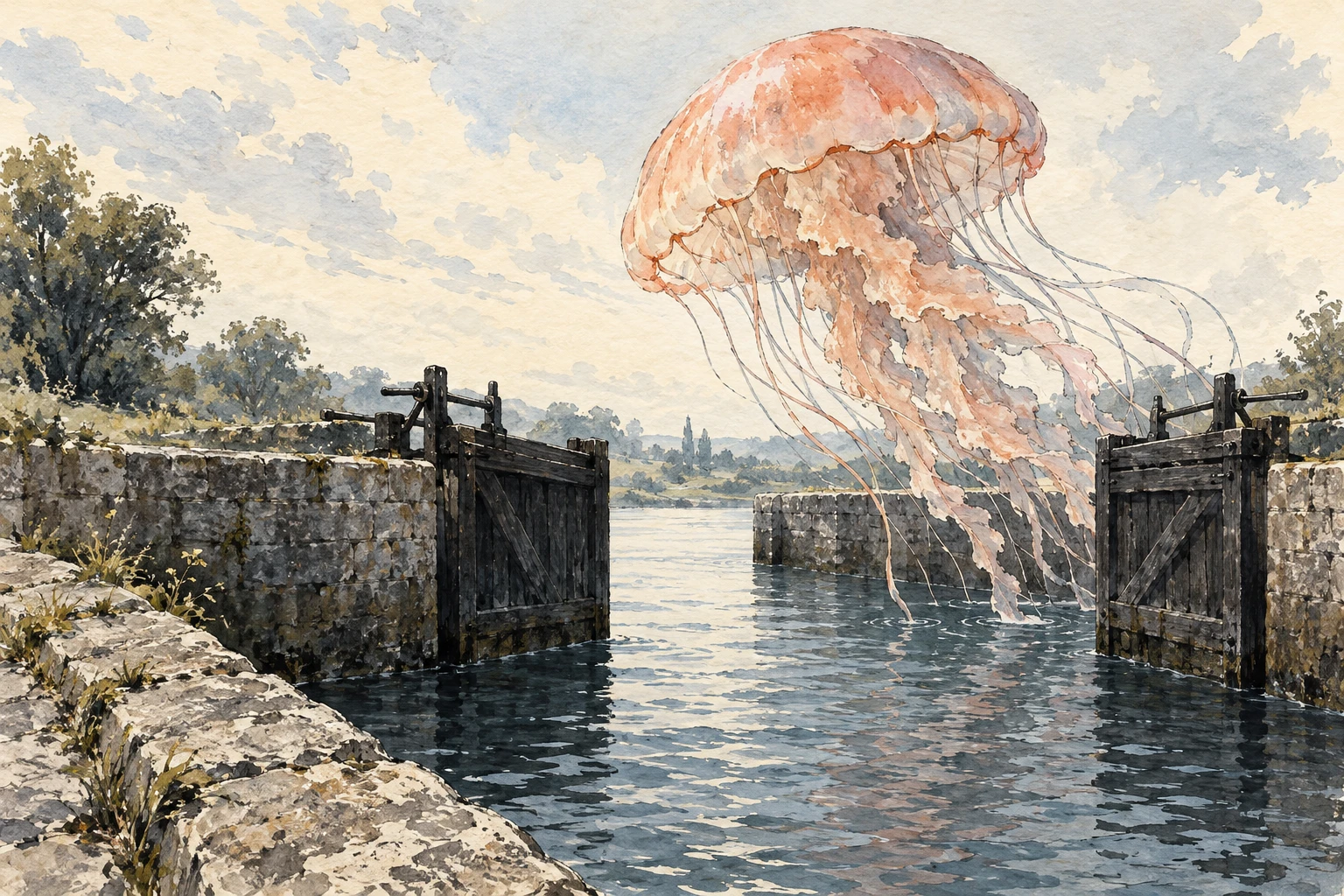
Jellyfish Above the Lock
An enormous jellyfish floats above an old canal lock, its trailing tentacles touching the water. Broken brush lines and spreading ink washes give the spacious scene an unexpected presence.
Remix this referenceJellyfish Above the Lock
- Form language
- Reduce forms to swelling masses and elastic linear extensions; selective landmarks retain recognition while minor shapes may vary naturally.
- Contour
- Use pressure-sensitive brush contours with blunt starts, tapered exits and occasional dry breaks; let selected edges dissolve into adjacent wash.
- Mark-making
- Combine broad loaded-brush sweeps with sparse quick flicks and scratchy dry strokes; vary length and density with natural hand rhythm.
- Surface rendering
- Layer translucent ink washes with pooled edges, soft feathering and occasional blooms; overlapping washes deepen tone while paper remains exposed within forms.
Priority
Editorial ink wash must show brush authorship and liquid irregularity.
What to avoid & what to check
Exact prompt for this example
MODULE OWNERSHIP
subject: Subject count, type, stable proportions and landmarks, resting face geometry, hair shape, physical materials, garment construction and permanent marks. No emotion, movement, color assignment or rendering recipe.
expression: Facial soft-tissue displacement and pupil direction, muscle coordination, regional intensity, asymmetry and onset/peak/release. No head/body pose, stable appearance, skin color or rendering.
gesture: Head/neck/body/limb orientation, joint movement, support, contact and pose-caused occlusion using existing anatomy. No eye/pupil movement, emotion, identity, props inventory or camera.
props: Prop count, type, construction, physical material and scale relative to the subject. Holding/contact belongs to gesture, position to composition, color to palette.
scene: Environment elements, terrain, backdrop/floor presence and structural detail. No canvas positions, camera, lighting, assigned colors or render texture.
camera: Projection, focal-length impression, camera elevation/yaw/roll, viewing distance and crop. No actor pose, world placement, lighting or canvas aspect ratio.
composition: Normalized 0-100% canvas positions, scale in frame, depth/overlap, focal hierarchy and margins. No joint pose, camera projection, rendering, subject/prop inventory or emotion.
palette: Color anchors, hue/saturation/value ranges, colors assigned to parts and approximate color coverage. No illumination direction, shading algorithm, physical material or layout.
lighting: Light-source direction/softness/intensity, ambient illumination, physical shadow direction/length and highlight position. Absence of directional illumination is allowed. No shading technique, palette or material changes.
style: Reusable form abstraction, contour weight/taper/edge quality, medium and mark scale/density/direction, surface rendering and tonal transition technique. No fixed subject proportions, anatomy, identity, expression, pose, palette, light-source direction, camera or layout.
output: Image count, aspect ratio, size, file/alpha requirements and global lettering/logo/watermark restrictions. No background scenery, crop, style, identity or pose.

SUBJECT
inventory: One enormous jellyfish is the only animal present.
geometry: A broad umbrella-shaped bell has a scalloped rim, folded oral arms and a skirt of slender tentacles.
resting-face: No readable face or facial landmarks are present.
appearance: The jellyfish has translucent gelatinous tissue, with no garments or permanent markings.

PRIORITY


AVOID


CHECK


GESTURE
head: No separate head or neck articulation applies.
torso: The bell floats without support, tipping gently toward the open gates.
limbs: Oral arms curl loosely beneath the bell; longer tentacles sweep backward in uneven, relaxed arcs.
contact: A few tentacle tips touch the water while the remaining strands hang free.

PRIORITY


AVOID


CHECK


PROPS
inventory: No separate props.
construction: No prop construction applies.

PRIORITY


AVOID


CHECK


SCENE
inventory: An old canal lock contains water, stone retaining walls, two open timber gates and an unobstructed sky.
structure: The gates adjoin a narrow masonry passage, with worn coping stones and a recessed waterline.

PRIORITY


AVOID


CHECK


CAMERA
projection: Use natural perspective with a moderate focal-length impression and restrained depth convergence.
viewpoint: Look obliquely along the canal from slightly above the bank, with a level horizon.
crop: A medium-wide view includes the entire bell and both gates; the nearest wall continues beyond the frame.

PRIORITY


AVOID


CHECK


COMPOSITION
placement: Place the bell right of center above the gate opening and water, leaving a broad open interval on the left.
depth: The bell leads the focal hierarchy; strands overlap the farther gate while the near wall anchors the foreground.
spacing: Give the bell generous upper breathing room; alternate compact gate shapes with long open stretches.

PRIORITY


AVOID


CHECK


PALETTE
colors: Use warm ivory, cool charcoal, smoky blue-gray and restrained pale coral.
assignment: Assign coral to the bell, blue-gray to water and stone, charcoal to gates and lines, and ivory to the sky.
balance: Ivory dominates; muted middle values support sparse charcoal darks and a small coral accent.

PRIORITY


AVOID


CHECK


LIGHTING
sources: Broad, soft daylight arrives from the upper left, supported by gentle ambient light.
shadows: Gate shadows fall softly toward the lower right; the bell casts a faint shadow on the water.
highlights: A broad, quiet highlight rests on the bell's upper-left curve, with subtle glints at tentacle-water contacts.

PRIORITY


AVOID


CHECK


STYLE GUIDE
form-language: Reduce forms to swelling masses and elastic linear extensions; selective landmarks retain recognition while minor shapes may vary naturally.
contour: Use pressure-sensitive brush contours with blunt starts, tapered exits and occasional dry breaks; let selected edges dissolve into adjacent wash.
mark-making: Combine broad loaded-brush sweeps with sparse quick flicks and scratchy dry strokes; vary length and density with natural hand rhythm.
surface-rendering: Layer translucent ink washes with pooled edges, soft feathering and occasional blooms; overlapping washes deepen tone while paper remains exposed within forms.

PRIORITY
Editorial ink wash must show brush authorship and liquid irregularity.

AVOID


CHECK


OUTPUT
format: Deliver one finished image.
restrictions: Use a 3:2 landscape canvas, 1800 × 1200 pixels, opaque PNG; include no lettering, logos or watermarks.

PRIORITY


AVOID


CHECK


FINAL INTEGRATION
style + composition: Let the spacious arrangement support interrupted contours, so incomplete edges remain easy to read.
Model information comes from image provenance. The same prompt may produce a different result.