Text to imagePortraitStyle guide
Side-Parted Adult · Facial Perspective Compression
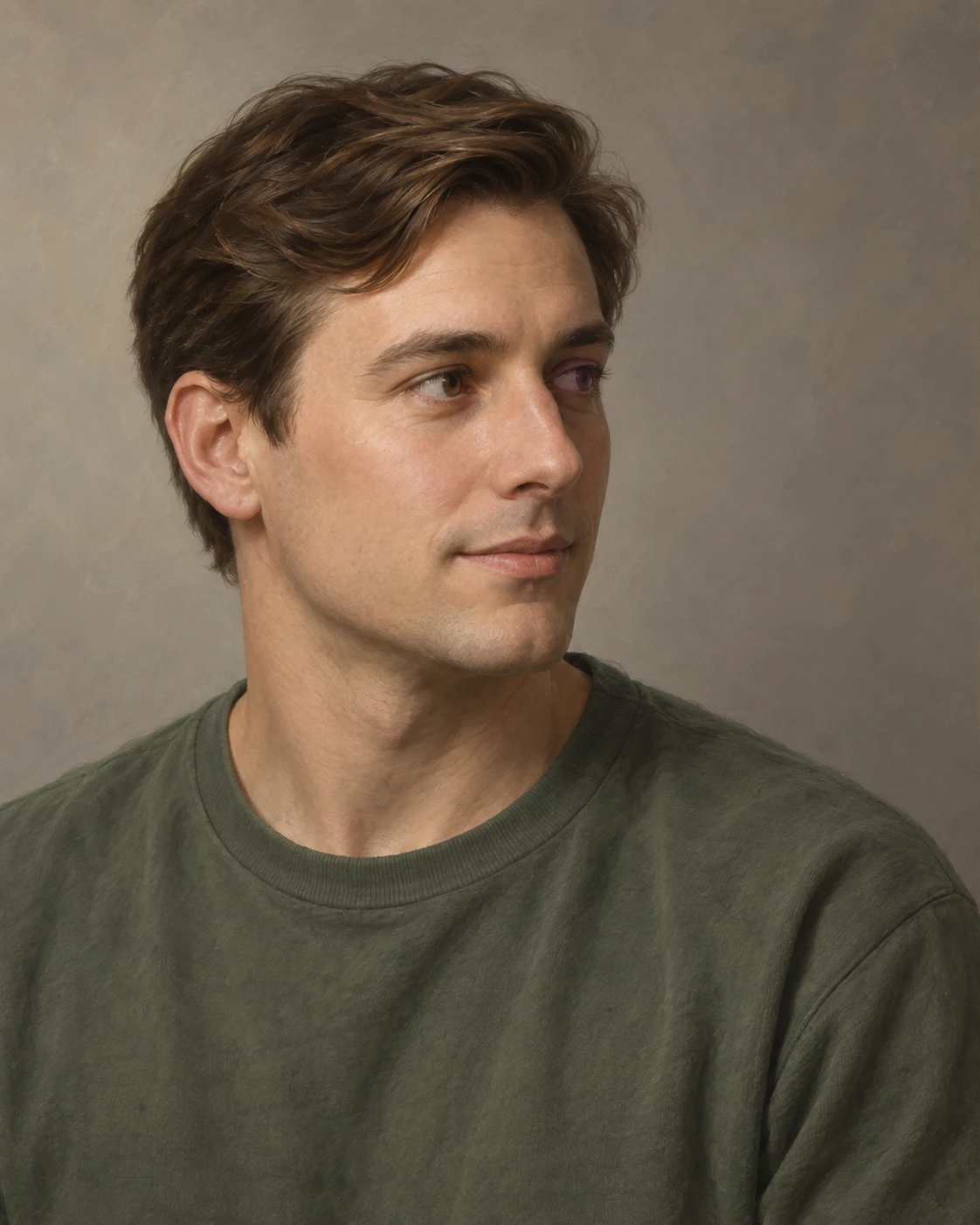
A portrait that makes a rightward head turn readable by compressing the farther eye and cheek.
Side-Parted Adult · Facial Perspective Compression
- Shape & line
- Build the turned face with a broad near cheek on image-left and a narrower far cheek on image-right. Shift the facial centerline toward image-right; make the far eye visibly narrower and its gap to the nose smaller, while the projecting nose partly overlaps the inner far-eye socket without hiding the eye.
- Color & light
- Use warm, subdued skin colors under a large soft light from above image-left. Let the forehead and near cheek carry broad light areas, with gentle darker transitions beside the nose and beneath the chin; keep the far eye readable within its softer shadow.
- Texture & material
- Paint skin with restrained matte brushwork and subtle tonal variation. Group the hair into curved locks that follow the side part, adding only a few strand accents; render the shirt as soft fabric with broad folds so surface detail does not compete with facial spacing.
- Composition
- Keep the head upright and the eye line nearly level so the turn is explained by unequal visible widths. Carry the same compression into the mouth: shorten its image-right half and let that corner wrap toward the far cheek; preserve clear space between the nose tip and the outer far-cheek contour.
Priority
Prioritize coherent compression of the far eye, cheek, and mouth over decorative detail.
What to avoid & what to check
Avoid equal-width eyes, a centered nose, or a frontal mouth on the turned head.
Check that the narrower image-right features and the nose overlap clearly convey the same head turn.
Exact prompt for this example
SUBJECT
One adult with short, side-parted brown hair and a plain muted-green crewneck, wearing a relaxed, closed-mouth expression. The head turns toward image-right while the shoulders remain nearly frontal; both eyes look in the direction of the head turn.

COMPOSITION
An eye-level, chest-up three-quarter portrait in a vertical frame. Place the head slightly left of center, leave breathing room toward image-right, and keep both eyes visible against a plain warm-gray background.

STYLE GUIDE
1. Shape & line
Build the turned face with a broad near cheek on image-left and a narrower far cheek on image-right. Shift the facial centerline toward image-right; make the far eye visibly narrower and its gap to the nose smaller, while the projecting nose partly overlaps the inner far-eye socket without hiding the eye.

2. Color & light
Use warm, subdued skin colors under a large soft light from above image-left. Let the forehead and near cheek carry broad light areas, with gentle darker transitions beside the nose and beneath the chin; keep the far eye readable within its softer shadow.

3. Texture & material
Paint skin with restrained matte brushwork and subtle tonal variation. Group the hair into curved locks that follow the side part, adding only a few strand accents; render the shirt as soft fabric with broad folds so surface detail does not compete with facial spacing.

4. Composition
Keep the head upright and the eye line nearly level so the turn is explained by unequal visible widths. Carry the same compression into the mouth: shorten its image-right half and let that corner wrap toward the far cheek; preserve clear space between the nose tip and the outer far-cheek contour.

PRIORITY
Preserve the requested identity, count, action, composition and output settings. Apply the style rules within those constraints; a style reference must not replace the subject or layout. Within the style: Prioritize coherent compression of the far eye, cheek, and mouth over decorative detail.

AVOID
Avoid equal-width eyes, a centered nose, or a frontal mouth on the turned head.

OUTPUT
One finished digital painted portrait, 4:5 aspect ratio, with no text, lettering, watermark, or diagram overlays.

SELF-CHECK
Check that the narrower image-right features and the nose overlap clearly convey the same head turn.
Model information comes from image provenance. The same prompt may produce a different result.