Text to imageArt stylesStyle guide
Giant Watermelon at the Threshold
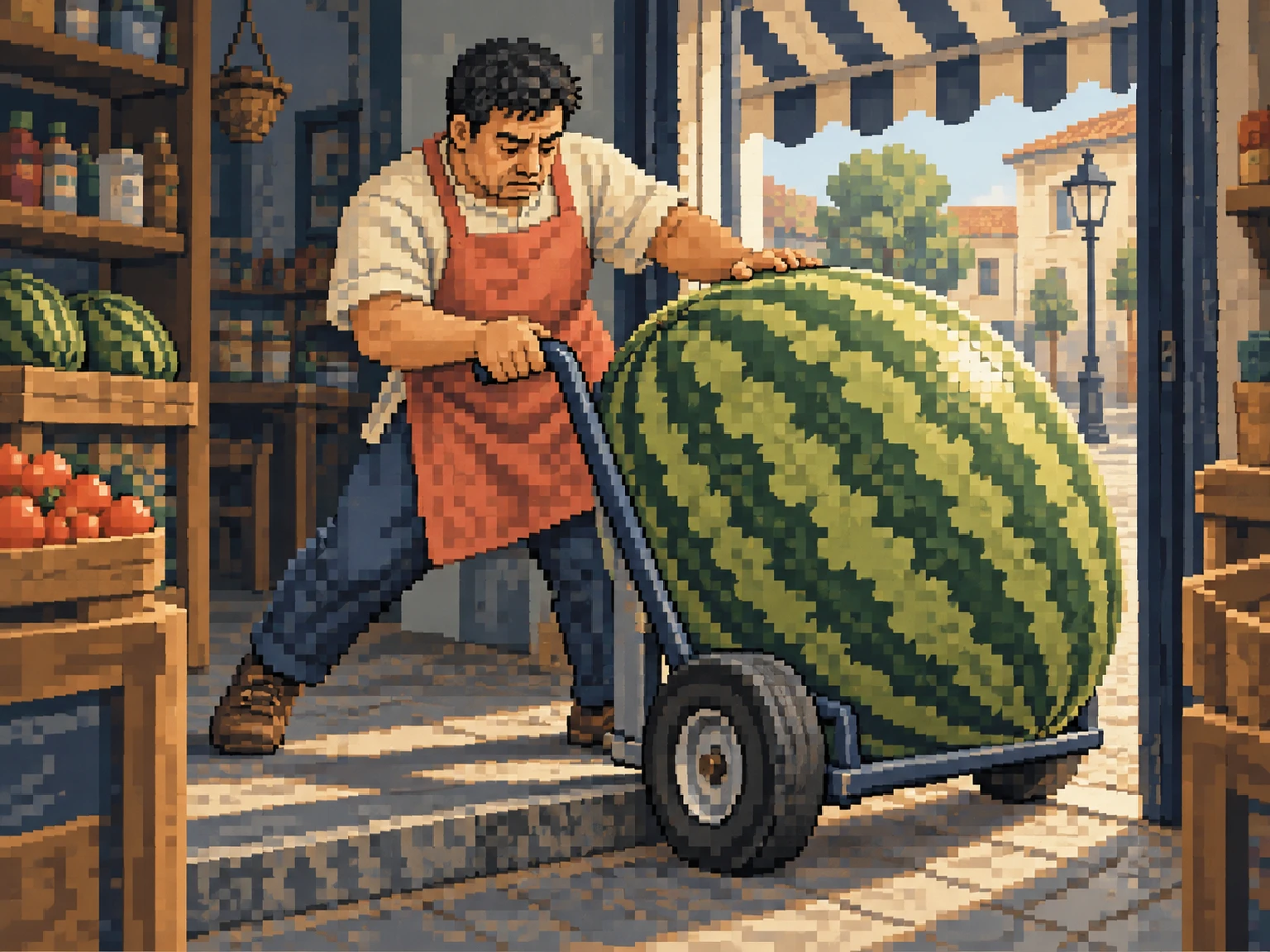
A shopkeeper pushes a giant watermelon over a raised shop threshold. Interwoven marks and chunky pixel steps knit the overlapping figure, fruit, and doorway into a lively narrative image.
Remix this referenceGiant Watermelon at the Threshold
- Form language
- Build forms from interlocking chunky pixel clusters, using stepped curves and broad planes rather than individually outlined pixels.
- Contour
- Keep deliberate low-resolution stair steps; vary their run lengths naturally, with occasional broken dark edge clusters.
- Mark-making
- Weave short horizontal bars through interrupted vertical bands, allowing irregular crossings that remain legible as pixel clusters.
- Surface rendering
- Shift tone through woven block interleaving and compact solid patches; retain small uneven gaps instead of smoothing every transition.
Priority
Make the woven crossings and coarse pixel edges visibly belong to the same rendering language.
What to avoid & what to check
Exact prompt for this example
MODULE OWNERSHIP
subject: Subject count, type, stable proportions and landmarks, resting face geometry, hair shape, physical materials, garment construction and permanent marks. No emotion, movement, color assignment or rendering recipe.
expression: Facial soft-tissue displacement and pupil direction, muscle coordination, regional intensity, asymmetry and onset/peak/release. No head/body pose, stable appearance, skin color or rendering.
gesture: Head/neck/body/limb orientation, joint movement, support, contact and pose-caused occlusion using existing anatomy. No eye/pupil movement, emotion, identity, props inventory or camera.
props: Prop count, type, construction, physical material and scale relative to the subject. Holding/contact belongs to gesture, position to composition, color to palette.
scene: Environment elements, terrain, backdrop/floor presence and structural detail. No canvas positions, camera, lighting, assigned colors or render texture.
camera: Projection, focal-length impression, camera elevation/yaw/roll, viewing distance and crop. No actor pose, world placement, lighting or canvas aspect ratio.
composition: Normalized 0-100% canvas positions, scale in frame, depth/overlap, focal hierarchy and margins. No joint pose, camera projection, rendering, subject/prop inventory or emotion.
palette: Color anchors, hue/saturation/value ranges, colors assigned to parts and approximate color coverage. No illumination direction, shading algorithm, physical material or layout.
lighting: Light-source direction/softness/intensity, ambient illumination, physical shadow direction/length and highlight position. Absence of directional illumination is allowed. No shading technique, palette or material changes.
style: Reusable form abstraction, contour weight/taper/edge quality, medium and mark scale/density/direction, surface rendering and tonal transition technique. No fixed subject proportions, anatomy, identity, expression, pose, palette, light-source direction, camera or layout.
output: Image count, aspect ratio, size, file/alpha requirements and global lettering/logo/watermark restrictions. No background scenery, crop, style, identity or pose.

SUBJECT
inventory: One original adult shopkeeper, actor A; no other people or animals.
geometry: A has a sturdy everyday build, broad hands, a softly squared chin, and short hair arranged in close waves.
resting-face: Broad cheeks, level eye openings, a short straight nose, and a naturally closed mouth establish the resting face.
appearance: A wears a cotton short-sleeved tunic, a canvas bib apron, work trousers, and closed leather shoes; no permanent markings.

PRIORITY


AVOID


CHECK


EXPRESSION — ACTOR A
brows: Inner brow ends draw slightly together; the outer ends remain level.
lids: Upper lids lower slightly while lower lids firm without squeezing shut.
cheeks: Cheeks stay mostly relaxed with slight tension beside the mouth.
nose: Nostrils remain relaxed, with no bridge wrinkle.
mouth: Closed lips press lightly together, with one corner tucked inward.
jaw: The jaw stays closed with mild muscular engagement.
gaze: Both pupils point downward toward the cart wheel.
coordination: Brow and lid tension carry the effort; the quieter mouth retains a small asymmetry.
timing: Hold the apex of concentrated effort, before the lips release.

PRIORITY


AVOID


CHECK


GESTURE
head: A lowers the chin and turns the neck slightly toward the threshold.
torso: A leans forward with a modest torso twist, letting the apron bunch against the waist.
limbs: One knee bends inside the shop while the trailing leg braces outside; one arm pushes and the other steadies.
contact: One hand grips the cart handle and the other presses the melon; both feet stay planted as the front wheel meets the sill.

PRIORITY


AVOID


CHECK


PROPS
inventory: Two props: one giant watermelon and one handcart; the fruit reaches approximately A's chest height.
construction: The watermelon has an oval rind shell; the cart has a tubular steel frame, a shallow platform, and rubber wheels.

PRIORITY


AVOID


CHECK


SCENE
inventory: A small neighborhood shop entrance with a masonry doorway, raised sill, fabric awning, interior floor, and pavement.
structure: The narrow doorway opens into a shallow shop interior; worn sill corners and simple shutter panels may vary naturally.

PRIORITY


AVOID


CHECK


CAMERA
projection: Use gentle perspective with a normal-lens impression and readable near-to-far size changes.
viewpoint: View obliquely from inside the shop, slightly below adult eye level, with no camera roll.
crop: A medium-wide view includes A's full figure, the cart wheels, and the doorway; the awning may extend beyond the crop.

PRIORITY


AVOID


CHECK


COMPOSITION
placement: Place A's head near 35% across and 30% down; the watermelon dominates the lower-right half as the first focal mass.
depth: The melon overlaps A's lower torso, the cart overlaps the sill, and the doorway frames the group from behind, extending into the upper-right field.
spacing: Keep a breathing gap above the head and a clear interval around the threshold wheel; let the lower forms crowd together.

PRIORITY


AVOID


CHECK


PALETTE
colors: Use moss green, coral red, warm cream, and deep indigo, with restrained saturation outside the coral accent.
assignment: Give the melon moss and cream stripes, the apron coral, the tunic cream, and the doorway and cart indigo; skin is warm ochre.
balance: Green carries the broadest saturated area; cream opens the surrounding field, while coral stays concentrated on A.

PRIORITY


AVOID


CHECK


LIGHTING
sources: Soft daylight enters from upper right, with weaker ambient light inside the shop.
shadows: Broad, short shadows fall inward toward the lower left, gathering beneath the cart and shoes.
highlights: A broad highlight follows the melon's upper-right shoulder; smaller highlights touch A's cheek and exposed hand.

PRIORITY


AVOID


CHECK


STYLE GUIDE
form-language: Build forms from interlocking chunky pixel clusters, using stepped curves and broad planes rather than individually outlined pixels.
contour: Keep deliberate low-resolution stair steps; vary their run lengths naturally, with occasional broken dark edge clusters.
mark-making: Weave short horizontal bars through interrupted vertical bands, allowing irregular crossings that remain legible as pixel clusters.
surface-rendering: Shift tone through woven block interleaving and compact solid patches; retain small uneven gaps instead of smoothing every transition.

PRIORITY
Make the woven crossings and coarse pixel edges visibly belong to the same rendering language.

AVOID


CHECK


OUTPUT
format: One finished image, 4:3 landscape, 1536 × 1152 pixels, opaque PNG.
restrictions: No lettering, logos, signatures, or watermarks.

PRIORITY


AVOID


CHECK


FINAL INTEGRATION
expression + gesture: Facial effort and bodily effort should read as one simultaneous action.
composition + style: Keep the overlaps readable even where the woven marks become lively and irregular.
Model information comes from image provenance. The same prompt may produce a different result.