Text to imageIllustrationStyle guide
One Rope Knot · Crossing-Path Clarity
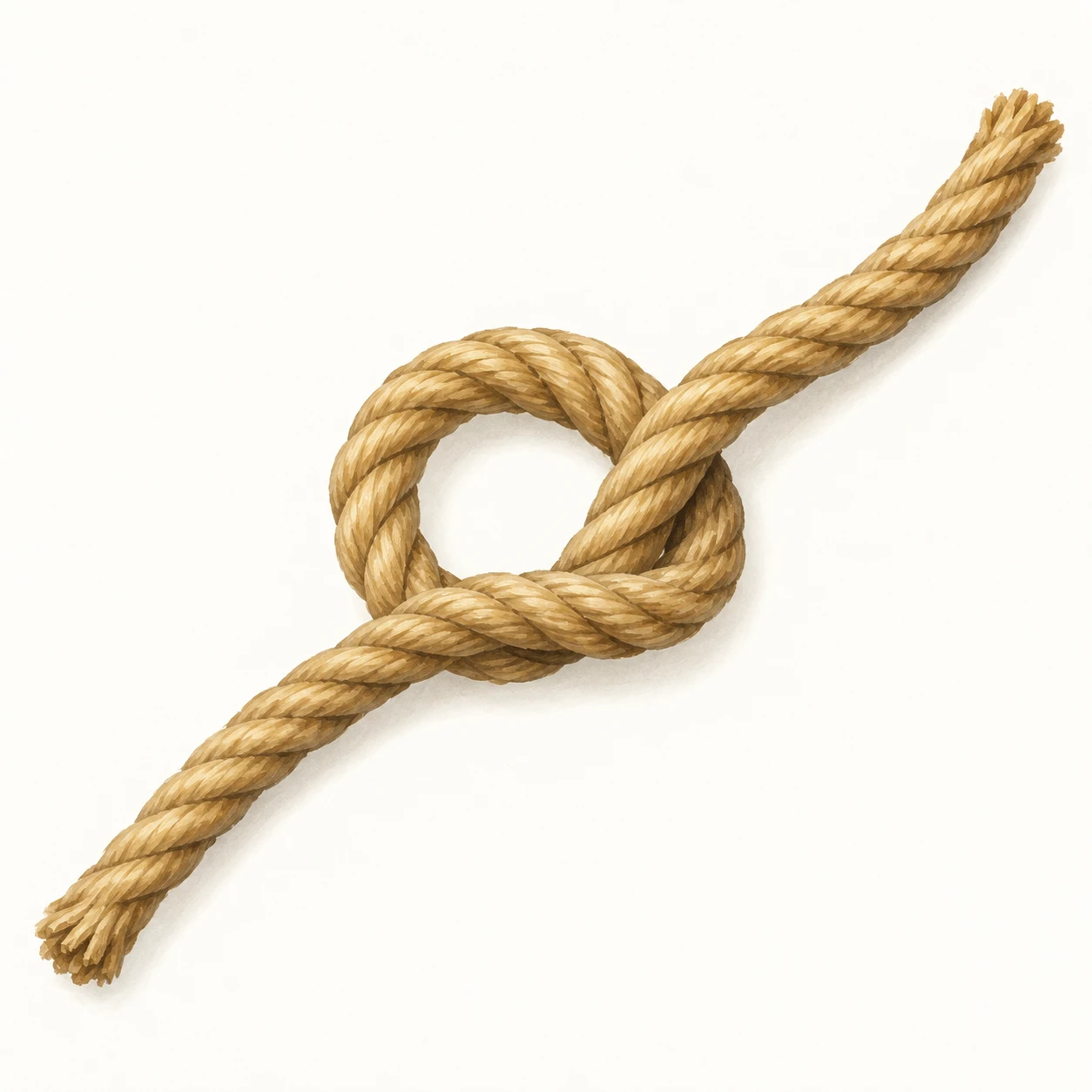
An illustration that uses contour breaks and local shadows to make one continuous rope readable through a loose knot.
One Rope Knot · Crossing-Path Clarity
- Shape & line
- Draw the rope as a gently curving band of consistent apparent thickness. At the prominent crossing just right of image center, keep both contours of the lower-left-to-upper-right foreground strand continuous; stop the contours of the strand passing beneath it at the foreground edges and resume them on the other side.
- Color & light
- Use muted ochre for the rope and warm brown for its shadows, with light arriving from the upper-left image side. Place a short dark shadow on the underlying strand immediately below and to the image-right of the foreground strand; keep the upper-left-facing rope surfaces pale so the crossing reads as a raised overlap.
- Texture & material
- Render the rope in opaque gouache with sparse, short diagonal fiber strokes that turn with each curve. Keep the painted surface matte and the fiber marks quieter than the main contours; leave the crossing edges clean enough to preserve the over-under relationship.
- Composition
- Keep a clearly visible background opening inside the central loop and small background gaps between neighboring rope sections. Arrange the two free ends on the lower-left to upper-right diagonal without cropping them, making the knot the largest and most detailed area in the image.
Priority
Prioritize a traceable continuous rope and an unmistakable over-under crossing.
What to avoid & what to check
Avoid fused crossings, disconnected rope sections, and fiber marks that obscure the contours.
Check that both ends belong to one rope and that the foreground strand visibly passes over the shadowed underlying strand.
Exact prompt for this example
SUBJECT
Draw one continuous length of rope tied into one loose overhand knot, with an open central loop and two visible free ends. The same rope must remain traceable from the lower-left end, through the knot, to the upper-right end.

COMPOSITION
Use a near-overhead view on a plain warm-white background. Center the knot, spread the free ends toward the lower-left and upper-right image corners, and leave generous margins around the entire rope.

STYLE GUIDE
1. Shape & line
Draw the rope as a gently curving band of consistent apparent thickness. At the prominent crossing just right of image center, keep both contours of the lower-left-to-upper-right foreground strand continuous; stop the contours of the strand passing beneath it at the foreground edges and resume them on the other side.

2. Color & light
Use muted ochre for the rope and warm brown for its shadows, with light arriving from the upper-left image side. Place a short dark shadow on the underlying strand immediately below and to the image-right of the foreground strand; keep the upper-left-facing rope surfaces pale so the crossing reads as a raised overlap.

3. Texture & material
Render the rope in opaque gouache with sparse, short diagonal fiber strokes that turn with each curve. Keep the painted surface matte and the fiber marks quieter than the main contours; leave the crossing edges clean enough to preserve the over-under relationship.

4. Composition
Keep a clearly visible background opening inside the central loop and small background gaps between neighboring rope sections. Arrange the two free ends on the lower-left to upper-right diagonal without cropping them, making the knot the largest and most detailed area in the image.

PRIORITY
Preserve the requested identity, count, action, composition and output settings. Apply the style rules within those constraints; a style reference must not replace the subject or layout. Within the style: Prioritize a traceable continuous rope and an unmistakable over-under crossing.

AVOID
Avoid fused crossings, disconnected rope sections, and fiber marks that obscure the contours.

OUTPUT
Create one square illustration with no lettering, labels, border, or watermark.

SELF-CHECK
Check that both ends belong to one rope and that the foreground strand visibly passes over the shadowed underlying strand.
Model information comes from image provenance. The same prompt may produce a different result.