Text to imageArt stylesStyle guide
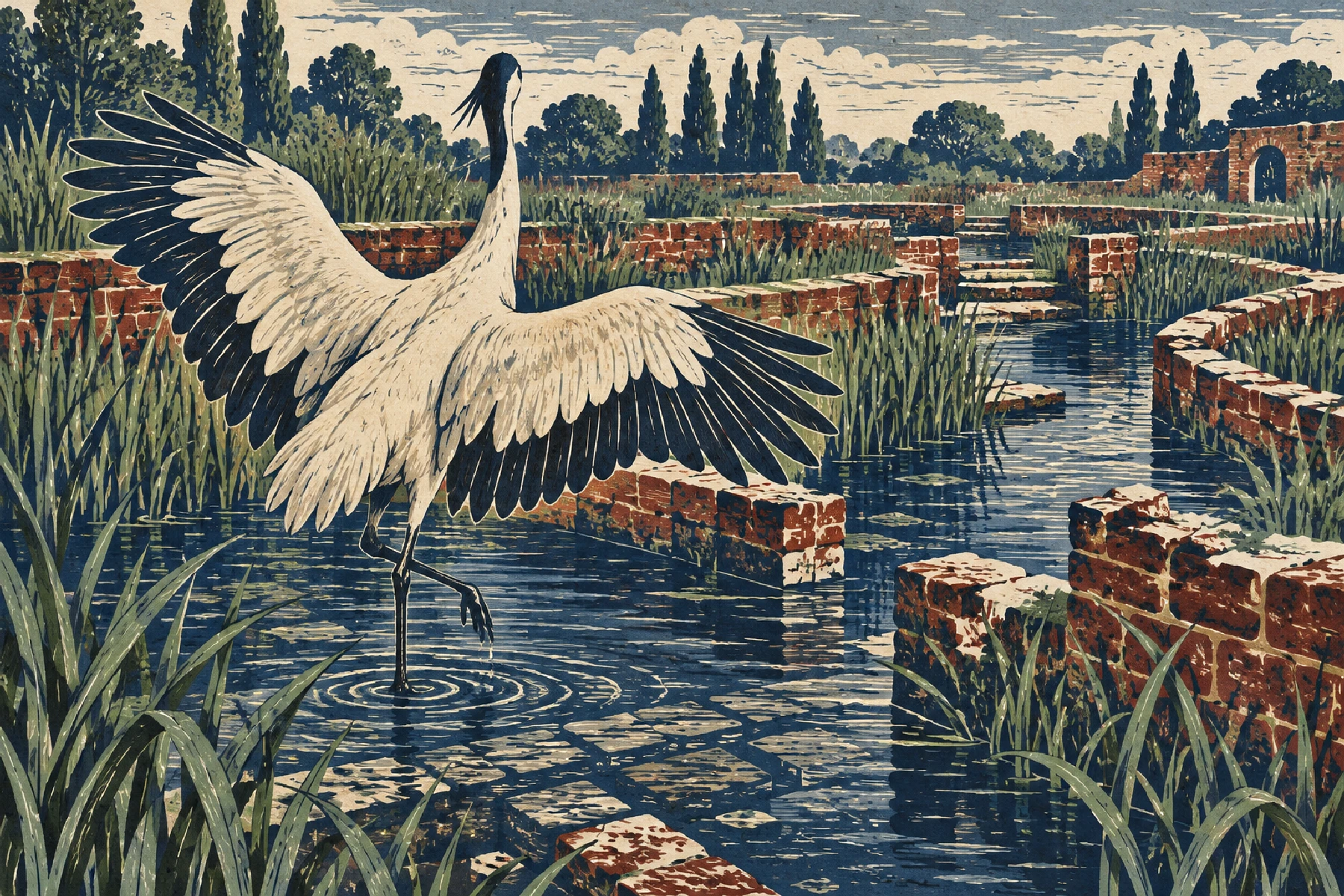
Crane Spreading Its Wings in a Flooded Maze
A crane spreads its wings among reeds and submerged brick paths. Bold linocut masses and rhythmic carved marks give the flooded maze an immersive depth.
Remix this referenceCrane Spreading Its Wings in a Flooded Maze
- Form language
- Reduce forms to interlocking curved wedges and substantial masses; small irregularities soften the geometric construction.
- Contour
- Use broad, slightly chipped ink edges, occasional tapered cuts, and shared boundaries where adjacent masses meet.
- Mark-making
- Carve rhythmic gouge strokes in shifting bundles of curves and slants; vary length and spacing with natural hand pressure.
- Surface rendering
- Build tones from dense ink masses and widening carved gaps; retain uneven hand-pulled ink transfer and occasional plate-edge chatter.
Priority
Make bold linocut visibly defined by carved rhythmic marks and substantial printed masses.
What to avoid & what to check
Exact prompt for this example
MODULE OWNERSHIP
subject: Subject count, type, stable proportions and landmarks, resting face geometry, hair shape, physical materials, garment construction and permanent marks. No emotion, movement, color assignment or rendering recipe.
expression: Facial soft-tissue displacement and pupil direction, muscle coordination, regional intensity, asymmetry and onset/peak/release. No head/body pose, stable appearance, skin color or rendering.
gesture: Head/neck/body/limb orientation, joint movement, support, contact and pose-caused occlusion using existing anatomy. No eye/pupil movement, emotion, identity, props inventory or camera.
props: Prop count, type, construction, physical material and scale relative to the subject. Holding/contact belongs to gesture, position to composition, color to palette.
scene: Environment elements, terrain, backdrop/floor presence and structural detail. No canvas positions, camera, lighting, assigned colors or render texture.
camera: Projection, focal-length impression, camera elevation/yaw/roll, viewing distance and crop. No actor pose, world placement, lighting or canvas aspect ratio.
composition: Normalized 0-100% canvas positions, scale in frame, depth/overlap, focal hierarchy and margins. No joint pose, camera projection, rendering, subject/prop inventory or emotion.
palette: Color anchors, hue/saturation/value ranges, colors assigned to parts and approximate color coverage. No illumination direction, shading algorithm, physical material or layout.
lighting: Light-source direction/softness/intensity, ambient illumination, physical shadow direction/length and highlight position. Absence of directional illumination is allowed. No shading technique, palette or material changes.
style: Reusable form abstraction, contour weight/taper/edge quality, medium and mark scale/density/direction, surface rendering and tonal transition technique. No fixed subject proportions, anatomy, identity, expression, pose, palette, light-source direction, camera or layout.
output: Image count, aspect ratio, size, file/alpha requirements and global lettering/logo/watermark restrictions. No background scenery, crop, style, identity or pose.

SUBJECT
inventory: One adult crane, actor A.
geometry: A has a compact torso, long slender legs and neck, broad wings, and a narrow tapered beak.
resting-face: At rest, the two halves of the tapered beak meet along a narrow seam.
appearance: Layered flight feathers, short crown plumes, and bare scaled lower legs; minor feather irregularities may vary.

PRIORITY


AVOID


CHECK


EXPRESSION — ACTOR A
brows: Leave the brow state unprescribed.
lids: Leave eyelid opening unprescribed.
cheeks: Prescribe no cheek displacement.
nose: Prescribe no change in the nostril region.
mouth: Leave beak opening unprescribed.
jaw: Prescribe no jaw tension or movement.
gaze: Leave pupil direction unprescribed.
coordination: No coordinated facial muscle changes are required.
timing: Sustain a neutral resting state without a facial transition.

PRIORITY


AVOID


CHECK


GESTURE
head: A stretches its neck upward and turns its head away, leaving the face out of view.
torso: The torso rises with a slight forward inclination as the wings open.
limbs: Both wings open in a broad uneven arc; one leg remains planted while the other foot lifts clear of the water.
contact: The planted foot supports A on submerged paving; the lifted foot has just broken contact with the water.

PRIORITY


AVOID


CHECK


PROPS
inventory: No separate props.
construction: No prop construction applies.

PRIORITY


AVOID


CHECK


SCENE
inventory: A flooded garden maze contains reed beds, shallow water, submerged brick paths, and broken low walls.
structure: Curving corridors join small stepped landings; gaps in the masonry connect the waterways.

PRIORITY


AVOID


CHECK


CAMERA
projection: Moderately wide perspective gives gentle size recession without pronounced lens distortion.
viewpoint: View from just above the low walls, looking slightly downward from a rear three-quarter viewpoint with no roll.
crop: Show the entire crane and enough surrounding maze to establish several connected passages.

PRIORITY


AVOID


CHECK


COMPOSITION
placement: A occupies the left middle as the focal silhouette; winding passages carry attention onward to the right.
depth: Cropped foreground reeds overlap the nearest wall; successive corridors recede behind A in layered intervals.
spacing: Leave breathing room around the wing tips and a broad water interval before the denser distant passages.

PRIORITY


AVOID


CHECK


PALETTE
colors: Use deep indigo, muted reed green, warm brick red, and pale parchment with restrained saturation.
assignment: Give A parchment plumage and indigo extremities; assign green to reeds, brick red to masonry, and indigo to water.
balance: Indigo and green dominate; parchment provides concentrated contrast, with brick red as smaller accents.

PRIORITY


AVOID


CHECK


LIGHTING
sources: Broad soft daylight enters from the upper left with ample ambient illumination.
shadows: Short softened shadows fall toward the lower right beneath projecting forms.
highlights: Gentle highlights occupy upper-left-facing surfaces and exposed upper wing edges.

PRIORITY


AVOID


CHECK


STYLE GUIDE
form-language: Reduce forms to interlocking curved wedges and substantial masses; small irregularities soften the geometric construction.
contour: Use broad, slightly chipped ink edges, occasional tapered cuts, and shared boundaries where adjacent masses meet.
mark-making: Carve rhythmic gouge strokes in shifting bundles of curves and slants; vary length and spacing with natural hand pressure.
surface-rendering: Build tones from dense ink masses and widening carved gaps; retain uneven hand-pulled ink transfer and occasional plate-edge chatter.

PRIORITY
Make bold linocut visibly defined by carved rhythmic marks and substantial printed masses.

AVOID


CHECK


OUTPUT
format: One finished landscape illustration, 3:2 aspect ratio, 1800 × 1200 pixels, opaque PNG.
restrictions: No lettering, logos, or watermarks.

PRIORITY


AVOID


CHECK


FINAL INTEGRATION
gesture + composition: Use separation and overlap to keep the gesture legible within the layered setting.
lighting + style: Translate illumination into the print's tonal language while preserving carved edge character.
Model information comes from image provenance. The same prompt may produce a different result.