Text to imageArt stylesStyle guide
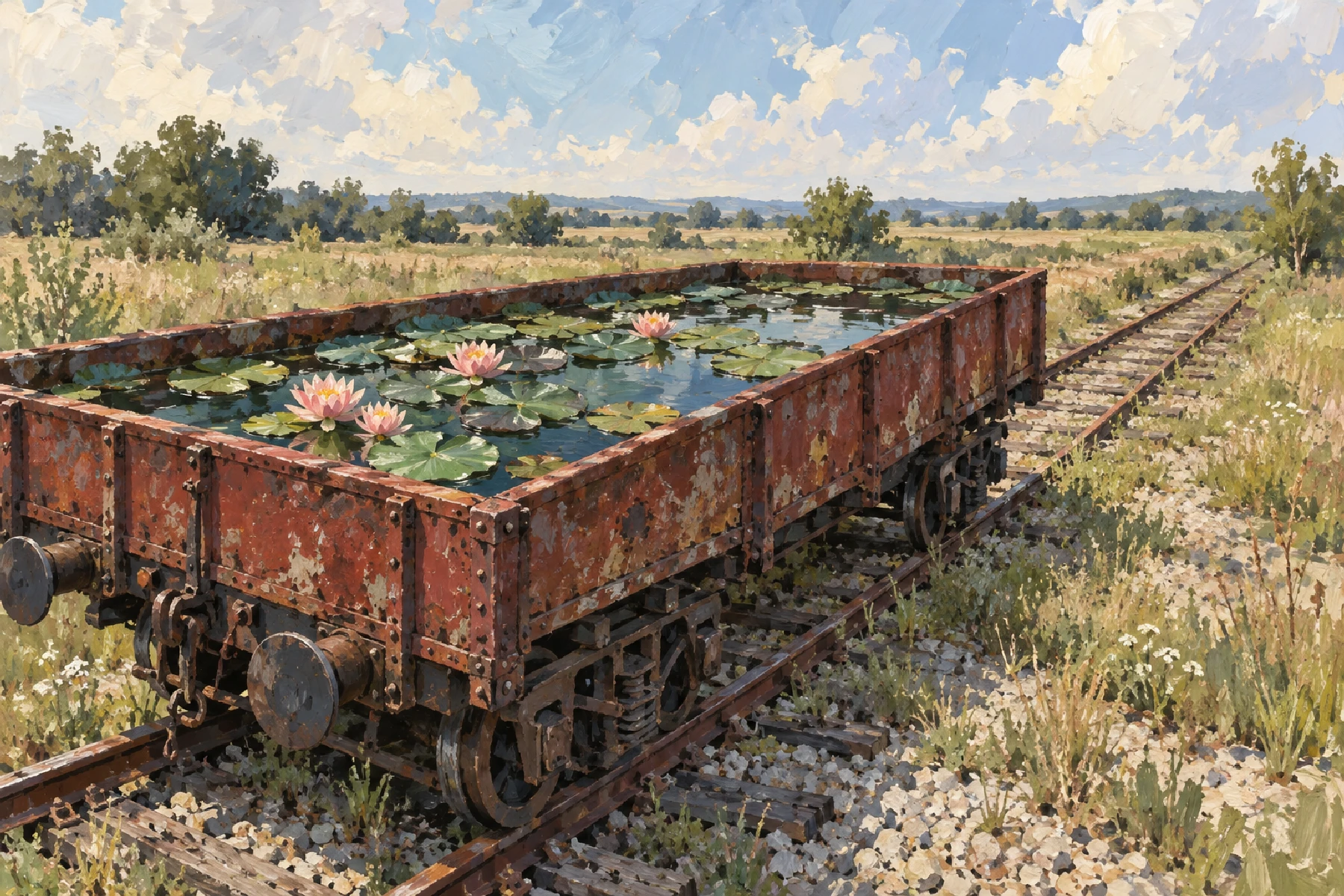
Water Lilies in a Freight Wagon
Water lilies grow in rainwater pooled inside an abandoned freight wagon. Spacious tracks and sky surround opaque gouache brushwork contrasting iron panels with floating leaves.
Remix this referenceWater Lilies in a Freight Wagon
- Form language
- Reduce forms into broad, slightly irregular painted masses, retaining a few structural accents within each mass.
- Contour
- Let opaque brush edges define contours; alternate blunt boundaries with broken dry edges and occasional lost edges.
- Mark-making
- Use loose gouache strokes of varied breadth, with dragged bristles, partial overpainting and decisive loaded dabs.
- Surface rendering
- Build matte opaque layers with visible underpaint interruptions; shift tones through overlapping strokes and sparse dry scumbling.
Priority
Keep opaque brushwork visibly active across broad painted areas.
What to avoid & what to check
Exact prompt for this example
MODULE OWNERSHIP
subject: Subject count, type, stable proportions and landmarks, resting face geometry, hair shape, physical materials, garment construction and permanent marks. No emotion, movement, color assignment or rendering recipe.
expression: Facial soft-tissue displacement and pupil direction, muscle coordination, regional intensity, asymmetry and onset/peak/release. No head/body pose, stable appearance, skin color or rendering.
gesture: Head/neck/body/limb orientation, joint movement, support, contact and pose-caused occlusion using existing anatomy. No eye/pupil movement, emotion, identity, props inventory or camera.
props: Prop count, type, construction, physical material and scale relative to the subject. Holding/contact belongs to gesture, position to composition, color to palette.
scene: Environment elements, terrain, backdrop/floor presence and structural detail. No canvas positions, camera, lighting, assigned colors or render texture.
camera: Projection, focal-length impression, camera elevation/yaw/roll, viewing distance and crop. No actor pose, world placement, lighting or canvas aspect ratio.
composition: Normalized 0-100% canvas positions, scale in frame, depth/overlap, focal hierarchy and margins. No joint pose, camera projection, rendering, subject/prop inventory or emotion.
palette: Color anchors, hue/saturation/value ranges, colors assigned to parts and approximate color coverage. No illumination direction, shading algorithm, physical material or layout.
lighting: Light-source direction/softness/intensity, ambient illumination, physical shadow direction/length and highlight position. Absence of directional illumination is allowed. No shading technique, palette or material changes.
style: Reusable form abstraction, contour weight/taper/edge quality, medium and mark scale/density/direction, surface rendering and tonal transition technique. No fixed subject proportions, anatomy, identity, expression, pose, palette, light-source direction, camera or layout.
output: Image count, aspect ratio, size, file/alpha requirements and global lettering/logo/watermark restrictions. No background scenery, crop, style, identity or pose.

SUBJECT
inventory: One original abandoned open freight wagon and a water-lily colony with a few blossoms.
geometry: A low rectangular wagon bed rests above paired wheel assemblies; broad lily discs have radial notches.
resting-face: No faces are present.
appearance: Riveted iron panels have dents and corrosion; fleshy leaves and layered petals vary naturally in shape.

PRIORITY


AVOID


CHECK


PROPS
inventory: No separate props.
construction: No prop construction applies.

PRIORITY


AVOID


CHECK


SCENE
inventory: A disused railway siding with ballast, grasses, distant meadow and open sky; rainwater fills the wagon bed.
structure: Rails continue through uneven ballast, with grass reclaiming their edges; the surrounding land stays open.

PRIORITY


AVOID


CHECK


CAMERA
projection: Natural perspective with a moderately wide focal-length impression and restrained convergence.
viewpoint: View from slightly above wagon-rim height at an oblique angle, looking into the water-filled bed.
crop: Show the complete wagon with generous surrounding ground and sky.

PRIORITY


AVOID


CHECK


COMPOSITION
placement: The wagon anchors the lower-left; blossoms form the first focal point within its broad opening.
depth: The near rim overlaps the lily pool; receding rails lead beyond the wagon into the quieter meadow.
spacing: Leave spacious track and sky to the right, with an uneven rhythm of leaf clusters and open water.

PRIORITY


AVOID


CHECK


PALETTE
colors: Use oxide red, deep blue-green, chalk cream and a restrained dusty pink.
assignment: Oxide red belongs to the wagon, blue-green to leaves and water, cream to sky and ballast, pink to blossoms.
balance: Cream occupies the broadest area; red and blue-green carry the main contrast, with pink used sparingly.

PRIORITY


AVOID


CHECK


LIGHTING
sources: Broad soft daylight enters from the upper left with ample ambient illumination.
shadows: Soft short shadows fall to the right beneath the wagon and along the inner rim.
highlights: Gentle highlights touch upper leaf surfaces, petal tips and the exposed wagon rim.

PRIORITY


AVOID


CHECK


STYLE GUIDE
form-language: Reduce forms into broad, slightly irregular painted masses, retaining a few structural accents within each mass.
contour: Let opaque brush edges define contours; alternate blunt boundaries with broken dry edges and occasional lost edges.
mark-making: Use loose gouache strokes of varied breadth, with dragged bristles, partial overpainting and decisive loaded dabs.
surface-rendering: Build matte opaque layers with visible underpaint interruptions; shift tones through overlapping strokes and sparse dry scumbling.

PRIORITY
Keep opaque brushwork visibly active across broad painted areas.

AVOID


CHECK


OUTPUT
format: Produce one finished 3:2 landscape image, 1800 × 1200 pixels, as an opaque PNG.
restrictions: No lettering, logos, signatures or watermarks.

PRIORITY


AVOID


CHECK


FINAL INTEGRATION
subject + scene + style: Subject recognition and environmental continuity should survive the shared painterly simplification.
Model information comes from image provenance. The same prompt may produce a different result.