Text to imageLandscapeStyle guide
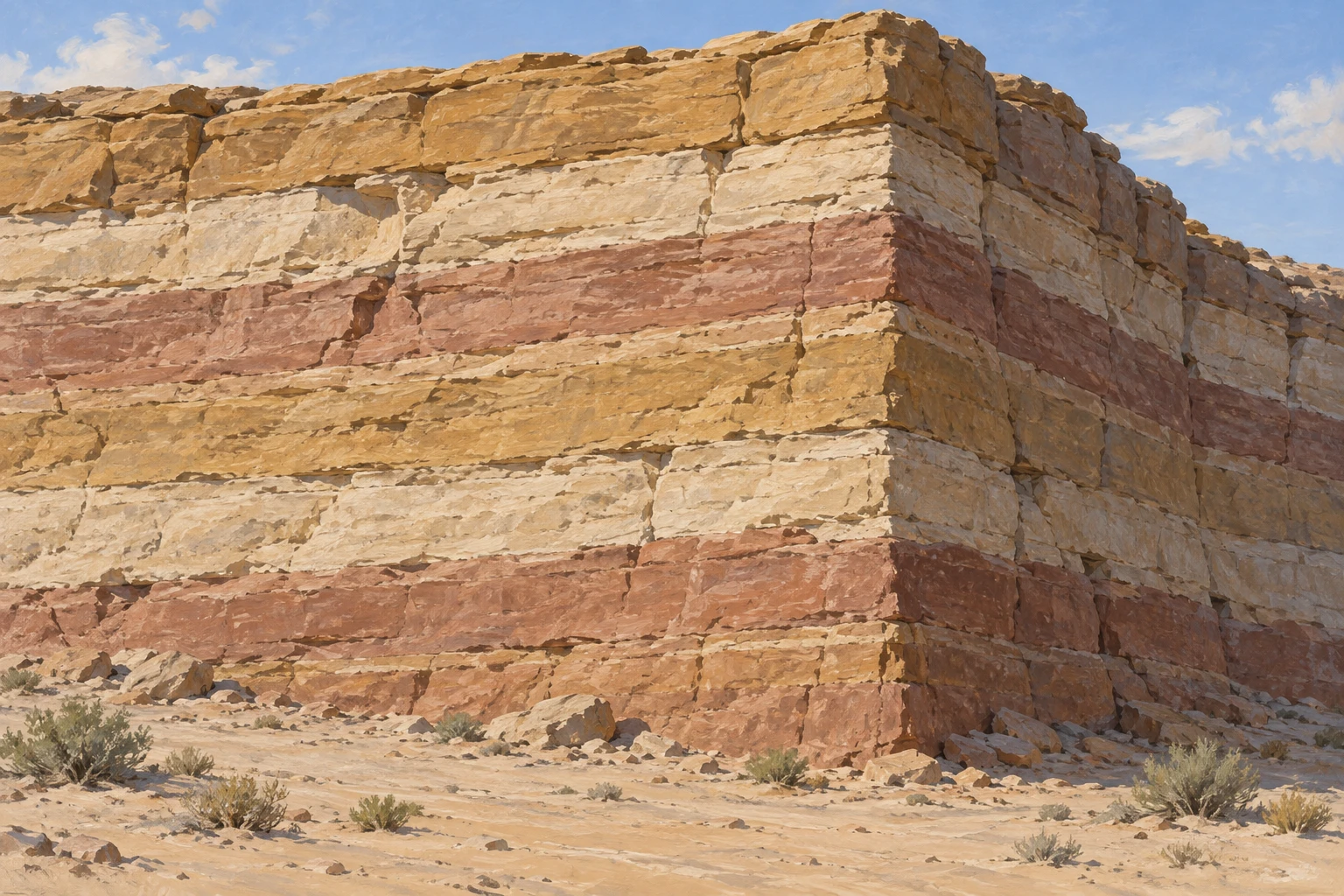
Sandstone Cliff · Strata Across a Corner
Use continuous sediment bands across two faces of a low sandstone cliff to reveal its change in direction.
Sandstone Cliff · Strata Across a Corner
- Shape & line
- Build the cliff from broad, uneven horizontal strata. Carry each major boundary to the projecting corner, then change its image-plane angle along the right receding face; keep the layer sequence recognizable through that turn.
- Color & light
- Alternate muted ochre, dusty rose and pale cream layers. Light the broad image-left face from upper image-left, and paint the image-right face in darker, cooler versions of those same colors so the corner reads through a clear value change.
- Texture & material
- Use matte, opaque gouache with broken dry-brush marks running along the bedding. Add a few shallow chips and short vertical cracks that interrupt small portions of the bands while leaving their larger continuity visible.
- Composition
- Place the projecting corner slightly right of center, with the broad left face occupying most of the cliff. Keep the sky and sandy base as quiet, simple fields, and reserve the clearest band junctions for the corner where their direction changes.
Priority
Prioritize the visible continuity and directional turn of the sediment layers.
What to avoid & what to check
Avoid disconnected stripes, perfectly uniform bands or cracks that obscure the layer sequence.
Check that several major layers can be traced from the left face across the corner onto the right face.
Exact prompt for this example
SUBJECT
One low sandstone cliff with a projecting corner separating a broad front face on image-left from a narrower receding face on image-right; the same sediment layers continue across both faces above a bare sandy base.

COMPOSITION
A horizontal three-quarter landscape view at roughly mid-cliff height, showing the entire corner, a thin strip of pale sky and enough sandy foreground to ground the cliff.

STYLE GUIDE
1. Shape & line
Build the cliff from broad, uneven horizontal strata. Carry each major boundary to the projecting corner, then change its image-plane angle along the right receding face; keep the layer sequence recognizable through that turn.

2. Color & light
Alternate muted ochre, dusty rose and pale cream layers. Light the broad image-left face from upper image-left, and paint the image-right face in darker, cooler versions of those same colors so the corner reads through a clear value change.

3. Texture & material
Use matte, opaque gouache with broken dry-brush marks running along the bedding. Add a few shallow chips and short vertical cracks that interrupt small portions of the bands while leaving their larger continuity visible.

4. Composition
Place the projecting corner slightly right of center, with the broad left face occupying most of the cliff. Keep the sky and sandy base as quiet, simple fields, and reserve the clearest band junctions for the corner where their direction changes.

PRIORITY
Preserve the requested identity, count, action, composition and output settings. Apply the style rules within those constraints; a style reference must not replace the subject or layout. Within the style: Prioritize the visible continuity and directional turn of the sediment layers.

AVOID
Avoid disconnected stripes, perfectly uniform bands or cracks that obscure the layer sequence.

OUTPUT
One landscape image, 3:2 aspect ratio, rendered as a naturalistic opaque-gouache study without lettering, labels or a border.

SELF-CHECK
Check that several major layers can be traced from the left face across the corner onto the right face.
Model information comes from image provenance. The same prompt may produce a different result.