Text to imageCharacterStyle guide
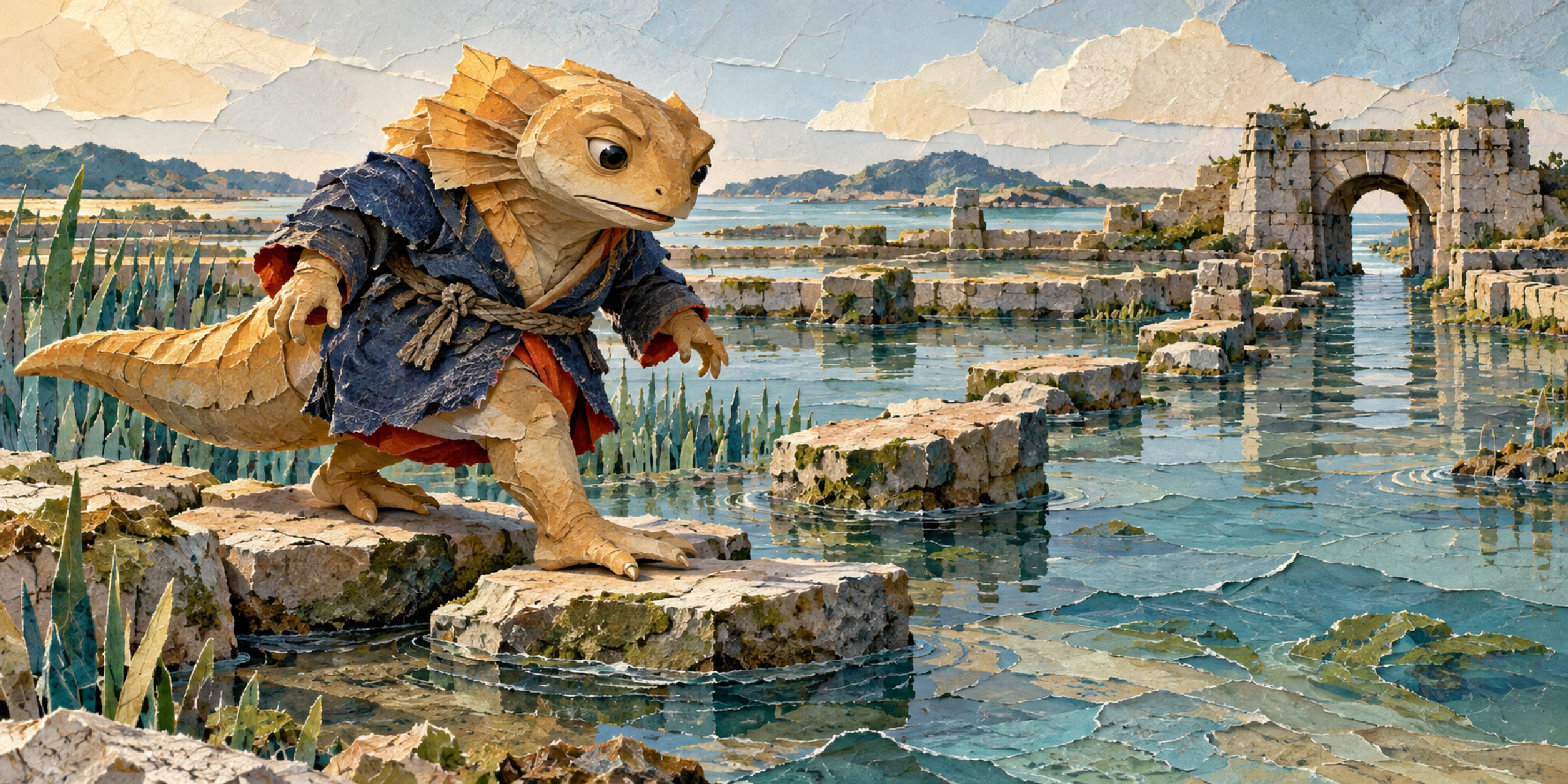
Frilled Traveler on the Flooded Causeway
A frilled traveler cautiously tests the next submerged stepping stone with a paddle-shaped foot. Layered cut paper builds a sweeping tidal landscape, where an old causeway leads toward a distant sluice.
Remix this referenceFrilled Traveler on the Flooded Causeway
- Form language
- Build broad interlocking silhouettes from irregular cut shapes; small angular facets interrupt curves without fragmenting their overall sweep.
- Contour
- Let cut edges form the contours, alternating crisp scissor turns with occasional softly torn edges; omit continuous drawn outlines.
- Mark-making
- Leave sparse pencil scoring and uneven dry-brush sweeps within selected pieces; vary pressure, spacing and direction naturally.
- Surface rendering
- Layer opaque rag paper with translucent tissue; slight edge curls expose the stacking, while rubbed pigment creates broken, soft tonal transitions.
Priority
Make tactile cut-paper layering visibly essential to the finished image.
What to avoid & what to check
Exact prompt for this example
MODULE OWNERSHIP
subject: Subject count, type, stable proportions and landmarks, resting face geometry, hair shape, physical materials, garment construction and permanent marks. No emotion, movement, color assignment or rendering recipe.
expression: Facial soft-tissue displacement and pupil direction, muscle coordination, regional intensity, asymmetry and onset/peak/release. No head/body pose, stable appearance, skin color or rendering.
gesture: Head/neck/body/limb orientation, joint movement, support, contact and pose-caused occlusion using existing anatomy. No eye/pupil movement, emotion, identity, props inventory or camera.
props: Prop count, type, construction, physical material and scale relative to the subject. Holding/contact belongs to gesture, position to composition, color to palette.
scene: Environment elements, terrain, backdrop/floor presence and structural detail. No canvas positions, camera, lighting, assigned colors or render texture.
camera: Projection, focal-length impression, camera elevation/yaw/roll, viewing distance and crop. No actor pose, world placement, lighting or canvas aspect ratio.
composition: Normalized 0-100% canvas positions, scale in frame, depth/overlap, focal hierarchy and margins. No joint pose, camera projection, rendering, subject/prop inventory or emotion.
palette: Color anchors, hue/saturation/value ranges, colors assigned to parts and approximate color coverage. No illumination direction, shading algorithm, physical material or layout.
lighting: Light-source direction/softness/intensity, ambient illumination, physical shadow direction/length and highlight position. Absence of directional illumination is allowed. No shading technique, palette or material changes.
style: Reusable form abstraction, contour weight/taper/edge quality, medium and mark scale/density/direction, surface rendering and tonal transition technique. No fixed subject proportions, anatomy, identity, expression, pose, palette, light-source direction, camera or layout.
output: Image count, aspect ratio, size, file/alpha requirements and global lettering/logo/watermark restrictions. No background scenery, crop, style, identity or pose.

SUBJECT
inventory: One original amphibious traveler, actor A; no other characters.
geometry: A pear-shaped torso, broad wedge-shaped head, short arms, paddle feet and a thick, heavy tapering tail define the silhouette.
resting-face: Wide-set oval eyes sit above slit nostrils; the broad, thin-lipped mouth has a shallow central notch.
appearance: Hairless pliant skin, a flexible pleated neck frill and a coarse woven wrap coat secured by its own belt.

PRIORITY


AVOID


CHECK


EXPRESSION — ACTOR A
brows: The nearer inner brow lifts slightly higher than the farther brow.
lids: Upper lids lift a little; lower lids remain loose.
cheeks: Cheeks stay relaxed without a smile-driven lift.
nose: Nostrils remain at rest without flare or wrinkling.
mouth: Lips barely separate, with one corner opening a little first.
jaw: The jaw releases only enough to support the small lip opening.
gaze: Pupils aim down and right toward the next stone.
coordination: Brow and lid changes carry the inquiry; the lower face stays quiet.
timing: Capture onset: the brow has just lifted and the lips are beginning to part.

PRIORITY


AVOID


CHECK


GESTURE
head: A angles the head downward, with the neck extending slightly forward.
torso: The torso inclines forward while the tail extends behind as a counterbalance.
limbs: One leg reaches ahead with toes spread; the arms hover apart with loosely open hands.
contact: The rear foot bears weight on one stone; the leading toes just touch the next stone.

PRIORITY


AVOID


CHECK


PROPS
inventory: No separate props.
construction: No prop construction applies.

PRIORITY


AVOID


CHECK


SCENE
inventory: An abandoned tidal saltworks contains shallow water, stone causeway remnants, low basin walls, reeds and an arched sluice.
structure: The broken causeway crosses breached salt basins toward a sluice opening onto the tidal channel; one dry stone precedes a submerged stone.

PRIORITY


AVOID


CHECK


CAMERA
projection: Use moderate wide-angle perspective with gentle recession and little edge distortion.
viewpoint: View from chest height at a shallow three-quarter angle, with a level horizon and no roll.
crop: Include the whole traveler, feet and tail, within a broad environmental view.

PRIORITY


AVOID


CHECK


COMPOSITION
placement: Place A large in the left third; the causeway sweeps from the lower left toward the distant sluice at right.
depth: Foreground basin walls overlap the nearest stones; successive causeway fragments diminish toward the sluice.
spacing: Keep the face and foot as the primary focal pair; open water gives the route breathing room and the sluice a quiet endpoint.

PRIORITY


AVOID


CHECK


PALETTE
colors: Use shell cream, muted tidal teal, warm ochre, deep indigo and a restrained vermilion accent.
assignment: Ochre skin and frill, indigo coat, vermilion coat lining, teal water and reeds, cream sky and pale stone.
balance: Pale neutrals dominate, teal occupies the next broadest share, and the coat lining supplies only a small sharp accent.

PRIORITY


AVOID


CHECK


LIGHTING
sources: Broad soft daylight arrives from the upper left, supported by gentle ambient illumination.
shadows: Short soft shadows fall lower right, with narrow contact shadows where surfaces meet.
highlights: Keep highlights broad and quiet across the forehead, upper frill and exposed stone tops.

PRIORITY


AVOID


CHECK


STYLE GUIDE
form-language: Build broad interlocking silhouettes from irregular cut shapes; small angular facets interrupt curves without fragmenting their overall sweep.
contour: Let cut edges form the contours, alternating crisp scissor turns with occasional softly torn edges; omit continuous drawn outlines.
mark-making: Leave sparse pencil scoring and uneven dry-brush sweeps within selected pieces; vary pressure, spacing and direction naturally.
surface-rendering: Layer opaque rag paper with translucent tissue; slight edge curls expose the stacking, while rubbed pigment creates broken, soft tonal transitions.

PRIORITY
Make tactile cut-paper layering visibly essential to the finished image.

AVOID


CHECK


OUTPUT
format: One finished image, panoramic 2:1 aspect ratio, 2400 × 1200 pixels, opaque PNG.
restrictions: No lettering, logos or watermarks.

PRIORITY


AVOID


CHECK


FINAL INTEGRATION
lighting + style: Let narrow contact shadows reveal the raised edges of the cut-paper overlaps.
Model information comes from image provenance. The same prompt may produce a different result.