Text to imageCharacterStyle guide
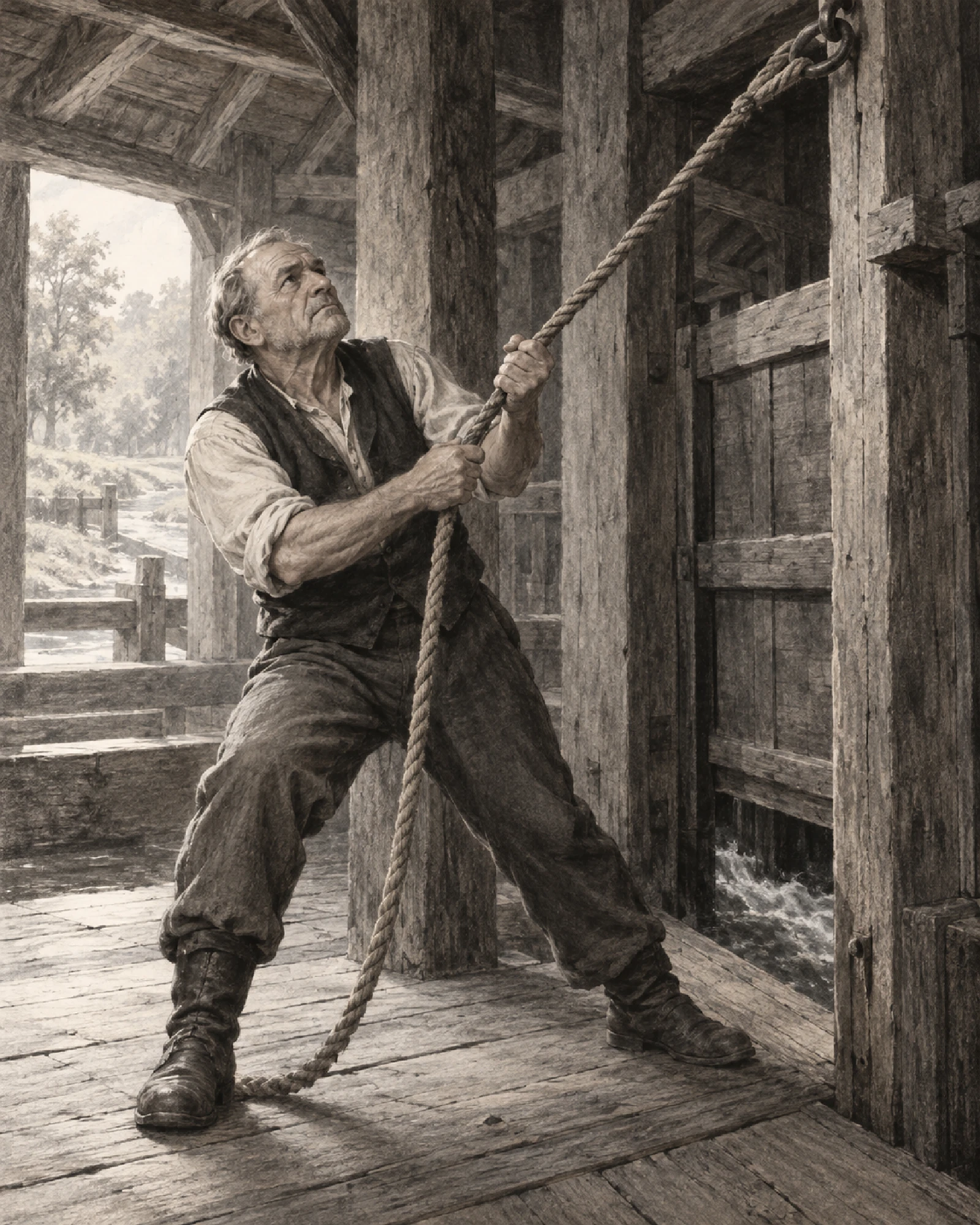
Miller Hauling the Sluice Rope
A miller hauls a sluice rope inside a timber watermill. His pulling gesture emerges between overlapping posts and water channels, with rubbed charcoal and erased light giving the working interior its depth.
Remix this referenceMiller Hauling the Sluice Rope
- Form language
- Observe weight and volume through economical masses, allowing secondary forms to remain suggestive rather than fully described.
- Contour
- Use searching charcoal contours that thicken, break and disappear into tone; retain occasional revisions as part of the drawing.
- Mark-making
- Combine broad side-of-stick strokes with rubbed smudges and spare pointed accents; vary pressure and let paper tooth interrupt marks.
- Surface rendering
- Build soft tonal beds, then lift light with kneaded-eraser sweeps and small cuts; keep some rubbed transitions unresolved.
Priority
Keep observational charcoal visible through smudged masses, searching edges and erased light.
What to avoid & what to check
Exact prompt for this example
MODULE OWNERSHIP
subject: Subject count, type, stable proportions and landmarks, resting face geometry, hair shape, physical materials, garment construction and permanent marks. No emotion, movement, color assignment or rendering recipe.
expression: Facial soft-tissue displacement and pupil direction, muscle coordination, regional intensity, asymmetry and onset/peak/release. No head/body pose, stable appearance, skin color or rendering.
gesture: Head/neck/body/limb orientation, joint movement, support, contact and pose-caused occlusion using existing anatomy. No eye/pupil movement, emotion, identity, props inventory or camera.
props: Prop count, type, construction, physical material and scale relative to the subject. Holding/contact belongs to gesture, position to composition, color to palette.
scene: Environment elements, terrain, backdrop/floor presence and structural detail. No canvas positions, camera, lighting, assigned colors or render texture.
camera: Projection, focal-length impression, camera elevation/yaw/roll, viewing distance and crop. No actor pose, world placement, lighting or canvas aspect ratio.
composition: Normalized 0-100% canvas positions, scale in frame, depth/overlap, focal hierarchy and margins. No joint pose, camera projection, rendering, subject/prop inventory or emotion.
palette: Color anchors, hue/saturation/value ranges, colors assigned to parts and approximate color coverage. No illumination direction, shading algorithm, physical material or layout.
lighting: Light-source direction/softness/intensity, ambient illumination, physical shadow direction/length and highlight position. Absence of directional illumination is allowed. No shading technique, palette or material changes.
style: Reusable form abstraction, contour weight/taper/edge quality, medium and mark scale/density/direction, surface rendering and tonal transition technique. No fixed subject proportions, anatomy, identity, expression, pose, palette, light-source direction, camera or layout.
output: Image count, aspect ratio, size, file/alpha requirements and global lettering/logo/watermark restrictions. No background scenery, crop, style, identity or pose.

SUBJECT
inventory: One original older male miller; no other figures.
geometry: A broad torso, substantial forearms, a long face and short thinning hair with an uneven crown.
resting-face: Low straight brows, deep-set eyes, a rounded nose tip and a wide mouth framed by lasting cheek folds.
appearance: A collarless woven shirt with folded cuffs, a wool waistcoat, loose work trousers and leather boots.

PRIORITY


AVOID


CHECK


EXPRESSION — ACTOR A
brows: Inner brow ends draw down and together, with a slightly stronger pull on one side.
lids: Upper lids lower moderately; lower lids tighten without closing the eyes.
cheeks: Cheeks draw taut beside the mouth without rising into a smile.
nose: Nose wings widen slightly while the bridge remains unwrinkled.
mouth: Lips press together, with one corner pulled slightly inward.
jaw: The jaw firms beneath closed lips, with no exaggerated clench.
gaze: Pupils focus upward along the rope toward its attachment.
coordination: Brow compression, lower-lid tension and the lip seal work together as concentrated effort.
timing: Hold the apex of facial effort, with facial tension fully established rather than just beginning.

PRIORITY


AVOID


CHECK


GESTURE
head: The chin lifts slightly toward the rope's attachment while the neck stays aligned with the upper torso.
torso: The torso leans backward from a lowered stance, with a small turn toward the pulling side; capture the peak of the pull.
limbs: Both elbows bend close to the ribs; one knee bends deeply while the other leg extends into a firm brace.
contact: Both hands grip the rope at staggered heights; boots press the floor and the spliced eye engages the gate ring.

PRIORITY


AVOID


CHECK


PROPS
inventory: One hauling rope, long enough to exceed the miller's height.
construction: A thumb-thick braided hemp rope with a spliced eye at one end and naturally uneven fibers.

PRIORITY


AVOID


CHECK


SCENE
inventory: A timber mill chamber with support posts, a plank floor, a sluice gate, a water channel and an open side bay.
structure: Beams cross above the channel; the gate slides within a timber frame and has an iron lifting ring.

PRIORITY


AVOID


CHECK


CAMERA
projection: Natural perspective with a mildly wide-lens impression and restrained near-to-far expansion.
viewpoint: View from slightly below chest height, oblique to the gate frame, with no camera roll.
crop: A full-body view retaining the boots and rope attachment; nearby structural edges may be cropped.

PRIORITY


AVOID


CHECK


COMPOSITION
placement: Set the miller left of center, the rope rising toward the upper right, the gate in the right middle ground, and the open bay at upper left.
depth: Foreground posts frame the hands and face; the gate follows in importance, with the channel extending behind it.
spacing: Leave a clear opening around the hands and rope; overlap peripheral structures freely while keeping both boot contacts legible.

PRIORITY


AVOID


CHECK


PALETTE
colors: Use charcoal black, warm gray and pale ivory in a nearly monochrome range.
assignment: Ivory belongs to the shirt and pale accents, warm gray to skin and timber, black to the waistcoat and deepest recesses.
balance: Mid-grays dominate, supported by substantial dark passages and a few clear ivory openings.

PRIORITY


AVOID


CHECK


LIGHTING
sources: Broad daylight through the open bay illuminates from upper image-left; interior ambient light remains subdued.
shadows: Post and body shadows fall toward lower image-right, with softer edges farther from their contact points.
highlights: Light catches the left cheek, upper forearms and exposed rope ridges, leaving the far side of the chamber dim.

PRIORITY


AVOID


CHECK


STYLE GUIDE
form-language: Observe weight and volume through economical masses, allowing secondary forms to remain suggestive rather than fully described.
contour: Use searching charcoal contours that thicken, break and disappear into tone; retain occasional revisions as part of the drawing.
mark-making: Combine broad side-of-stick strokes with rubbed smudges and spare pointed accents; vary pressure and let paper tooth interrupt marks.
surface-rendering: Build soft tonal beds, then lift light with kneaded-eraser sweeps and small cuts; keep some rubbed transitions unresolved.

PRIORITY
Keep observational charcoal visible through smudged masses, searching edges and erased light.

AVOID


CHECK


OUTPUT
format: One finished image, 4:5 portrait, 1600 × 2000 pixels, opaque PNG; no text, logos or watermarks.
restrictions: One finished image, 4:5 portrait, 1600 × 2000 pixels, opaque PNG; no text, logos or watermarks.

PRIORITY


AVOID


CHECK


FINAL INTEGRATION
gesture + composition + style: Let structural overlaps enrich the drawing while preserving the visible chain of contact through the pulling action.
Model information comes from image provenance. The same prompt may produce a different result.