Text to imageCharacterStyle guide
Rhinoceros on the Piano Pedal
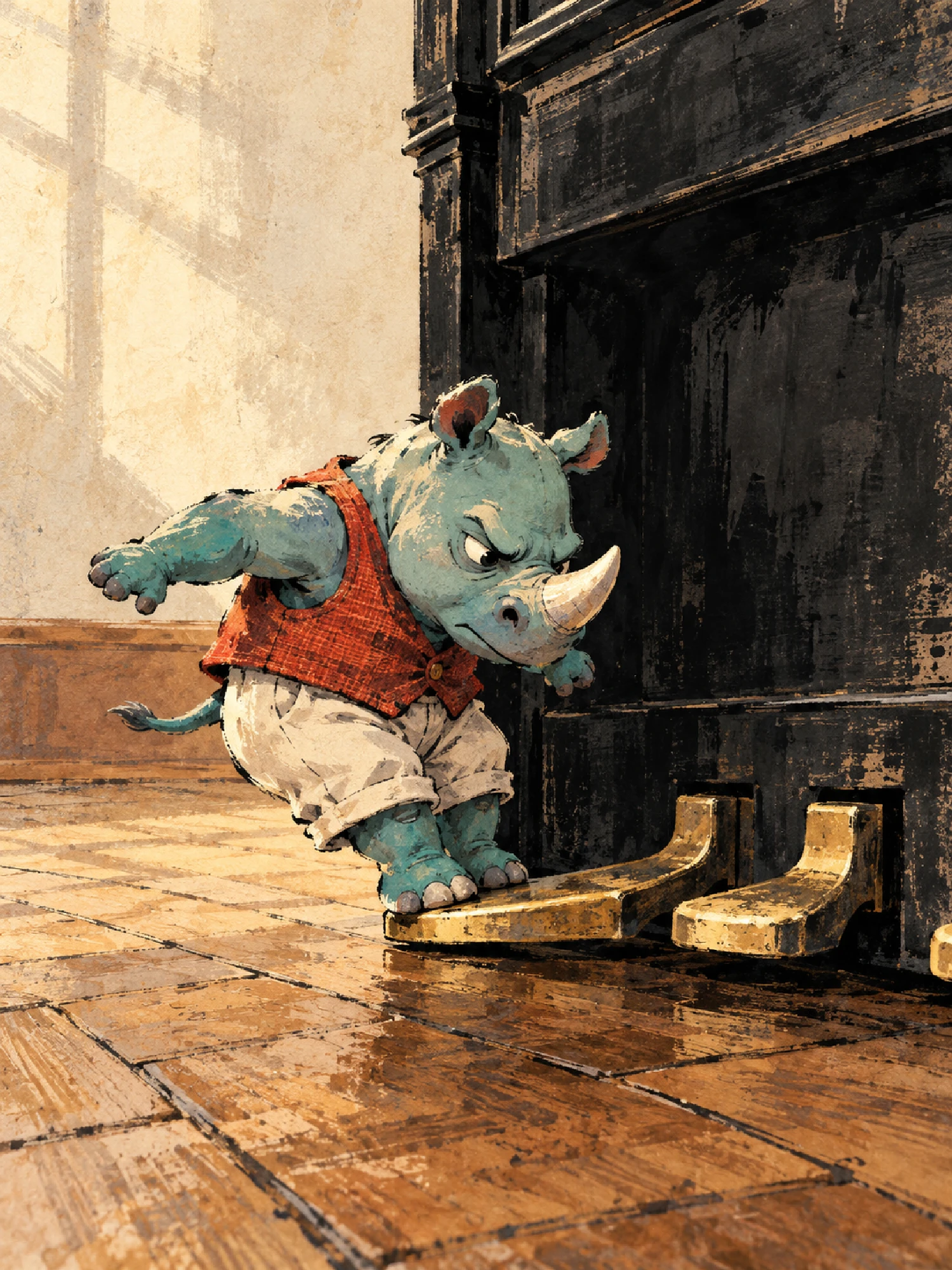
A mouse-sized rhinoceros puts its full weight onto an enormous piano pedal in a practice room. Rough ink contours and imperfect print layers turn its earnest effort into an experimental poster illustration.
Remix this referenceRhinoceros on the Piano Pedal
- Form language
- Reduce forms to blunt interlocking masses, interrupted by elastic brush distortions and sparse interior detail.
- Contour
- Alternate pooled brush starts with wiry broken endings; allow selected boundaries to disappear into ink.
- Mark-making
- Drag dry bristles in forceful sweeps and stamp blunt irregular patches, varying pressure and ink loading.
- Surface rendering
- Overlap translucent print passes on absorbent paper, retaining slight registration slips and rubbed tonal gaps.
Priority
Make the experimental ink-and-print medium visible through pressure changes and imperfect transfers.
What to avoid & what to check
Exact prompt for this example
MODULE OWNERSHIP
subject: Subject count, type, stable proportions and landmarks, resting face geometry, hair shape, physical materials, garment construction and permanent marks. No emotion, movement, color assignment or rendering recipe.
expression: Facial soft-tissue displacement and pupil direction, muscle coordination, regional intensity, asymmetry and onset/peak/release. No head/body pose, stable appearance, skin color or rendering.
gesture: Head/neck/body/limb orientation, joint movement, support, contact and pose-caused occlusion using existing anatomy. No eye/pupil movement, emotion, identity, props inventory or camera.
props: Prop count, type, construction, physical material and scale relative to the subject. Holding/contact belongs to gesture, position to composition, color to palette.
scene: Environment elements, terrain, backdrop/floor presence and structural detail. No canvas positions, camera, lighting, assigned colors or render texture.
camera: Projection, focal-length impression, camera elevation/yaw/roll, viewing distance and crop. No actor pose, world placement, lighting or canvas aspect ratio.
composition: Normalized 0-100% canvas positions, scale in frame, depth/overlap, focal hierarchy and margins. No joint pose, camera projection, rendering, subject/prop inventory or emotion.
palette: Color anchors, hue/saturation/value ranges, colors assigned to parts and approximate color coverage. No illumination direction, shading algorithm, physical material or layout.
lighting: Light-source direction/softness/intensity, ambient illumination, physical shadow direction/length and highlight position. Absence of directional illumination is allowed. No shading technique, palette or material changes.
style: Reusable form abstraction, contour weight/taper/edge quality, medium and mark scale/density/direction, surface rendering and tonal transition technique. No fixed subject proportions, anatomy, identity, expression, pose, palette, light-source direction, camera or layout.
output: Image count, aspect ratio, size, file/alpha requirements and global lettering/logo/watermark restrictions. No background scenery, crop, style, identity or pose.

SUBJECT
inventory: One original mouse-sized anthropomorphic rhinoceros, actor A.
geometry: A barrel torso, short sturdy legs, broad squared muzzle, round ears, short tail, and one nasal horn.
resting-face: Broad-set eyes sit above a heavy upper lip; shallow brow ridges frame the resting face.
appearance: Leathery skin, a keratin horn, a woven waistcoat, and loose cuffed shorts.

PRIORITY


AVOID


CHECK


EXPRESSION — ACTOR A
brows: Skin over the brow ridges draws inward and down, one side slightly lower than the other.
lids: Upper lids lower and lower lids tighten into a focused opening.
cheeks: The upper cheeks tighten slightly beneath the eyes.
nose: Nostrils flare modestly without wrinkling the entire muzzle.
mouth: Lips press together, with one corner pulled a little farther inward.
jaw: The jaw stays closed with a firm visible contraction.
gaze: Both pupils aim downward toward the pedal.
coordination: Brow-skin contraction and lip pressure work together; keep their asymmetry subtle.
timing: Hold the fully formed facial effort at its apex, before release.

PRIORITY


AVOID


CHECK


GESTURE
head: The neck inclines forward and the muzzle angles down.
torso: The torso leans forward over the supporting feet as the body bears down.
limbs: Both knees bend; the arms spread unevenly for balance and the tail extends backward.
contact: Both feet stand on the pedal's free end, pressing it to the bottom of its travel.

PRIORITY


AVOID


CHECK


PROPS
inventory: One human-sized upright acoustic piano, monumental in scale relative to actor A.
construction: A timber cabinet with a recessed pedal assembly; the broad metal pedal can support both small feet.

PRIORITY


AVOID


CHECK


SCENE
inventory: A modest music practice room with parquet flooring, a plaster wall, and a timber baseboard.
structure: The floor meets an uninterrupted wall; broad parquet joints establish the room's ordinary human scale.

PRIORITY


AVOID


CHECK


CAMERA
projection: Use a moderately wide perspective with a natural 35 mm focal-length impression.
viewpoint: Observe from near floor level at a three-quarter angle, looking slightly upward without roll.
crop: Include the whole character and pedal assembly while cropping the piano above its lower cabinet.

PRIORITY


AVOID


CHECK


COMPOSITION
placement: Center the character near 35% width and 65% height; let the piano occupy the right half.
depth: The character leads against the pedal; the cabinet rises behind, with floor joints receding past both.
spacing: Keep the character roughly a third of the image height and preserve an open upper-left field.

PRIORITY


AVOID


CHECK


PALETTE
colors: Use soot black, chalk cream, vermilion, muted turquoise, and dull gold.
assignment: Give the piano black, the room cream, the skin turquoise, the waistcoat vermilion, and the pedal gold.
balance: Cream and black carry most of the image; turquoise and vermilion provide compact accents.

PRIORITY


AVOID


CHECK


LIGHTING
sources: Broad window light enters from the upper left, with subdued room ambience.
shadows: Soft-edged shadows extend rightward across the floor; the piano underside remains deeply shaded.
highlights: Light catches the upper horn, left cheek, shoulders, and exposed upper edge of the pedal.

PRIORITY


AVOID


CHECK


STYLE GUIDE
form-language: Reduce forms to blunt interlocking masses, interrupted by elastic brush distortions and sparse interior detail.
contour: Alternate pooled brush starts with wiry broken endings; allow selected boundaries to disappear into ink.
mark-making: Drag dry bristles in forceful sweeps and stamp blunt irregular patches, varying pressure and ink loading.
surface-rendering: Overlap translucent print passes on absorbent paper, retaining slight registration slips and rubbed tonal gaps.

PRIORITY
Make the experimental ink-and-print medium visible through pressure changes and imperfect transfers.

AVOID


CHECK


OUTPUT
format: Deliver one opaque PNG, 1500 × 2000 pixels, with a 3:4 aspect ratio.
restrictions: No lettering, logos, signatures, or watermarks.

PRIORITY


AVOID


CHECK


FINAL INTEGRATION
props + scene + composition: Let familiar room construction and the shared depth arrangement make the scale reversal immediately understandable.
expression + gesture + style: Preserve the readable effort of face and stance through the energetic ink distortions.
Model information comes from image provenance. The same prompt may produce a different result.