Text to imagePortraitStyle guide
Adult with Tucked Hair · Warm–Cool Skin Planes
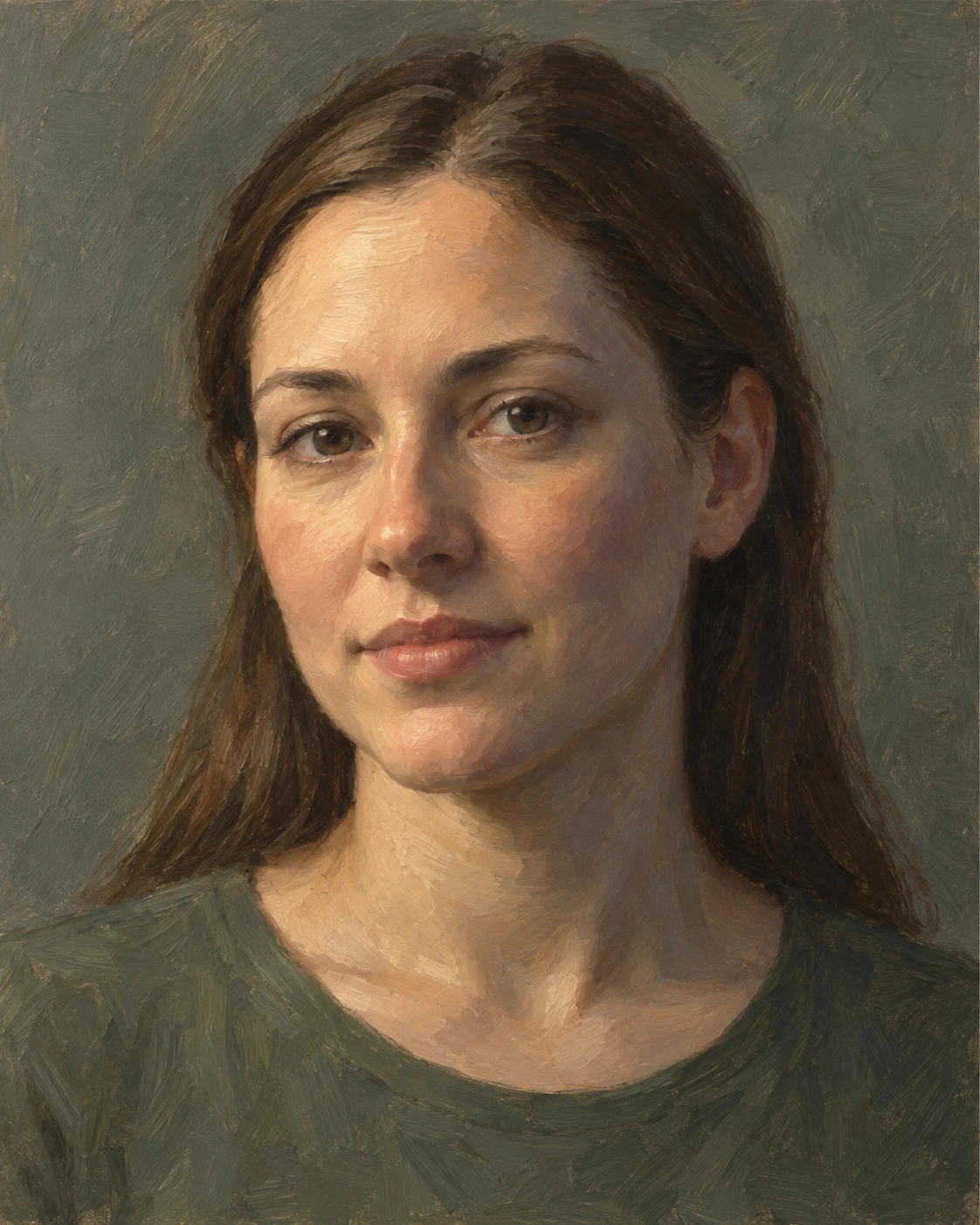
An oil-painted portrait that models facial volume through warm illuminated skin and cool shadow planes.
Adult with Tucked Hair · Warm–Cool Skin Planes
- Shape & line
- Build the head with connected, softly edged planes: a broad forehead, rounded cheek masses, a projecting nose, and a tapering jaw. Describe the eyes and closed mouth with a few controlled dark strokes, letting adjacent painted values define most facial boundaries.
- Color & light
- Place a broad warm key light above image-left. Paint the image-left forehead, cheek, and nose-facing plane in light peach and muted ochre; shift the image-right cheek and jaw into darker, muted lavender-gray. Carry intermediate rose tones around curved transitions so the warm and cool regions describe continuous volume rather than a straight color divide.
- Texture & material
- Use opaque oil-paint strokes that follow the forehead’s arc and the cheeks’ rounded surfaces. Keep slight bristle traces in the larger skin planes, soften their joins with restrained blending, and group the hair into broad painted locks so its texture remains quieter than the face’s color transitions.
- Composition
- Set the head slightly above the frame’s center against a flat, muted gray-green background. Keep the shirt and background close in value, and reserve the clearest warm–cool contrast and most defined edges for the central face so attention settles on the cheeks, nose, and eyes.
Priority
Prioritize continuous facial volume created by warm light planes and cooler, darker shadow planes.
What to avoid & what to check
Avoid saturated blue shadows, a hard color split, and uniformly peach-colored skin.
Check that the image-left skin is warmer and lighter, while the image-right skin is cooler and darker with curved transitions between them.
Exact prompt for this example
SUBJECT
One adult with straight brown hair tucked behind both ears, wearing a plain muted green shirt, with a relaxed expression and closed lips.

COMPOSITION
An eye-level, head-and-shoulders portrait in a vertical frame. The face is almost frontal, with a slight turn toward image-left; both eyes and both cheeks remain clearly visible. Leave comfortable space above the hair and crop below the collarbones.

STYLE GUIDE
1. Shape & line
Build the head with connected, softly edged planes: a broad forehead, rounded cheek masses, a projecting nose, and a tapering jaw. Describe the eyes and closed mouth with a few controlled dark strokes, letting adjacent painted values define most facial boundaries.

2. Color & light
Place a broad warm key light above image-left. Paint the image-left forehead, cheek, and nose-facing plane in light peach and muted ochre; shift the image-right cheek and jaw into darker, muted lavender-gray. Carry intermediate rose tones around curved transitions so the warm and cool regions describe continuous volume rather than a straight color divide.

3. Texture & material
Use opaque oil-paint strokes that follow the forehead’s arc and the cheeks’ rounded surfaces. Keep slight bristle traces in the larger skin planes, soften their joins with restrained blending, and group the hair into broad painted locks so its texture remains quieter than the face’s color transitions.

4. Composition
Set the head slightly above the frame’s center against a flat, muted gray-green background. Keep the shirt and background close in value, and reserve the clearest warm–cool contrast and most defined edges for the central face so attention settles on the cheeks, nose, and eyes.

PRIORITY
Preserve the requested identity, count, action, composition and output settings. Apply the style rules within those constraints; a style reference must not replace the subject or layout. Within the style: Prioritize continuous facial volume created by warm light planes and cooler, darker shadow planes.

AVOID
Avoid saturated blue shadows, a hard color split, and uniformly peach-colored skin.

OUTPUT
One finished oil-painted portrait, 4:5 aspect ratio, with no lettering, signature, watermark, or surrounding layout.

SELF-CHECK
Check that the image-left skin is warmer and lighter, while the image-right skin is cooler and darker with curved transitions between them.
Model information comes from image provenance. The same prompt may produce a different result.