Text to imageLandscapeStyle guide
Birch on a Plain · Counterchange
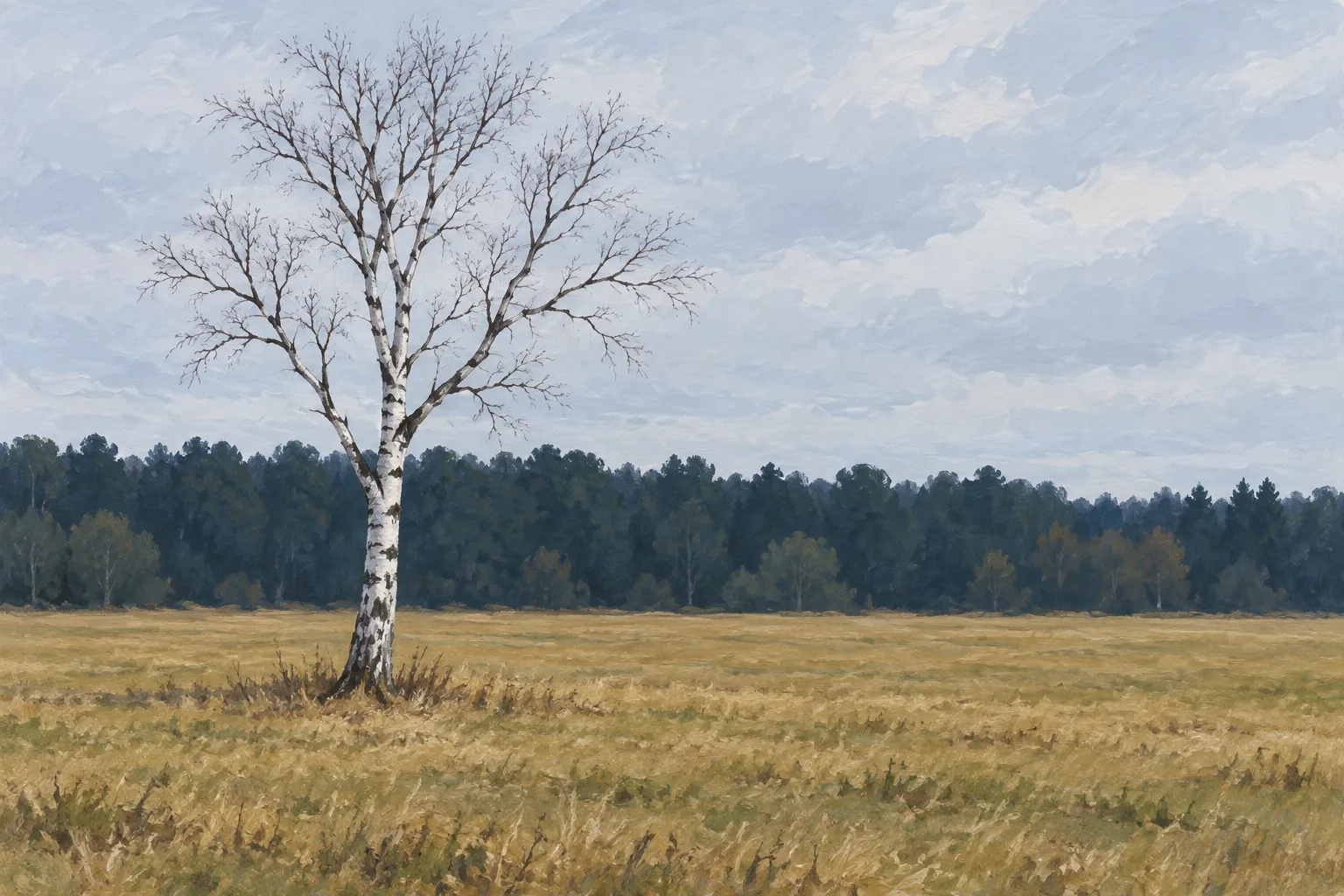
A landscape that reveals one tree through counterchange: its pale trunk stands against dark woodland, while its dark branches spread against a bright sky.
Birch on a Plain · Counterchange
- Shape & line
- Build the birch from a tapering pale trunk and a few irregular, dark branching forks; keep its contour crisp against the background, and simplify the distant woodland into a continuous low silhouette with only broad treetop variations.
- Color & light
- Use a pale gray-blue sky, deep blue-green woodland, and muted ochre grass under soft overcast light. Make the trunk visibly lighter than the woodland behind it and the upper branches visibly darker than the sky; preserve both contrasts without outlining the tree.
- Texture & material
- Apply matte, opaque gouache in broad overlapping strokes. Add sparse broken charcoal marks to the pale bark and a few dry-brush grass strokes near the tree's base, while keeping the sky and distant woodland largely smooth so texture does not interrupt the counterchange.
- Composition
- Keep the pale main trunk entirely in front of the dark woodland from its base to the woodland's upper edge, and place the main dark branch forks above that edge against open sky. Leave clear sky gaps between the larger forks so the switch from light-on-dark to dark-on-light reads at thumbnail size.
Priority
Prioritize the visible reversal of tree-to-background value contrast.
What to avoid & what to check
Avoid bright halos, contour outlines, and background detail that competes with the birch.
At thumbnail size, confirm that the pale trunk reads against the dark woodland and the dark forks read against the pale sky.
Exact prompt for this example
SUBJECT
One leafless birch tree on an open grassy plain, with one continuous distant woodland band behind it. The pale main trunk overlaps the dark woodland, and the dark upper branches extend above that band into the bright sky.

COMPOSITION
Use a wide, eye-level landscape view. Place the birch slightly left of center, showing its entire crown and its rooted base. Set the woodland's upper boundary below the crown's main branching junction, leaving open sky around the upper branches and generous empty field on image-right.

STYLE GUIDE
1. Shape & line
Build the birch from a tapering pale trunk and a few irregular, dark branching forks; keep its contour crisp against the background, and simplify the distant woodland into a continuous low silhouette with only broad treetop variations.

2. Color & light
Use a pale gray-blue sky, deep blue-green woodland, and muted ochre grass under soft overcast light. Make the trunk visibly lighter than the woodland behind it and the upper branches visibly darker than the sky; preserve both contrasts without outlining the tree.

3. Texture & material
Apply matte, opaque gouache in broad overlapping strokes. Add sparse broken charcoal marks to the pale bark and a few dry-brush grass strokes near the tree's base, while keeping the sky and distant woodland largely smooth so texture does not interrupt the counterchange.

4. Composition
Keep the pale main trunk entirely in front of the dark woodland from its base to the woodland's upper edge, and place the main dark branch forks above that edge against open sky. Leave clear sky gaps between the larger forks so the switch from light-on-dark to dark-on-light reads at thumbnail size.

PRIORITY
Preserve the requested identity, count, action, composition and output settings. Apply the style rules within those constraints; a style reference must not replace the subject or layout. Within the style: Prioritize the visible reversal of tree-to-background value contrast.

AVOID
Avoid bright halos, contour outlines, and background detail that competes with the birch.

OUTPUT
Create one landscape image in a 3:2 aspect ratio, rendered as an opaque gouache painting. Include no text, lettering, labels, borders, or watermark.

SELF-CHECK
At thumbnail size, confirm that the pale trunk reads against the dark woodland and the dark forks read against the pale sky.
Model information comes from image provenance. The same prompt may produce a different result.