Text to imageIllustrationStyle guide
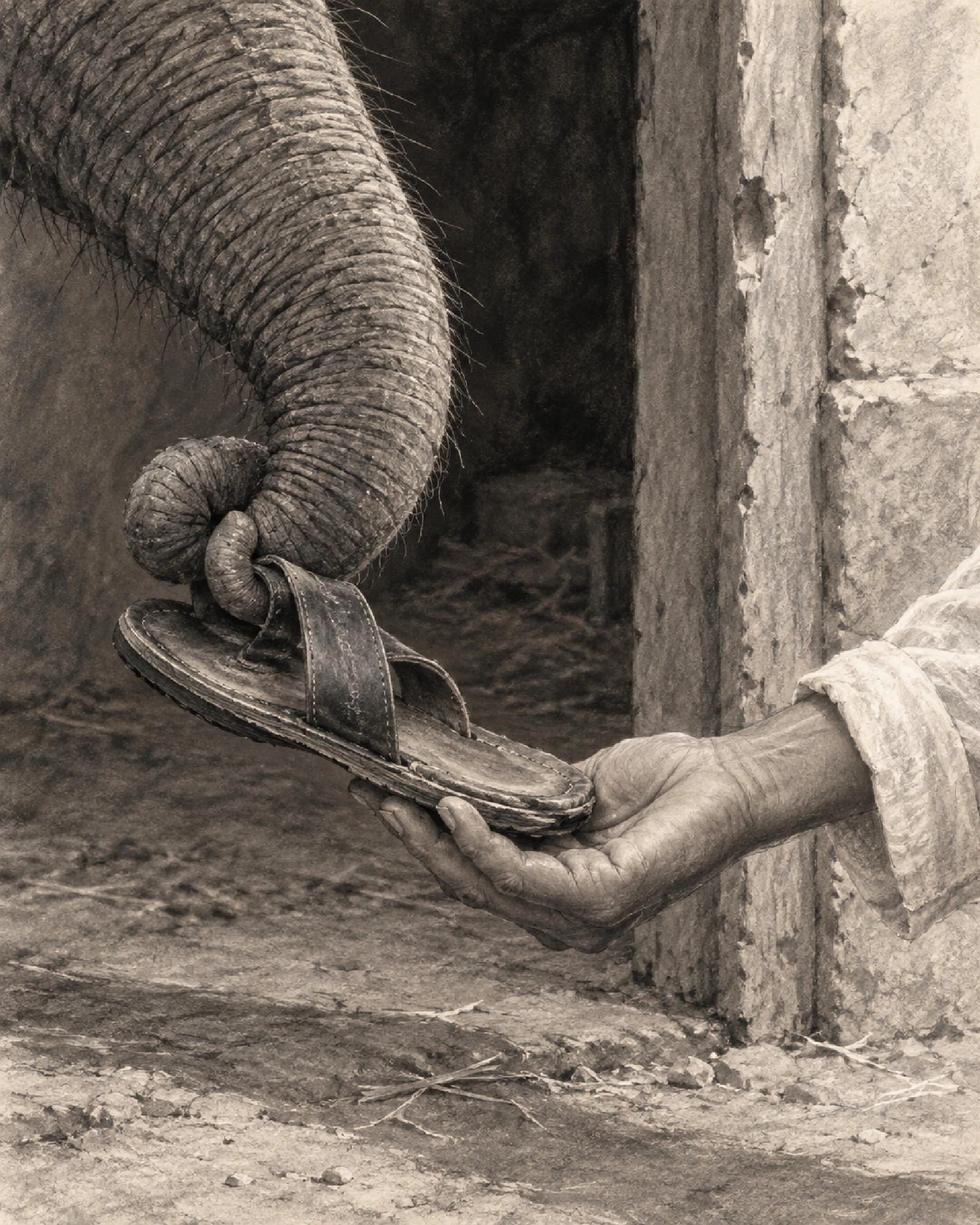
A Sandal in an Elephant’s Trunk
An intimate view of an elephant returning a worn sandal to a waiting hand. Smudged charcoal and erased light give weight and tenderness to the careful exchange.
Remix this referenceA Sandal in an Elephant’s Trunk
- Form language
- Build observed forms from broad, uneven masses; simplify small detail while retaining telling changes in weight and curvature.
- Contour
- Use broken charcoal edges that swell with pressure, briefly sharpen at junctions and dissolve into adjacent tone.
- Mark-making
- Sweep the charcoal’s broad side across the paper, interrupting rubbed passages with sparse wiry strokes; allow natural variation.
- Surface rendering
- Smudge powder into soft half-tones, then lift light with a kneaded eraser; retain paper tooth and imperfect tonal transitions.
Priority
Make observational charcoal visibly shaped by smudging and erased light.
What to avoid & what to check
Exact prompt for this example
MODULE OWNERSHIP
subject: Subject count, type, stable proportions and landmarks, resting face geometry, hair shape, physical materials, garment construction and permanent marks. No emotion, movement, color assignment or rendering recipe.
expression: Facial soft-tissue displacement and pupil direction, muscle coordination, regional intensity, asymmetry and onset/peak/release. No head/body pose, stable appearance, skin color or rendering.
gesture: Head/neck/body/limb orientation, joint movement, support, contact and pose-caused occlusion using existing anatomy. No eye/pupil movement, emotion, identity, props inventory or camera.
props: Prop count, type, construction, physical material and scale relative to the subject. Holding/contact belongs to gesture, position to composition, color to palette.
scene: Environment elements, terrain, backdrop/floor presence and structural detail. No canvas positions, camera, lighting, assigned colors or render texture.
camera: Projection, focal-length impression, camera elevation/yaw/roll, viewing distance and crop. No actor pose, world placement, lighting or canvas aspect ratio.
composition: Normalized 0-100% canvas positions, scale in frame, depth/overlap, focal hierarchy and margins. No joint pose, camera projection, rendering, subject/prop inventory or emotion.
palette: Color anchors, hue/saturation/value ranges, colors assigned to parts and approximate color coverage. No illumination direction, shading algorithm, physical material or layout.
lighting: Light-source direction/softness/intensity, ambient illumination, physical shadow direction/length and highlight position. Absence of directional illumination is allowed. No shading technique, palette or material changes.
style: Reusable form abstraction, contour weight/taper/edge quality, medium and mark scale/density/direction, surface rendering and tonal transition technique. No fixed subject proportions, anatomy, identity, expression, pose, palette, light-source direction, camera or layout.
output: Image count, aspect ratio, size, file/alpha requirements and global lettering/logo/watermark restrictions. No background scenery, crop, style, identity or pose.

SUBJECT
inventory: One adult elephant and one adult human.
geometry: The elephant has a heavy tapering trunk with two small tip lobes; the human has broad hand knuckles.
resting-face: No resting facial geometry is prescribed for this anatomical detail.
appearance: Deep skin folds and sparse bristles distinguish the elephant; the human wears a loose linen sleeve with a turned cuff.

PRIORITY


AVOID


CHECK


GESTURE
head: The elephant bends its trunk downward into a loose hook; no further head or neck action is prescribed.
torso: No torso action is prescribed.
limbs: The human extends a forearm, palm upward, with fingers gently cupped beneath the sandal.
contact: The trunk tip hooks through the strap as the human fingertips begin supporting the heel of the sole.

PRIORITY


AVOID


CHECK


PROPS
inventory: One worn adult sandal, small beside the trunk and naturally sized for the human hand.
construction: Supple leather, a broad instep strap and a layered sole with softened, uneven edges.

PRIORITY


AVOID


CHECK


SCENE
inventory: A stable threshold with a rough doorway jamb and a little compacted earth.
structure: The doorway opens into an undetailed interior; shallow chips interrupt the jamb’s vertical surface.

PRIORITY


AVOID


CHECK


CAMERA
projection: Natural perspective with a short-telephoto impression and little near-to-far exaggeration.
viewpoint: A close side view, slightly above palm level, with no camera roll.
crop: Cut through the trunk above its bend and through the forearm; both faces and torsos remain outside the frame.

PRIORITY


AVOID


CHECK


COMPOSITION
placement: The trunk enters upper left and the forearm lower right; the exchange rests just below the canvas center.
depth: The sandal bridges overlapping trunk and fingertips; the doorway remains a recessed secondary interval.
spacing: The two contact points lead the hierarchy; an open pocket beside the trunk gives the close arrangement breathing room.

PRIORITY


AVOID


CHECK


PALETTE
colors: Warm ivory, soot black and smoky grays form a nearly achromatic range.
assignment: Ivory anchors the ground and sleeve; smoky gray marks the trunk, deep gray the sandal and pale gray the hand.
balance: Middle values occupy most of the image, with concentrated blacks and smaller ivory passages.

PRIORITY


AVOID


CHECK


LIGHTING
sources: Broad daylight enters softly from upper right; weak ambient illumination reaches the stable interior.
shadows: Soft shadows fall lower left, with narrow contact shadows beneath the strap and fingertips.
highlights: Light catches right-facing trunk ridges, upper knuckles and the exposed sole rim.

PRIORITY


AVOID


CHECK


STYLE GUIDE
form-language: Build observed forms from broad, uneven masses; simplify small detail while retaining telling changes in weight and curvature.
contour: Use broken charcoal edges that swell with pressure, briefly sharpen at junctions and dissolve into adjacent tone.
mark-making: Sweep the charcoal’s broad side across the paper, interrupting rubbed passages with sparse wiry strokes; allow natural variation.
surface-rendering: Smudge powder into soft half-tones, then lift light with a kneaded eraser; retain paper tooth and imperfect tonal transitions.

PRIORITY
Make observational charcoal visibly shaped by smudging and erased light.

AVOID


CHECK


OUTPUT
format: One finished illustration, portrait 4:5, 1600 × 2000 pixels, opaque PNG.
restrictions: No lettering, logos, signatures or watermarks.

PRIORITY


AVOID


CHECK


FINAL INTEGRATION
gesture + composition + style: Let contact and overlap keep the exchange legible while exploratory charcoal edges preserve its delicacy.
Model information comes from image provenance. The same prompt may produce a different result.