Text to imageCharacterStyle guide
Porter Turning a Round Window Frame
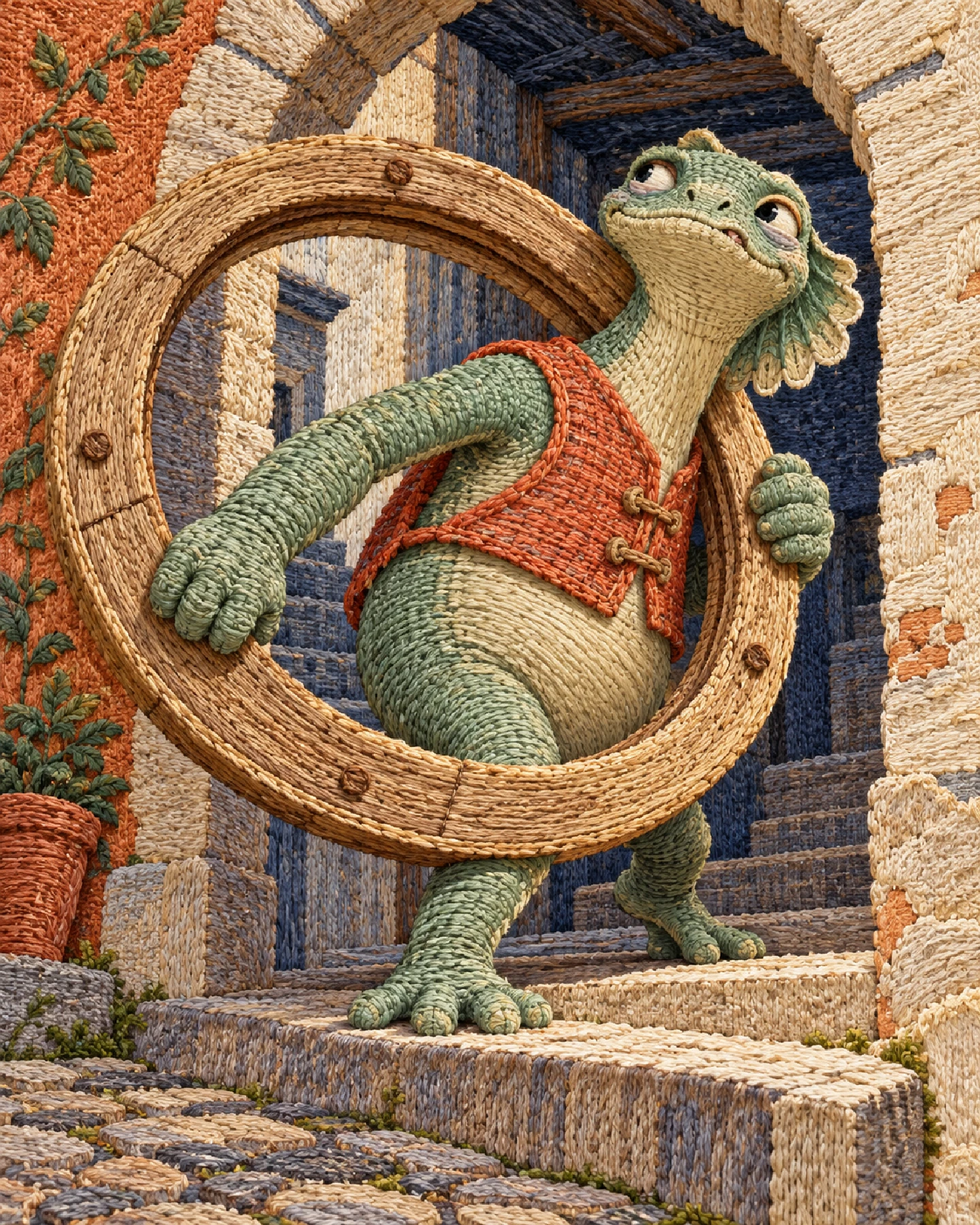
A long-necked amphibian porter tilts a large round window frame through an arched passage. Raised threads and overlapping embroidered fields give the busy moment a tactile presence.
Remix this referencePorter Turning a Round Window Frame
- Form language
- Translate forms into rounded, interlocking textile fields with gently irregular boundaries; incidental details may vary naturally.
- Contour
- Build contours from couched cords with occasional gaps and uneven thickness; let neighboring stitched fields share some edges.
- Mark-making
- Use long directional stitches for broad planes, shorter clustered stitches at turns, and loose thread ends sparingly.
- Surface rendering
- Layer embroidery over a visible woven ground; model volume through stitch direction, thread overlap and gradual density changes.
Priority
The finished illustration must visibly read as raised embroidery, with actual thread relief and a woven ground.
What to avoid & what to check
Exact prompt for this example
MODULE OWNERSHIP
subject: Subject count, type, stable proportions and landmarks, resting face geometry, hair shape, physical materials, garment construction and permanent marks. No emotion, movement, color assignment or rendering recipe.
expression: Facial soft-tissue displacement and pupil direction, muscle coordination, regional intensity, asymmetry and onset/peak/release. No head/body pose, stable appearance, skin color or rendering.
gesture: Head/neck/body/limb orientation, joint movement, support, contact and pose-caused occlusion using existing anatomy. No eye/pupil movement, emotion, identity, props inventory or camera.
props: Prop count, type, construction, physical material and scale relative to the subject. Holding/contact belongs to gesture, position to composition, color to palette.
scene: Environment elements, terrain, backdrop/floor presence and structural detail. No canvas positions, camera, lighting, assigned colors or render texture.
camera: Projection, focal-length impression, camera elevation/yaw/roll, viewing distance and crop. No actor pose, world placement, lighting or canvas aspect ratio.
composition: Normalized 0-100% canvas positions, scale in frame, depth/overlap, focal hierarchy and margins. No joint pose, camera projection, rendering, subject/prop inventory or emotion.
palette: Color anchors, hue/saturation/value ranges, colors assigned to parts and approximate color coverage. No illumination direction, shading algorithm, physical material or layout.
lighting: Light-source direction/softness/intensity, ambient illumination, physical shadow direction/length and highlight position. Absence of directional illumination is allowed. No shading technique, palette or material changes.
style: Reusable form abstraction, contour weight/taper/edge quality, medium and mark scale/density/direction, surface rendering and tonal transition technique. No fixed subject proportions, anatomy, identity, expression, pose, palette, light-source direction, camera or layout.
output: Image count, aspect ratio, size, file/alpha requirements and global lettering/logo/watermark restrictions. No background scenery, crop, style, identity or pose.

SUBJECT
inventory: One original amphibian porter, designated A; no other characters.
geometry: A has a small blunt head on a long neck, a pear-shaped trunk, stout arms, broad hands and flat spreading feet.
resting-face: Widely spaced lidded eyes, low brow pads, paired nostril slits and a wide horizontal mouth define the face.
appearance: Supple leathery skin and a scalloped nape fin accompany a woven vest with open sides and a simple front fastening.

PRIORITY


AVOID


CHECK


EXPRESSION — ACTOR A
brows: Brow pads draw inward, with one held slightly higher.
lids: The upper lids narrow while the lower lids brace lightly.
cheeks: One cheek gathers slightly toward the compressed mouth corner.
nose: The nostril slits remain relaxed without flaring.
mouth: The lips press together, with one corner tucked inward.
jaw: The jaw stays closed without a heavy clench.
gaze: Both pupils look up and left toward the narrow clearance above the frame.
coordination: The unequal brows and compressed mouth create concentrated effort without alarm.
timing: Hold the apex of concentration at the tightest point of passage.

PRIORITY


AVOID


CHECK


GESTURE
head: The neck curves sideways and the head tips clear of the upper rim.
torso: The torso twists through the doorway while leaning back against the frame's weight.
limbs: Bent arms turn the frame obliquely; one foot plants on the threshold while the trailing heel lifts.
contact: Both hands grip opposing rim sections; the near hand wraps over the edge and the rim obscures part of the belly.

PRIORITY


AVOID


CHECK


PROPS
inventory: One empty circular window frame, wider than A's torso and nearly as tall as the body below the neck.
construction: A substantial timber ring with a recessed inner lip and a few exposed joining pegs; no glazing.

PRIORITY


AVOID


CHECK


SCENE
inventory: A stepped neighborhood passage with a stone arch, plaster walls, a raised threshold and a cobbled landing.
structure: The narrow arch joins two uneven wall planes; shallow steps continue through it into a covered corridor.

PRIORITY


AVOID


CHECK


CAMERA
projection: Moderately wide perspective with clear depth and little edge distortion.
viewpoint: View from just below chest height, obliquely across the doorway, with no roll.
crop: Full-figure view including the feet, the complete circular frame and a cropped section of the surrounding architecture.

PRIORITY


AVOID


CHECK


COMPOSITION
placement: Set A's face near 64% across and 25% down; the large ring sweeps across the middle toward the left.
depth: The face leads, the circular opening follows, and the arch encloses the deeper corridor behind the foreground frame.
spacing: Use tight overlaps around the ring and arch, balanced by a quieter wall interval beside the head.

PRIORITY


AVOID


CHECK


PALETTE
colors: Celadon, paprika coral, oat cream and deep indigo form a compact, expressive palette.
assignment: Celadon belongs to A's skin, coral to the vest, oat to timber and plaster, and indigo to the corridor and deep accents.
balance: Oat and indigo establish broad value contrasts; the smaller coral area gives the celadon figure a lively counterpoint.

PRIORITY


AVOID


CHECK


LIGHTING
sources: A broad soft source from the upper right illuminates the scene and reveals the raised thread relief.
shadows: Forms cast soft shadows down and left; raised threads produce small attached shadows in the same direction.
highlights: Subtle highlights catch upper-right thread ridges and the exposed rim.

PRIORITY


AVOID


CHECK


STYLE GUIDE
form-language: Translate forms into rounded, interlocking textile fields with gently irregular boundaries; incidental details may vary naturally.
contour: Build contours from couched cords with occasional gaps and uneven thickness; let neighboring stitched fields share some edges.
mark-making: Use long directional stitches for broad planes, shorter clustered stitches at turns, and loose thread ends sparingly.
surface-rendering: Layer embroidery over a visible woven ground; model volume through stitch direction, thread overlap and gradual density changes.

PRIORITY
The finished illustration must visibly read as raised embroidery, with actual thread relief and a woven ground.

AVOID


CHECK


OUTPUT
format: One finished image, portrait 4:5, 1440 × 1800 pixels, opaque PNG.
restrictions: No lettering, logos or watermarks.

PRIORITY


AVOID


CHECK
Model information comes from image provenance. The same prompt may produce a different result.