Text to imageCharacterStyle guide
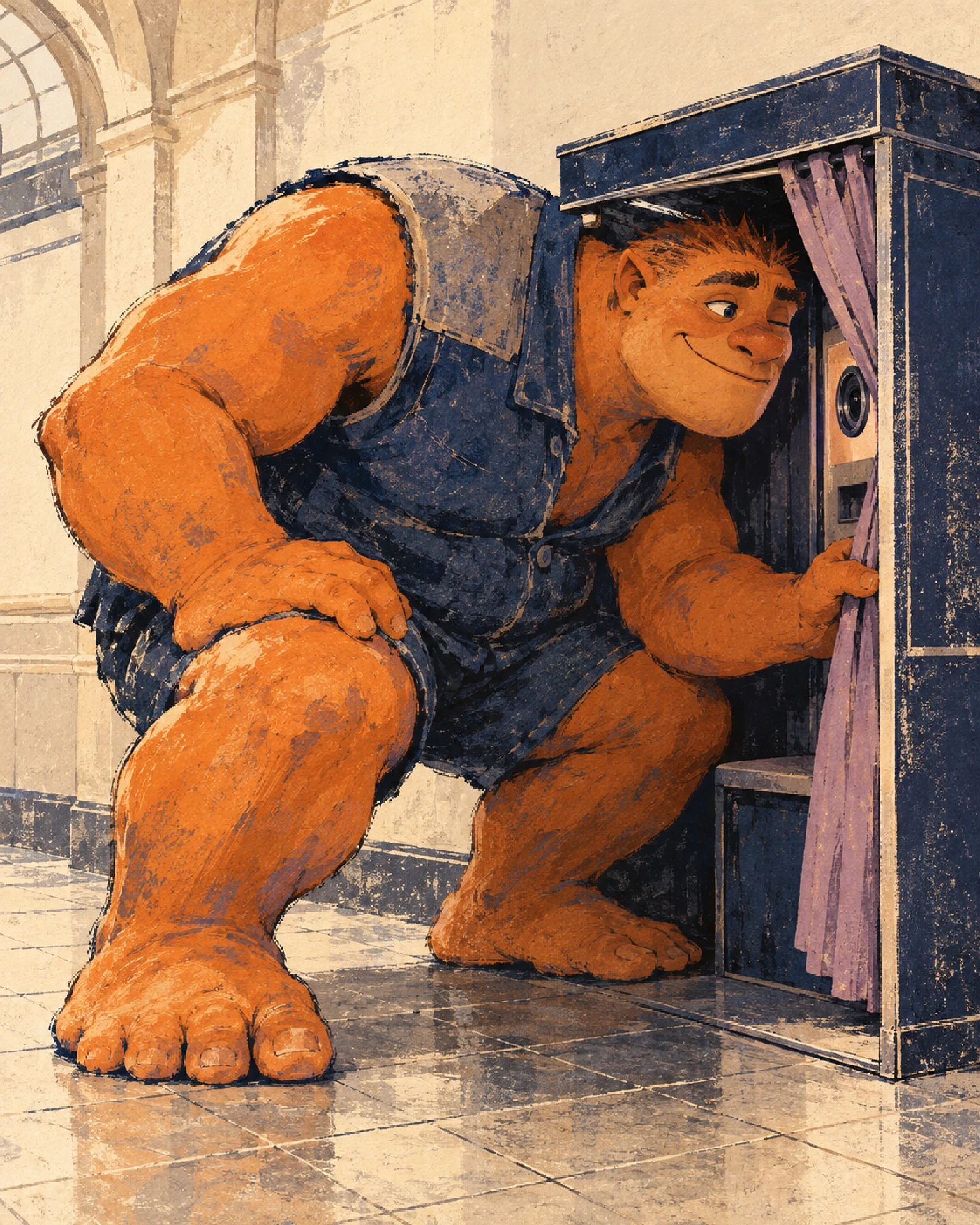
A Giant Folding into a Photo Booth
An enormous visitor crouches to fit their face into a small photo booth. Bleeding ink contours and displaced print shapes give the cramped moment a gentle humor.
Remix this referenceA Giant Folding into a Photo Booth
- Form language
- Simplify forms into weighty bent masses and blunt architectural cuts; retain irregularities that make the drawing feel discovered.
- Contour
- Use swelling brush-ink contours that break into dry skips, with occasional thin exploratory lines surviving beside them.
- Mark-making
- Combine broad ink sweeps with dragged roller streaks and a few scratched interruptions; let pressure and mark length vary naturally.
- Surface rendering
- Build tone from translucent print overlaps, uneven ink deposits and rubbed paper openings; allow slight registration drift at selected edges.
Priority
Make the experimental ink-and-print process visible through the interaction of brush contours and imperfect printed masses.
What to avoid & what to check
Exact prompt for this example
MODULE OWNERSHIP
subject: Subject count, type, stable proportions and landmarks, resting face geometry, hair shape, physical materials, garment construction and permanent marks. No emotion, movement, color assignment or rendering recipe.
expression: Facial soft-tissue displacement and pupil direction, muscle coordination, regional intensity, asymmetry and onset/peak/release. No head/body pose, stable appearance, skin color or rendering.
gesture: Head/neck/body/limb orientation, joint movement, support, contact and pose-caused occlusion using existing anatomy. No eye/pupil movement, emotion, identity, props inventory or camera.
props: Prop count, type, construction, physical material and scale relative to the subject. Holding/contact belongs to gesture, position to composition, color to palette.
scene: Environment elements, terrain, backdrop/floor presence and structural detail. No canvas positions, camera, lighting, assigned colors or render texture.
camera: Projection, focal-length impression, camera elevation/yaw/roll, viewing distance and crop. No actor pose, world placement, lighting or canvas aspect ratio.
composition: Normalized 0-100% canvas positions, scale in frame, depth/overlap, focal hierarchy and margins. No joint pose, camera projection, rendering, subject/prop inventory or emotion.
palette: Color anchors, hue/saturation/value ranges, colors assigned to parts and approximate color coverage. No illumination direction, shading algorithm, physical material or layout.
lighting: Light-source direction/softness/intensity, ambient illumination, physical shadow direction/length and highlight position. Absence of directional illumination is allowed. No shading technique, palette or material changes.
style: Reusable form abstraction, contour weight/taper/edge quality, medium and mark scale/density/direction, surface rendering and tonal transition technique. No fixed subject proportions, anatomy, identity, expression, pose, palette, light-source direction, camera or layout.
output: Image count, aspect ratio, size, file/alpha requirements and global lettering/logo/watermark restrictions. No background scenery, crop, style, identity or pose.

SUBJECT
inventory: One original giant humanoid visitor, actor A; no other figures.
geometry: A broad wedge-shaped head, pear-shaped trunk, long forearms and substantial feet establish a heavy, supple build.
resting-face: Wide-set eyes sit beneath a continuous brow shelf; a low blunt nose and broad mouth occupy the shallow muzzle.
appearance: Smooth hide, a short bristled crown and a sleeveless canvas vest with a shoulder yoke; minor wear may vary.

PRIORITY


AVOID


CHECK


EXPRESSION — ACTOR A
brows: One brow lifts slightly while the other stays relaxed.
lids: Lower lids rise gently; the eyes remain clearly open.
cheeks: One cheek gathers upward before the other.
nose: Nostrils remain relaxed without a nose wrinkle.
mouth: A closed smile begins at one corner, with a soft lower lip.
jaw: The jaw stays loose with no visible mouth opening.
gaze: Both pupils turn toward the booth's inset lens.
coordination: The cheek lift and mouth corner lead; brow and lids respond more quietly.
timing: Catch the onset of a private chuckle, before the smile spreads.

PRIORITY


AVOID


CHECK


GESTURE
head: A ducks the head beneath the booth lintel and turns the face toward the inner side wall.
torso: The torso folds deeply forward from a low crouch, compressing the vest across the belly.
limbs: Both knees spread outside the entrance; one arm reaches to the curtain while the other braces on a thigh.
contact: Both feet bear weight on the floor; one hand bunches the curtain aside, leaving the face unobstructed.

PRIORITY


AVOID


CHECK


PROPS
inventory: No separate props.
construction: No prop construction applies.

PRIORITY


AVOID


CHECK


SCENE
inventory: A conventional photo booth in a railway-station alcove, with a tiled floor and a plain plaster wall.
structure: The booth has a shallow roof, a curtained entrance, a short fixed seat and a circular lens inset in its inner side wall.

PRIORITY


AVOID


CHECK


CAMERA
projection: Moderate wide-angle perspective with restrained edge stretching.
viewpoint: Look obliquely through the entrance from slightly above seat height, with a level horizon and no roll.
crop: A full-figure environmental view retains both feet, the booth roof and enough surrounding floor to explain the encounter.

PRIORITY


AVOID


CHECK


COMPOSITION
placement: The giant occupies a diagonal band from the lower left toward the booth at right; the face is the primary focal point.
depth: The nearer knee overlaps the entrance edge; the face sits between the curtain and the recessed inner wall.
spacing: The booth occupies markedly less of the frame than the visitor; leave generous open wall above the visitor.

PRIORITY


AVOID


CHECK


PALETTE
colors: Use warm paper cream, smoky indigo, burnt orange and a restrained dusty lilac.
assignment: Assign orange to the hide, indigo to the vest and booth shell, lilac to the curtain, and cream to the station surfaces.
balance: Let cream occupy the broadest area, with concentrated indigo masses and a warm orange interruption.

PRIORITY


AVOID


CHECK


LIGHTING
sources: Broad soft station light enters from the upper left; weak ambient light reaches inside the booth.
shadows: A short diffuse shadow falls rightward beneath the figure; the booth recess stays substantially darker.
highlights: Broad subdued highlights touch the upper brow, shoulder and nearer knee.

PRIORITY


AVOID


CHECK


STYLE GUIDE
form-language: Simplify forms into weighty bent masses and blunt architectural cuts; retain irregularities that make the drawing feel discovered.
contour: Use swelling brush-ink contours that break into dry skips, with occasional thin exploratory lines surviving beside them.
mark-making: Combine broad ink sweeps with dragged roller streaks and a few scratched interruptions; let pressure and mark length vary naturally.
surface-rendering: Build tone from translucent print overlaps, uneven ink deposits and rubbed paper openings; allow slight registration drift at selected edges.

PRIORITY
Make the experimental ink-and-print process visible through the interaction of brush contours and imperfect printed masses.

AVOID


CHECK


OUTPUT
format: One finished illustration, portrait 4:5, 1536 × 1920 pixels, opaque PNG.
restrictions: No lettering, logos or watermarks.

PRIORITY


AVOID


CHECK


FINAL INTEGRATION
subject + gesture + scene + composition: Let the visitor's compressed silhouette and the familiar booth architecture establish the scale surprise together.
expression + lighting + style: Keep the small facial changes legible through the ink variation and recessed light.
Model information comes from image provenance. The same prompt may produce a different result.