Text to imageCharacterStyle guide
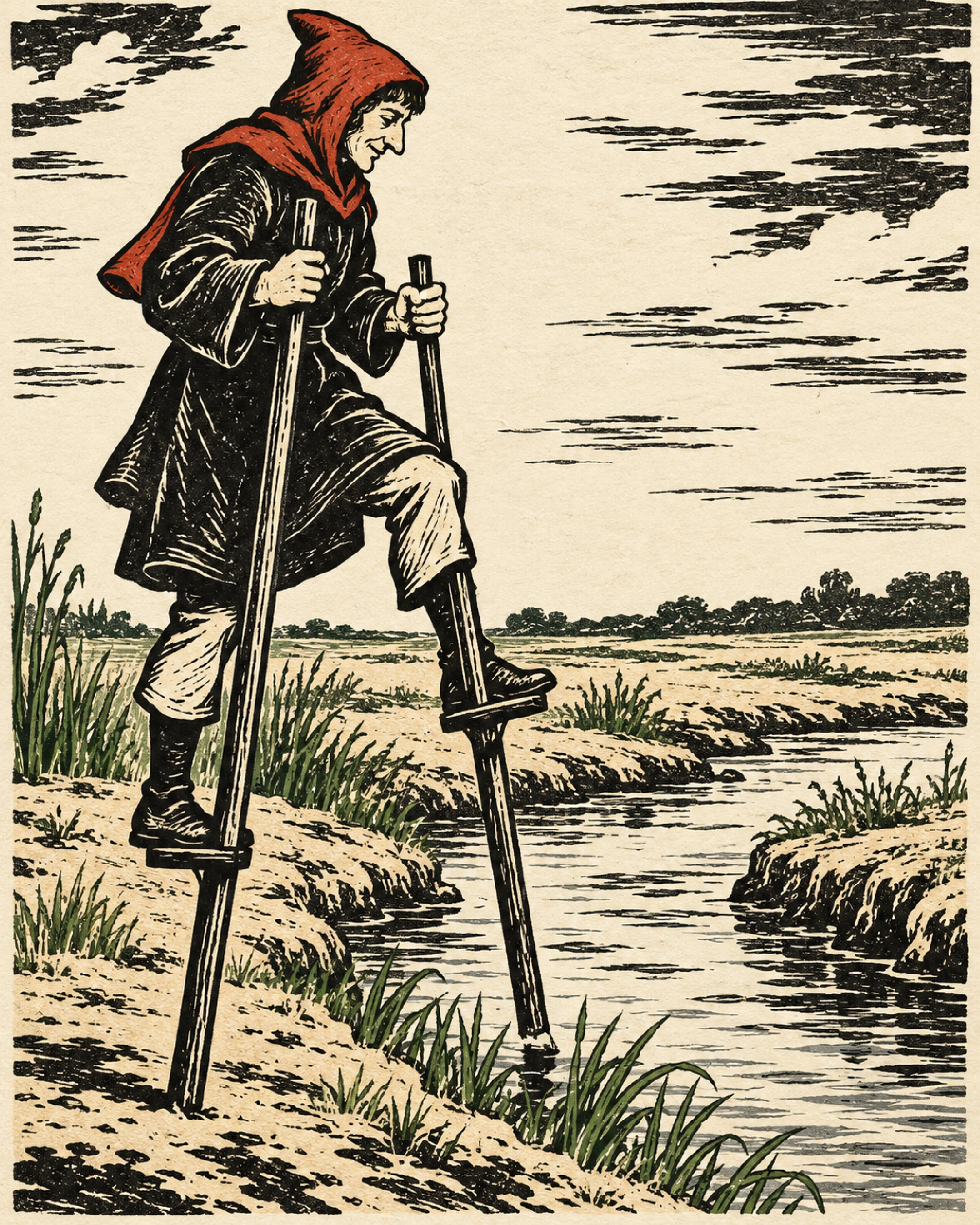
Stilt Walker Over the Creek
A walker in an oversized hood crosses a reedy creek on stilts. Bold linocut marks and generous open space frame the character’s long, peculiar silhouette.
Remix this referenceStilt Walker Over the Creek
- Form language
- Reduce forms into interlocking wedges and bowed masses, retaining small irregularities that make each shape feel cut by hand.
- Contour
- Use heavy, slightly bitten outer edges; let selected interior boundaries disappear into solid inked masses.
- Mark-making
- Carve rhythmic hooked cuts and long tapered gouges; vary their spacing and endings naturally rather than repeating a pattern.
- Surface rendering
- Build tones through reserved cuts within dense ink; allow occasional uneven transfer and slight overlap between printed layers.
Priority
Make the bold linocut character visible through decisive ink masses and rhythmic carved marks.
What to avoid & what to check
Exact prompt for this example
MODULE OWNERSHIP
subject: Subject count, type, stable proportions and landmarks, resting face geometry, hair shape, physical materials, garment construction and permanent marks. No emotion, movement, color assignment or rendering recipe.
expression: Facial soft-tissue displacement and pupil direction, muscle coordination, regional intensity, asymmetry and onset/peak/release. No head/body pose, stable appearance, skin color or rendering.
gesture: Head/neck/body/limb orientation, joint movement, support, contact and pose-caused occlusion using existing anatomy. No eye/pupil movement, emotion, identity, props inventory or camera.
props: Prop count, type, construction, physical material and scale relative to the subject. Holding/contact belongs to gesture, position to composition, color to palette.
scene: Environment elements, terrain, backdrop/floor presence and structural detail. No canvas positions, camera, lighting, assigned colors or render texture.
camera: Projection, focal-length impression, camera elevation/yaw/roll, viewing distance and crop. No actor pose, world placement, lighting or canvas aspect ratio.
composition: Normalized 0-100% canvas positions, scale in frame, depth/overlap, focal hierarchy and margins. No joint pose, camera projection, rendering, subject/prop inventory or emotion.
palette: Color anchors, hue/saturation/value ranges, colors assigned to parts and approximate color coverage. No illumination direction, shading algorithm, physical material or layout.
lighting: Light-source direction/softness/intensity, ambient illumination, physical shadow direction/length and highlight position. Absence of directional illumination is allowed. No shading technique, palette or material changes.
style: Reusable form abstraction, contour weight/taper/edge quality, medium and mark scale/density/direction, surface rendering and tonal transition technique. No fixed subject proportions, anatomy, identity, expression, pose, palette, light-source direction, camera or layout.
output: Image count, aspect ratio, size, file/alpha requirements and global lettering/logo/watermark restrictions. No background scenery, crop, style, identity or pose.

SUBJECT
inventory: One original adult human stilt walker, actor A.
geometry: A compact torso, long forearms and broad hands give the walker a sturdy, recognizable build.
resting-face: A long hooked nose, broad brow and short rounded chin define the resting face.
appearance: A thick wool coat has a large pointed hood, a short rear flap and broad cuffs; a blunt fringe remains visible.

PRIORITY


AVOID


CHECK


EXPRESSION — ACTOR A
brows: The brows settle into relaxed, shallow arches.
lids: The upper lids rest low without squeezing shut.
cheeks: A small cheek lift remains beneath each eye.
nose: The nostrils remain relaxed and unflared.
mouth: Closed lips retain a slight smile, stronger at one corner.
jaw: The jaw relaxes without dropping open.
gaze: The pupils look downward toward the next foothold.
coordination: Keep the cheeks and mouth gently engaged while the upper face relaxes.
timing: Catch the release of a smile, with only its last small lift remaining.

PRIORITY


AVOID


CHECK


GESTURE
head: The neck reaches slightly forward and the chin dips toward the crossing.
torso: The torso inclines forward over the supporting stilt.
limbs: One knee rises with the advancing stilt; the other leg stays extended, and both elbows remain softly bent.
contact: Each hand grips its stilt shaft and each foot rests on a platform; only the supporting tip touches the bank.

PRIORITY


AVOID


CHECK


PROPS
inventory: Two wooden walking stilts, each extending well beyond the walker’s natural leg length.
construction: Each stilt is a straight timber shaft with a projecting foot platform and a blunt ground tip.

PRIORITY


AVOID


CHECK


SCENE
inventory: A narrow creek, low earthen banks, sparse reeds and open sky.
structure: The banks break into shallow shelves, with isolated reed clumps marking the water’s edge.

PRIORITY


AVOID


CHECK


CAMERA
projection: Use a near-orthographic view with little perspective convergence.
viewpoint: View from slightly above in a three-quarter side view, with no camera roll.
crop: Show the entire walker and both complete stilts with surrounding landscape.

PRIORITY


AVOID


CHECK


COMPOSITION
placement: The walker occupies the left third and most of the image height; the creek opens broadly to the right.
depth: Let the nearer stilt overlap the coat; small banks and reeds establish a shallow landscape behind.
spacing: Read the hood first, the long stilt rhythm second; preserve a broad uninterrupted gap beside the figure.

PRIORITY


AVOID


CHECK


PALETTE
colors: Use soot black, warm ivory, vermilion and muted reed green.
assignment: Assign vermilion to the hood, black to the coat and stilts, green to reeds, and ivory to skin and open areas.
balance: Ivory and black dominate; vermilion provides one concentrated accent and green stays sparse.

PRIORITY


AVOID


CHECK


LIGHTING
sources: Broad daylight arrives softly from the upper left with generous ambient illumination.
shadows: A short, soft ground shadow falls to the lower right beneath the supporting tip.
highlights: Keep exposed forehead and nose planes gently brighter, without sharp glints.

PRIORITY


AVOID


CHECK


STYLE GUIDE
form-language: Reduce forms into interlocking wedges and bowed masses, retaining small irregularities that make each shape feel cut by hand.
contour: Use heavy, slightly bitten outer edges; let selected interior boundaries disappear into solid inked masses.
mark-making: Carve rhythmic hooked cuts and long tapered gouges; vary their spacing and endings naturally rather than repeating a pattern.
surface-rendering: Build tones through reserved cuts within dense ink; allow occasional uneven transfer and slight overlap between printed layers.

PRIORITY
Make the bold linocut character visible through decisive ink masses and rhythmic carved marks.

AVOID


CHECK


OUTPUT
format: One finished image, 4:5 aspect ratio, 2048 × 2560 pixels, opaque PNG.
restrictions: No lettering, logos or watermarks.

PRIORITY


AVOID


CHECK
Model information comes from image provenance. The same prompt may produce a different result.