Text to imageSpace & architectureStyle guide
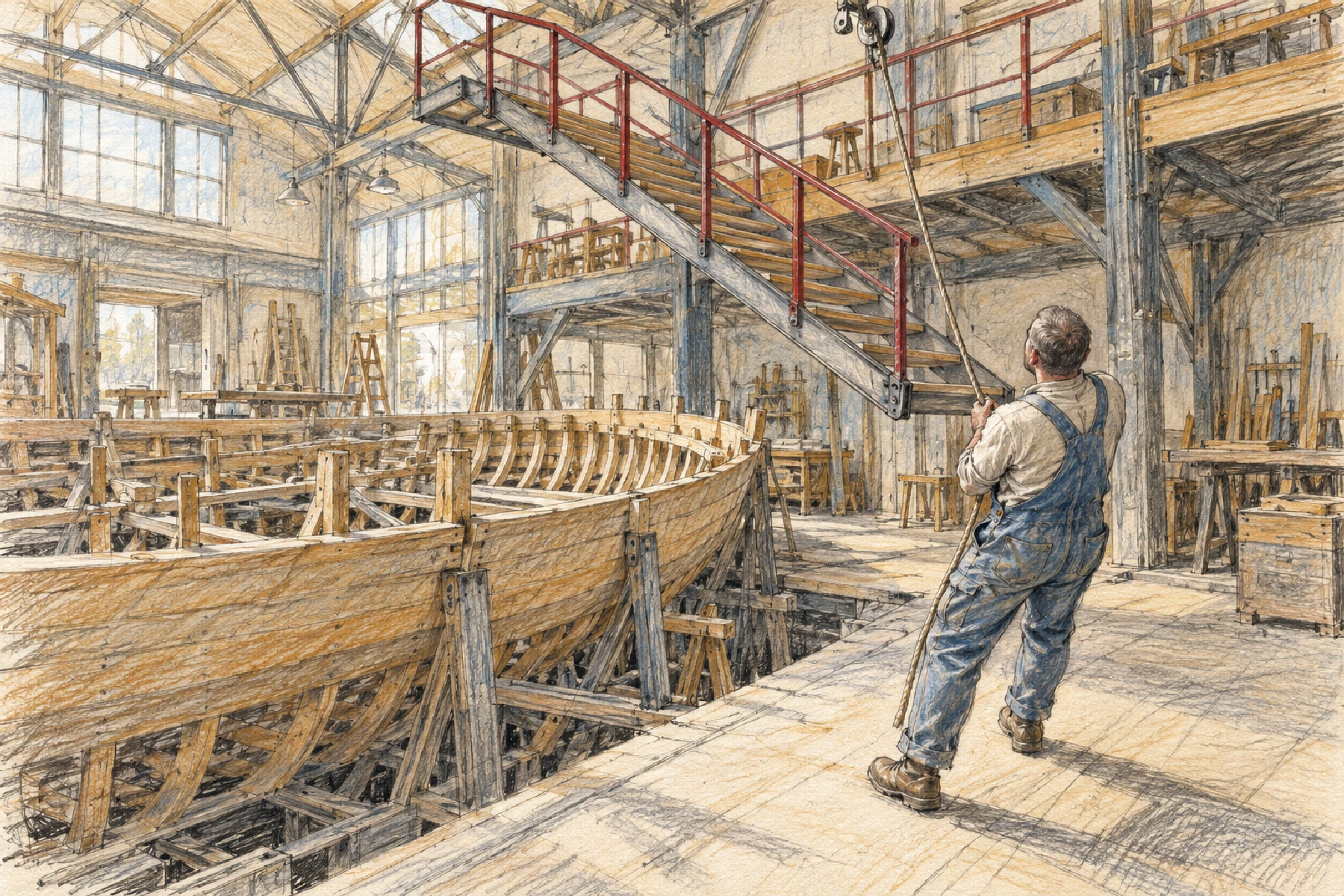
A Stair Lowering into the Boatbuilding Hall
A worker pulls a rope to lower a hinged stair amid an unfinished hull and mezzanine workspaces, rendered as a rough pencil and colored-pencil architectural drawing.
Remix this referenceA Stair Lowering into the Boatbuilding Hall
- Form language
- Reduce volumes to brisk wedges, arcs and open frameworks; retain exploratory corrections and loosely indicated minor detail.
- Contour
- Use searching pencil contours with doubled passages, broken endpoints and changing pressure rather than uniformly closed outlines.
- Mark-making
- Combine quick graphite hatching with broad side-of-colored-pencil strokes; vary stroke length and retain occasional construction lines.
- Surface rendering
- Build uneven tonal patches through overlapping dry strokes, exposing paper and leaving rubbed graphite transitions visibly imperfect.
Priority
Keep rough pencil and colored-pencil sketchbook drawing visibly present throughout the finished image.
What to avoid & what to check
Exact prompt for this example
MODULE OWNERSHIP
subject: Subject count, type, stable proportions and landmarks, resting face geometry, hair shape, physical materials, garment construction and permanent marks. No emotion, movement, color assignment or rendering recipe.
expression: Facial soft-tissue displacement and pupil direction, muscle coordination, regional intensity, asymmetry and onset/peak/release. No head/body pose, stable appearance, skin color or rendering.
gesture: Head/neck/body/limb orientation, joint movement, support, contact and pose-caused occlusion using existing anatomy. No eye/pupil movement, emotion, identity, props inventory or camera.
props: Prop count, type, construction, physical material and scale relative to the subject. Holding/contact belongs to gesture, position to composition, color to palette.
scene: Environment elements, terrain, backdrop/floor presence and structural detail. No canvas positions, camera, lighting, assigned colors or render texture.
camera: Projection, focal-length impression, camera elevation/yaw/roll, viewing distance and crop. No actor pose, world placement, lighting or canvas aspect ratio.
composition: Normalized 0-100% canvas positions, scale in frame, depth/overlap, focal hierarchy and margins. No joint pose, camera projection, rendering, subject/prop inventory or emotion.
palette: Color anchors, hue/saturation/value ranges, colors assigned to parts and approximate color coverage. No illumination direction, shading algorithm, physical material or layout.
lighting: Light-source direction/softness/intensity, ambient illumination, physical shadow direction/length and highlight position. Absence of directional illumination is allowed. No shading technique, palette or material changes.
style: Reusable form abstraction, contour weight/taper/edge quality, medium and mark scale/density/direction, surface rendering and tonal transition technique. No fixed subject proportions, anatomy, identity, expression, pose, palette, light-source direction, camera or layout.
output: Image count, aspect ratio, size, file/alpha requirements and global lettering/logo/watermark restrictions. No background scenery, crop, style, identity or pose.

SUBJECT
inventory: Actor A is one adult boatyard worker; no other people appear.
geometry: A has ordinary adult proportions, a sturdy build and a short neck; small physical details may vary naturally.
resting-face: Resting facial geometry is left unspecified.
appearance: A has close-cropped hair, loose canvas work overalls with a broad bib and sturdy ankle boots.

PRIORITY


AVOID


CHECK


EXPRESSION — ACTOR A
brows: Brow displacement is unprescribed.
lids: Eyelid opening and tension are unprescribed.
cheeks: Cheek lift and compression are unprescribed.
nose: Nostril movement is unprescribed.
mouth: Lip shape and tension are unprescribed.
jaw: Jaw opening and clenching are unprescribed.
gaze: Pupil direction is unprescribed.
coordination: Facial muscle coordination is unprescribed.
timing: Hold the neutral state at apex; no facial transition is prescribed.

PRIORITY


AVOID


CHECK


GESTURE
head: A tips the head upward toward the descending stair while keeping the face turned away.
torso: A leans back from the hips with a slight counter-twist through the shoulders.
limbs: Both arms draw downward together; the knees soften and one foot braces behind the other.
contact: Both hands pull the brake-release rope to let the stair descend; both boot soles remain planted on the floor.

PRIORITY


AVOID


CHECK


PROPS
inventory: One unfinished wooden boat hull is several times A's height in length.
construction: The open hull exposes curved ribs and partial planking.

PRIORITY


AVOID


CHECK


SCENE
inventory: A tall boatbuilding hall has a recessed building cradle, mezzanine workspaces, roof trusses and a hinged access stair.
structure: The mezzanine stair has a braked, damped hinge; a rope over an overhead pulley operates the brake release.

PRIORITY


AVOID


CHECK


CAMERA
projection: Use moderately wide perspective with clear convergence and restrained edge expansion.
viewpoint: View diagonally across the hall from behind A, slightly above shoulder height, with the camera level and facial landmarks out of view.
crop: Include A's whole figure and the full stair length; crop through nearby hull and roof structures.

PRIORITY


AVOID


CHECK


COMPOSITION
placement: Place A in the right third; the stair crosses the middle diagonally above the hull's broad foreground arc.
depth: Set the hull in its cradle; layer its cropped edge, A and stair, then mezzanine and far bays with visible gaps.
spacing: The hands-and-rope junction anchors attention; open floor around A separates it from denser structural layers.

PRIORITY


AVOID


CHECK


PALETTE
colors: Use paper ivory, graphite gray, honey ochre, faded workwear blue and a small iron-red accent.
assignment: Keep the structure mostly graphite gray, timber selectively ochre, A's overalls blue and the stair rail red.
balance: Ivory and graphite gray dominate; colored passages remain selective and generally subdued.

PRIORITY


AVOID


CHECK


LIGHTING
sources: Broad daylight enters from high windows on the left, supported by soft ambient light throughout the hall.
shadows: The stair and A cast soft shadows toward the right; the recessed cradle retains deeper enclosed shadow.
highlights: Broad highlights catch upper stair treads, A's shoulders and the exposed upper edges of the hull.

PRIORITY


AVOID


CHECK


STYLE GUIDE
form-language: Reduce volumes to brisk wedges, arcs and open frameworks; retain exploratory corrections and loosely indicated minor detail.
contour: Use searching pencil contours with doubled passages, broken endpoints and changing pressure rather than uniformly closed outlines.
mark-making: Combine quick graphite hatching with broad side-of-colored-pencil strokes; vary stroke length and retain occasional construction lines.
surface-rendering: Build uneven tonal patches through overlapping dry strokes, exposing paper and leaving rubbed graphite transitions visibly imperfect.

PRIORITY
Keep rough pencil and colored-pencil sketchbook drawing visibly present throughout the finished image.

AVOID


CHECK


OUTPUT
format: One finished image, 3:2 landscape, 1800 × 1200 pixels, opaque PNG.
restrictions: One finished image, 3:2 landscape, 1800 × 1200 pixels, opaque PNG; no lettering, logos or watermarks.

PRIORITY


AVOID


CHECK


FINAL INTEGRATION
subject + expression + gesture + camera: Let camera and gesture establish facial visibility together; unspecified facial geometry and acting add no visibility constraints.
Model information comes from image provenance. The same prompt may produce a different result.