Text to imageIllustrationStyle guide
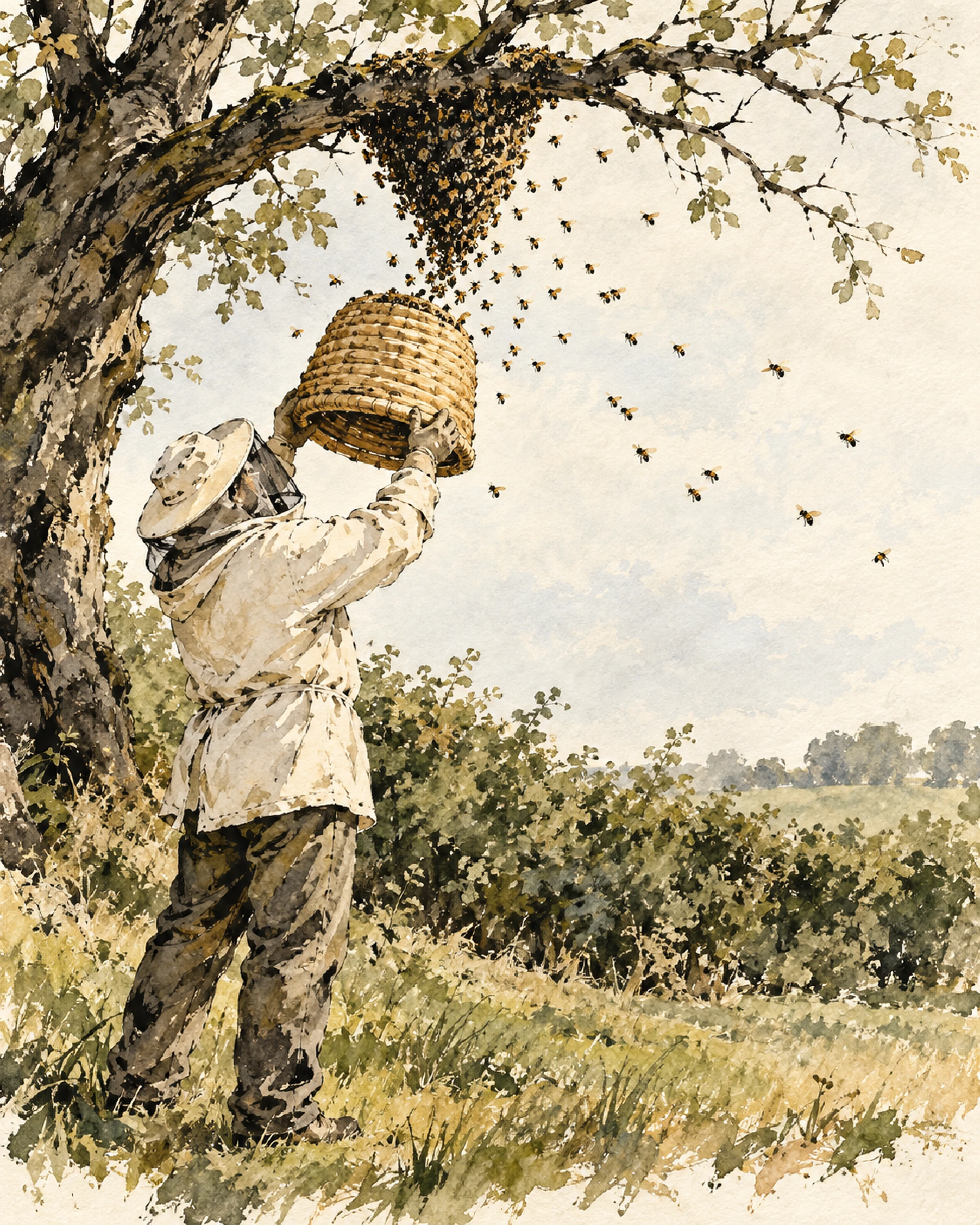
Beekeeper Beneath a Hanging Swarm
A beekeeper raises a woven skep beneath a swarm hanging from a crooked orchard branch. Blooming ink, broken brush lines and generous untouched paper surround a loose curve of airborne bees.
Remix this referenceBeekeeper Beneath a Hanging Swarm
- Form language
- Simplify forms into irregular, interlocking masses with a few descriptive notches; let minor shapes vary within this loose vocabulary.
- Contour
- Use elastic brush contours that swell, taper and break, allowing selected edges to dissolve into neighboring washes.
- Mark-making
- Alternate broad wet strokes with skipping dry-brush accents and quick, uneven flecks; vary the marks naturally rather than repeating a pattern.
- Surface rendering
- Diluted ink blooms into soft pools and darker tide edges; exposed paper interrupts transparent layers and occasional dense deposits.
Priority
Make the editorial ink wash visibly fluid, with dry-brush resistance and breathing paper.
What to avoid & what to check
Exact prompt for this example
MODULE OWNERSHIP
subject: Subject count, type, stable proportions and landmarks, resting face geometry, hair shape, physical materials, garment construction and permanent marks. No emotion, movement, color assignment or rendering recipe.
expression: Facial soft-tissue displacement and pupil direction, muscle coordination, regional intensity, asymmetry and onset/peak/release. No head/body pose, stable appearance, skin color or rendering.
gesture: Head/neck/body/limb orientation, joint movement, support, contact and pose-caused occlusion using existing anatomy. No eye/pupil movement, emotion, identity, props inventory or camera.
props: Prop count, type, construction, physical material and scale relative to the subject. Holding/contact belongs to gesture, position to composition, color to palette.
scene: Environment elements, terrain, backdrop/floor presence and structural detail. No canvas positions, camera, lighting, assigned colors or render texture.
camera: Projection, focal-length impression, camera elevation/yaw/roll, viewing distance and crop. No actor pose, world placement, lighting or canvas aspect ratio.
composition: Normalized 0-100% canvas positions, scale in frame, depth/overlap, focal hierarchy and margins. No joint pose, camera projection, rendering, subject/prop inventory or emotion.
palette: Color anchors, hue/saturation/value ranges, colors assigned to parts and approximate color coverage. No illumination direction, shading algorithm, physical material or layout.
lighting: Light-source direction/softness/intensity, ambient illumination, physical shadow direction/length and highlight position. Absence of directional illumination is allowed. No shading technique, palette or material changes.
style: Reusable form abstraction, contour weight/taper/edge quality, medium and mark scale/density/direction, surface rendering and tonal transition technique. No fixed subject proportions, anatomy, identity, expression, pose, palette, light-source direction, camera or layout.
output: Image count, aspect ratio, size, file/alpha requirements and global lettering/logo/watermark restrictions. No background scenery, crop, style, identity or pose.

SUBJECT
inventory: One adult beekeeper and one bee colony.
geometry: The beekeeper has ordinary adult proportions; the bees have small winged bodies.
resting-face: The protective veil conceals facial landmarks; no resting facial geometry is specified.
appearance: A loose canvas smock, protective gloves and a brimmed mesh veil cover the beekeeper; hair is fully concealed.

PRIORITY


AVOID


CHECK


GESTURE
head: The covered head tips upward toward the hanging colony, with the neck following the reach.
torso: The beekeeper leans gently forward from a grounded standing stance, keeping the torso beneath the raised arms.
limbs: Both elbows bend outward while the hands raise the skep with its opening upward; the feet stand comfortably apart.
contact: Both gloved hands cradle the skep's sides; the cluster hangs from the branch while individual bees fly in a curve toward the opening.

PRIORITY


AVOID


CHECK


PROPS
inventory: One traditional woven skep, approximately as broad as the beekeeper's torso.
construction: Coiled straw forms a deep rounded dome with an open circular base and a firm rolled rim.

PRIORITY


AVOID


CHECK


SCENE
inventory: A sparse orchard clearing with one old fruit tree, a low grassy bank and a hedge.
structure: The tree has a crooked trunk and one long low branch, with only sparse leaves around its outer twigs.

PRIORITY


AVOID


CHECK


CAMERA
projection: Natural perspective with a mild long-lens impression and little foreground enlargement.
viewpoint: Look from slightly below shoulder height at a rear three-quarter angle, with a level horizon.
crop: A medium-wide view includes the full figure and branch; the outer tree crown continues beyond the frame.

PRIORITY


AVOID


CHECK


COMPOSITION
placement: The figure anchors the lower-left third; the skep and tapering bee cluster create the primary focal interval just left of center.
depth: The branch passes behind the colony; the figure and skep overlap the bank, while the distant hedge stays subordinate.
spacing: Keep most of the right half open, with scattered bees in a loose arc, readable individuals along the cluster edges and generous space around the focal interval.

PRIORITY


AVOID


CHECK


PALETTE
colors: Warm ivory, charcoal black, muted olive and restrained honey ochre establish a low-saturation range.
assignment: Ivory belongs to paper and clothing, charcoal to tree and bees, olive to vegetation, and ochre to the skep.
balance: Ivory dominates; charcoal provides the strongest value contrast, with olive and ochre used sparingly.

PRIORITY


AVOID


CHECK


LIGHTING
sources: Broad, soft daylight arrives from the upper left, supported by generous ambient illumination.
shadows: Short, diffuse cast shadows fall toward the lower right; the branch underside remains gently shaded.
highlights: Soft highlights touch the upper-left portions of the veil brim and skep rim, without sharp glints.

PRIORITY


AVOID


CHECK


STYLE GUIDE
form-language: Simplify forms into irregular, interlocking masses with a few descriptive notches; let minor shapes vary within this loose vocabulary.
contour: Use elastic brush contours that swell, taper and break, allowing selected edges to dissolve into neighboring washes.
mark-making: Alternate broad wet strokes with skipping dry-brush accents and quick, uneven flecks; vary the marks naturally rather than repeating a pattern.
surface-rendering: Diluted ink blooms into soft pools and darker tide edges; exposed paper interrupts transparent layers and occasional dense deposits.

PRIORITY
Make the editorial ink wash visibly fluid, with dry-brush resistance and breathing paper.

AVOID


CHECK


OUTPUT
format: One finished illustration, portrait 4:5, 2400 × 3000 pixels, opaque PNG.
restrictions: No lettering, logos or watermarks.

PRIORITY


AVOID


CHECK


FINAL INTEGRATION
gesture + props + composition: Coordinate the supported skep with the focal interval so the collection attempt reads immediately.
style + palette + composition: Let fluid marks and restrained color sustain the open arrangement as a finished editorial image.
Model information comes from image provenance. The same prompt may produce a different result.