Text to imageProductStyle guide
Desk Cable Dock · Minimum Bend Radius
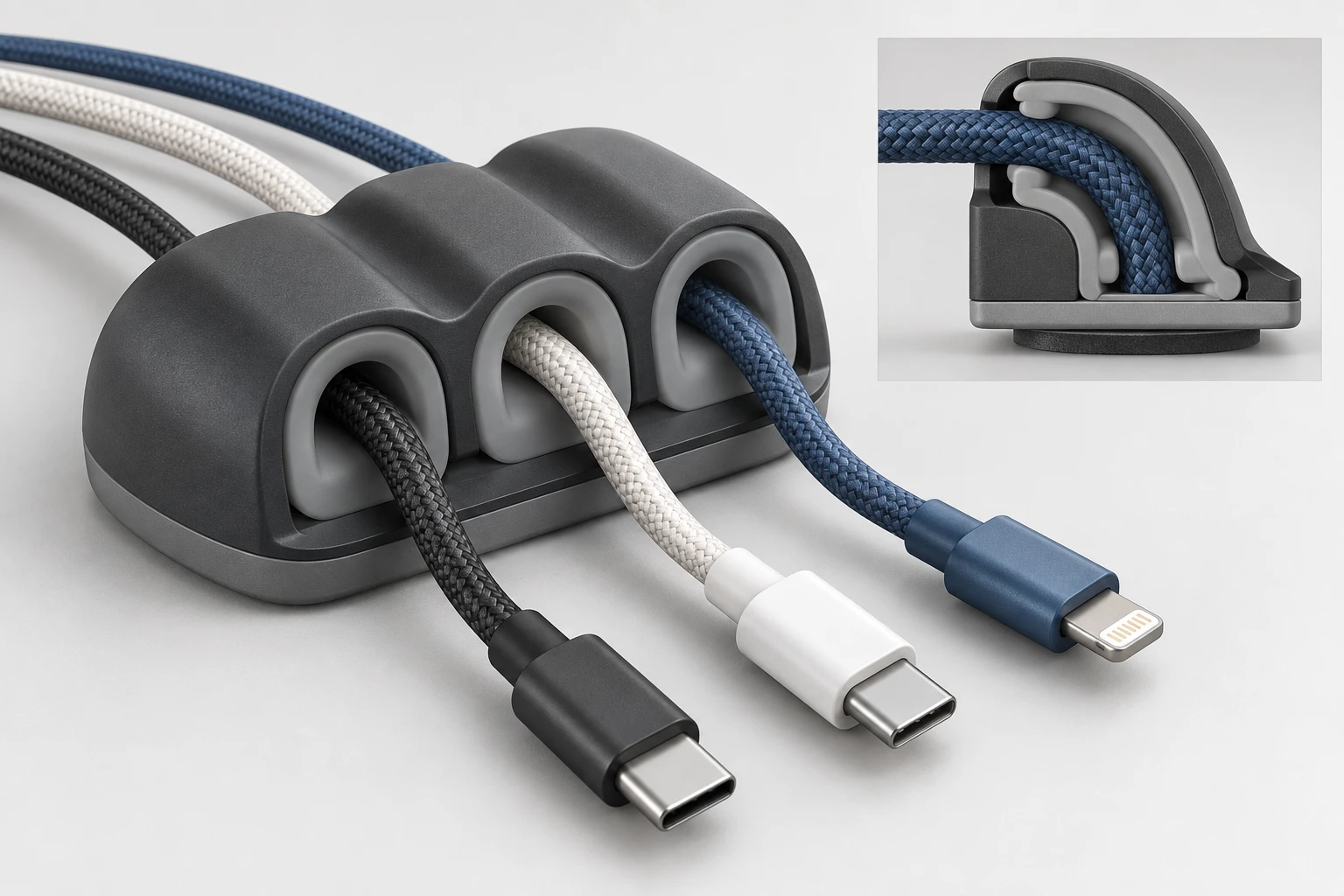
Show how a dock's channels and anchors guide cables around safe, generous bends.
Remix this referenceDesk Cable Dock · Minimum Bend Radius
- Shape & line
- Use precise continuous rounded geometry with generous bend arcs. Place small gripping contacts only where needed to retain flexible elements, avoiding abrupt kinks.
- Color & light
- Use restrained neutral studio colors with soft broad lighting and enough tonal contrast to separate adjacent components without dramatic shadows.
- Texture & material
- Clearly distinguish matte rigid polymer, soft silicone and braided fiber by finish and microtexture, not by color alone. Keep materials realistic and understated.
- Composition
- Make the hero view dominant with a smaller clean cutaway inset. Separate the views with whitespace and expose inner liner, outer shell and attachment layers without labels.
Priority
Preserve the defining shape and construction rule first, readable composition second, material and lighting treatment third.
What to avoid & what to check
Avoid extra subjects, inconsistent repeated geometry, hidden key contact points, illegible overlaps, unwanted text and watermarks.
Check each of the four style rules independently: shape construction, color and lighting, surface treatment, and hierarchy and spacing must all remain visible.
Exact prompt for this example
SUBJECT
Create a precise industrial-design reference image of an original compact desk cable dock. Show a three-quarter hero view with three charging cables entering separate rounded channels, turning through generous curves, and exiting toward devices without sharp kinks. Add a small, clean sectional inset that reveals the soft gripping liner, rigid outer shell, and recessed underside attachment. Make the bend arcs and retention points obvious through the actual geometry of the product, using a few detached cable ends only where needed for clarity. Render matte polymer, soft silicone, and braided cable with realistic but restrained material differences against a plain studio background. No dimensions, lettering, unrelated logos, or watermarks.

COMPOSITION
Use a landscape-format three-quarter hero view with a small separated sectional inset. Show three cables in distinct rounded channels, with broad bends and no tangles. Keep liner, shell and underside attachment readable in the inset.

STYLE GUIDE
1. Shape & line
Use precise continuous rounded geometry with generous bend arcs. Place small gripping contacts only where needed to retain flexible elements, avoiding abrupt kinks.

2. Color & light
Use restrained neutral studio colors with soft broad lighting and enough tonal contrast to separate adjacent components without dramatic shadows.

3. Texture & material
Clearly distinguish matte rigid polymer, soft silicone and braided fiber by finish and microtexture, not by color alone. Keep materials realistic and understated.

4. Composition
Make the hero view dominant with a smaller clean cutaway inset. Separate the views with whitespace and expose inner liner, outer shell and attachment layers without labels.

PRIORITY
Preserve the requested identity, count, action, composition and output settings. Apply the style rules within those constraints; a style reference must not replace the subject or layout. Within the style: Preserve the defining shape and construction rule first, readable composition second, material and lighting treatment third.

AVOID
Avoid extra subjects, inconsistent repeated geometry, hidden key contact points, illegible overlaps, unwanted text and watermarks.

OUTPUT
One finished landscape image, aspect ratio 3:2. No lettering, dimensions, unrelated logos, watermark, border or interface.

SELF-CHECK
Check each of the four style rules independently: shape construction, color and lighting, surface treatment, and hierarchy and spacing must all remain visible.
Model information comes from image provenance. The same prompt may produce a different result.