Text to imageCafe & brandStyle guide
Little Ferry Between Two Harbors
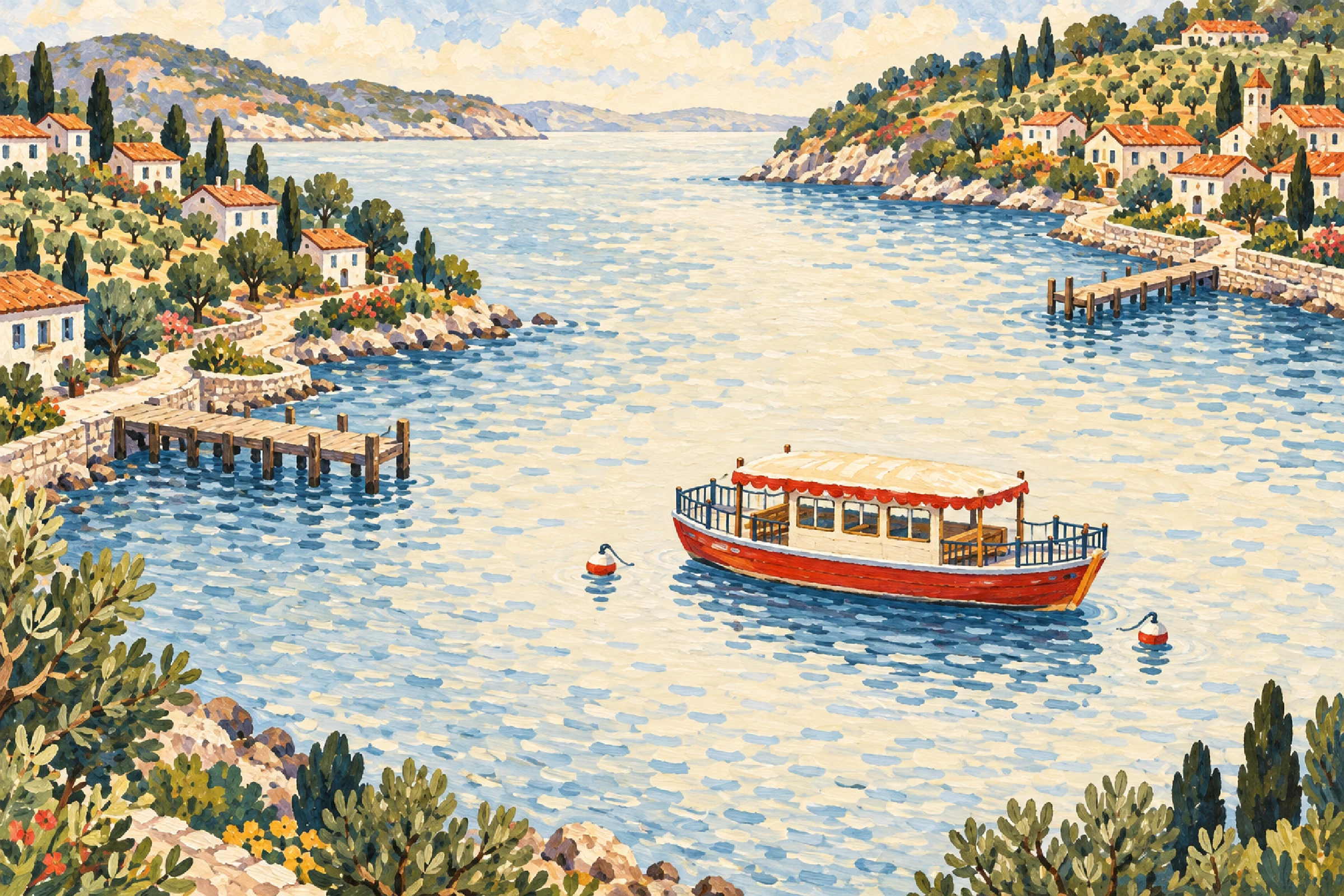
A regional ferry brand illustration places a little passenger boat between two coastal villages. Decorative waves and roof rhythms in naive folk painting surround a spacious open bay.
Remix this referenceLittle Ferry Between Two Harbors
- Form language
- Simplify forms into friendly uneven shapes, repeating scallops and leaf-like motifs without rigid symmetry.
- Contour
- Use softly wobbling brush boundaries and occasional blunt outlines; allow small gaps and uneven joins.
- Mark-making
- Group short dashes, dotted clusters and curved brush touches into decorative rhythms with naturally varied spacing.
- Surface rendering
- Lay opaque paint in slightly streaked patches, using sparse second-tone strokes rather than smoothly modeled volumes.
Priority
Make naive folk painting visible through lively decorative simplification and imperfect brushwork.
What to avoid & what to check
Exact prompt for this example
MODULE OWNERSHIP
subject: Subject count, type, stable proportions and landmarks, resting face geometry, hair shape, physical materials, garment construction and permanent marks. No emotion, movement, color assignment or rendering recipe.
expression: Facial soft-tissue displacement and pupil direction, muscle coordination, regional intensity, asymmetry and onset/peak/release. No head/body pose, stable appearance, skin color or rendering.
gesture: Head/neck/body/limb orientation, joint movement, support, contact and pose-caused occlusion using existing anatomy. No eye/pupil movement, emotion, identity, props inventory or camera.
props: Prop count, type, construction, physical material and scale relative to the subject. Holding/contact belongs to gesture, position to composition, color to palette.
scene: Environment elements, terrain, backdrop/floor presence and structural detail. No canvas positions, camera, lighting, assigned colors or render texture.
camera: Projection, focal-length impression, camera elevation/yaw/roll, viewing distance and crop. No actor pose, world placement, lighting or canvas aspect ratio.
composition: Normalized 0-100% canvas positions, scale in frame, depth/overlap, focal hierarchy and margins. No joint pose, camera projection, rendering, subject/prop inventory or emotion.
palette: Color anchors, hue/saturation/value ranges, colors assigned to parts and approximate color coverage. No illumination direction, shading algorithm, physical material or layout.
lighting: Light-source direction/softness/intensity, ambient illumination, physical shadow direction/length and highlight position. Absence of directional illumination is allowed. No shading technique, palette or material changes.
style: Reusable form abstraction, contour weight/taper/edge quality, medium and mark scale/density/direction, surface rendering and tonal transition technique. No fixed subject proportions, anatomy, identity, expression, pose, palette, light-source direction, camera or layout.
output: Image count, aspect ratio, size, file/alpha requirements and global lettering/logo/watermark restrictions. No background scenery, crop, style, identity or pose.

SUBJECT
inventory: One original small passenger ferry; no visible people or animals.
geometry: A broad double-ended hull supports a low cabin with paired end gates and a scalloped canopy.
resting-face: No facial features apply.
appearance: Timber hull planking, glazed cabin openings, fabric canopy and simple metal railings; minor details may vary.

PRIORITY


AVOID


CHECK


PROPS
inventory: Two mooring buoys.
construction: Rounded sealed floats with short rope loops, each much smaller than the ferry cabin.

PRIORITY


AVOID


CHECK


SCENE
inventory: A sheltered bay, two timber landing piers, clustered village houses and small coastal orchards.
structure: Two curved headlands enclose the bay; short paths connect each pier to its village.

PRIORITY


AVOID


CHECK


CAMERA
projection: A shallow oblique projection with gently compressed distance.
viewpoint: Look down from a moderate elevation across the bay, with no camera roll.
crop: A broad view includes the whole ferry and both piers; outer village edges continue beyond the frame.

PRIORITY


AVOID


CHECK


COMPOSITION
placement: Place the ferry below and right of center; opposing shore arcs enter from the left and upper right.
depth: Let piers overlap their shorelines and roof clusters overlap orchard shapes, keeping the ferry clear of both banks.
spacing: The ferry is the first focal point; a generous uninterrupted bay separates the lively village clusters.

PRIORITY


AVOID


CHECK


PALETTE
colors: Warm cream, vermilion, leafy green, ochre and restrained deep blue.
assignment: Cream fills the water, vermilion marks the ferry, green belongs to orchards, ochre to roofs, and blue to waves and railings.
balance: Cream occupies the largest area; saturated accents remain compact, with deep blue used sparingly.

PRIORITY


AVOID


CHECK


LIGHTING
sources: Soft daylight comes broadly from the upper left, with ample ambient illumination.
shadows: Short, soft shadows fall to the lower right beneath canopy edges, piers and roof eaves.
highlights: Gentle highlights sit on upper-left roof edges and the canopy crest.

PRIORITY


AVOID


CHECK


STYLE GUIDE
form-language: Simplify forms into friendly uneven shapes, repeating scallops and leaf-like motifs without rigid symmetry.
contour: Use softly wobbling brush boundaries and occasional blunt outlines; allow small gaps and uneven joins.
mark-making: Group short dashes, dotted clusters and curved brush touches into decorative rhythms with naturally varied spacing.
surface-rendering: Lay opaque paint in slightly streaked patches, using sparse second-tone strokes rather than smoothly modeled volumes.

PRIORITY
Make naive folk painting visible through lively decorative simplification and imperfect brushwork.

AVOID


CHECK


OUTPUT
format: Deliver one landscape 3:2 image, 2400 × 1600 pixels, as an opaque PNG.
restrictions: No lettering, logos or watermarks.

PRIORITY


AVOID


CHECK


FINAL INTEGRATION
composition + style: Let decorative rhythms connect the two settlements while the open bay gives the finished brand image breathing room.
Model information comes from image provenance. The same prompt may produce a different result.