Text to imageLandscapeStyle guide
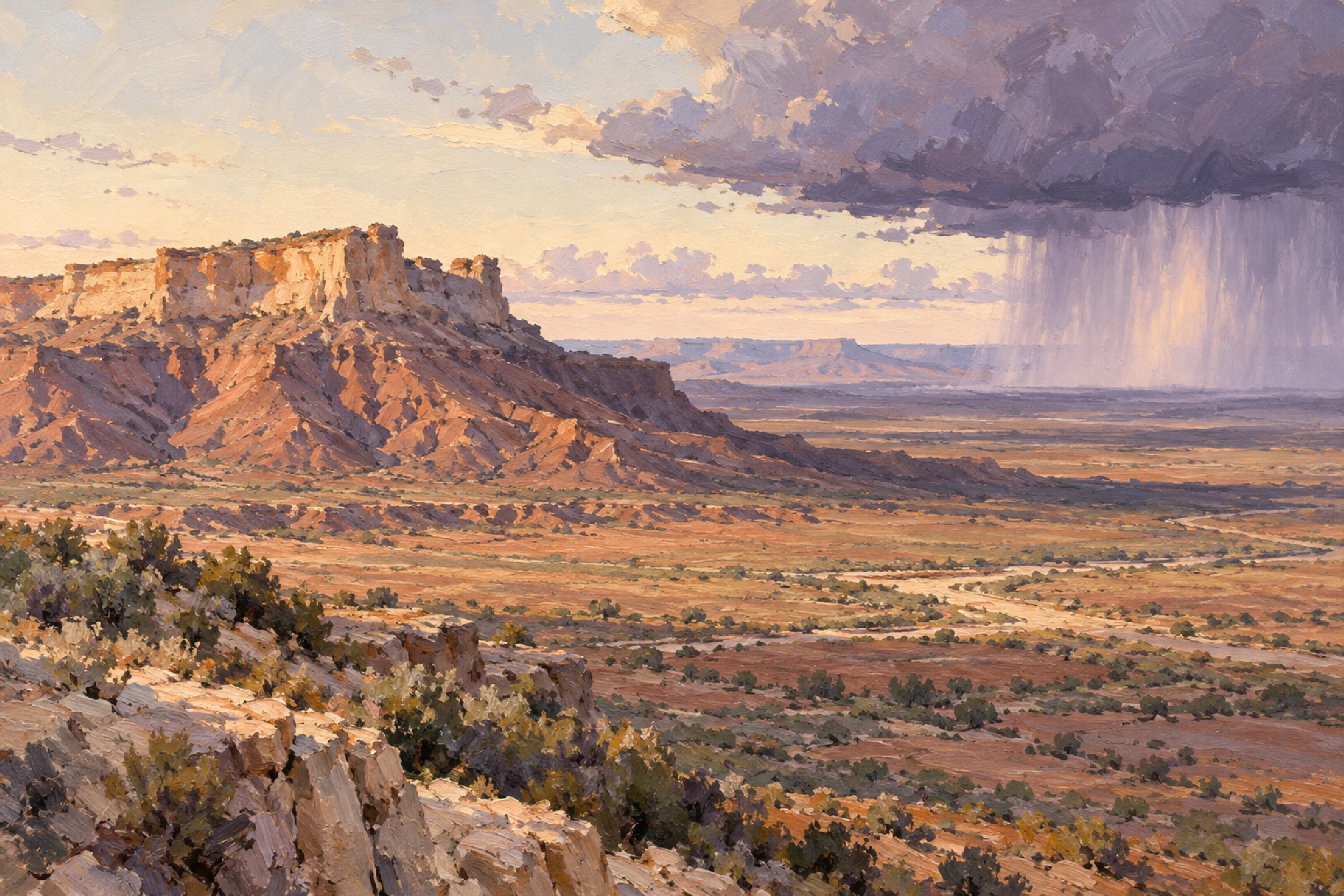
Rain Beyond the Mesa
A curtain of rain descends beyond an eroded mesa and an open basin. Opaque gouache brushwork and generous negative space set dry earth against approaching weather.
Remix this referenceRain Beyond the Mesa
- Form language
- Reduce complex forms to interlocking slabs and loose wedges; preserve irregular breaks rather than polishing every silhouette.
- Contour
- Build edges with brush boundaries instead of drawn outlines, alternating blunt opaque edges with frayed, incomplete passages.
- Mark-making
- Use loose gouache strokes with visible bristle splits and occasional dragging; let stroke size and spacing vary naturally.
- Surface rendering
- Stack opaque patches over partly exposed underpainting; turn tones through broken overlaps and occasional chalky scumbles.
Priority
Keep the opaque brushwork visibly loose and hand-painted.
What to avoid & what to check
Exact prompt for this example
MODULE OWNERSHIP
subject: Subject count, type, stable proportions and landmarks, resting face geometry, hair shape, physical materials, garment construction and permanent marks. No emotion, movement, color assignment or rendering recipe.
expression: Facial soft-tissue displacement and pupil direction, muscle coordination, regional intensity, asymmetry and onset/peak/release. No head/body pose, stable appearance, skin color or rendering.
gesture: Head/neck/body/limb orientation, joint movement, support, contact and pose-caused occlusion using existing anatomy. No eye/pupil movement, emotion, identity, props inventory or camera.
props: Prop count, type, construction, physical material and scale relative to the subject. Holding/contact belongs to gesture, position to composition, color to palette.
scene: Environment elements, terrain, backdrop/floor presence and structural detail. No canvas positions, camera, lighting, assigned colors or render texture.
camera: Projection, focal-length impression, camera elevation/yaw/roll, viewing distance and crop. No actor pose, world placement, lighting or canvas aspect ratio.
composition: Normalized 0-100% canvas positions, scale in frame, depth/overlap, focal hierarchy and margins. No joint pose, camera projection, rendering, subject/prop inventory or emotion.
palette: Color anchors, hue/saturation/value ranges, colors assigned to parts and approximate color coverage. No illumination direction, shading algorithm, physical material or layout.
lighting: Light-source direction/softness/intensity, ambient illumination, physical shadow direction/length and highlight position. Absence of directional illumination is allowed. No shading technique, palette or material changes.
style: Reusable form abstraction, contour weight/taper/edge quality, medium and mark scale/density/direction, surface rendering and tonal transition technique. No fixed subject proportions, anatomy, identity, expression, pose, palette, light-source direction, camera or layout.
output: Image count, aspect ratio, size, file/alpha requirements and global lettering/logo/watermark restrictions. No background scenery, crop, style, identity or pose.

SUBJECT
inventory: No human or animal subjects.
geometry: No actor proportions or anatomical landmarks apply.
resting-face: No faces are present.
appearance: No actor appearance or garments apply.

PRIORITY


AVOID


CHECK


PROPS
inventory: No separate props.
construction: No prop construction applies.

PRIORITY


AVOID


CHECK


SCENE
inventory: An eroded mesa, an open dry basin, sparse scrub, and a storm cloud trailing a distant rain curtain.
structure: The mesa has a broken cap and branching gullies; a low wash crosses the basin beneath uninterrupted sky.

PRIORITY


AVOID


CHECK


CAMERA
projection: A gently compressed perspective with the impression of a short telephoto lens.
viewpoint: Observe from a low neighboring ridge, looking slightly downward across the basin with a level horizon.
crop: A broad landscape view crops into the near escarpment while retaining the cloud and rain curtain.

PRIORITY


AVOID


CHECK


COMPOSITION
placement: The mesa occupies the left third; rain hangs near the right third, with the basin opening across the lower half.
depth: The near escarpment overlaps the basin; the distant rain becomes the first focal stop, followed by the mesa rim.
spacing: Leave a spacious interval between cliff and rain, with broad quiet sky and basin around their unequal masses.

PRIORITY


AVOID


CHECK


PALETTE
colors: Use chalk cream, baked apricot, muted aubergine, and gray lilac, with restrained saturation.
assignment: Cream fills the clear sky, apricot belongs to earth, aubergine to cloud and gullies, and lilac to rain.
balance: Pale sky and warm earth dominate; the compact cloud supplies the darkest values and rain stays intermediate.

PRIORITY


AVOID


CHECK


LIGHTING
sources: Broad late daylight enters from the upper left while the storm receives softer ambient illumination.
shadows: The mesa throws a long soft shadow toward the right; deep gullies retain smaller sheltered shadows.
highlights: Broad highlights catch the upper cliff ledges; the rain carries a faint, diffuse brightness.

PRIORITY


AVOID


CHECK


STYLE GUIDE
form-language: Reduce complex forms to interlocking slabs and loose wedges; preserve irregular breaks rather than polishing every silhouette.
contour: Build edges with brush boundaries instead of drawn outlines, alternating blunt opaque edges with frayed, incomplete passages.
mark-making: Use loose gouache strokes with visible bristle splits and occasional dragging; let stroke size and spacing vary naturally.
surface-rendering: Stack opaque patches over partly exposed underpainting; turn tones through broken overlaps and occasional chalky scumbles.

PRIORITY
Keep the opaque brushwork visibly loose and hand-painted.

AVOID


CHECK


OUTPUT
format: One finished image, landscape 3:2, 2400 × 1600 pixels, opaque PNG.
restrictions: Deliver one landscape 3:2 image at 2400 × 1600 pixels as an opaque PNG, without lettering, logos, or watermarks.

PRIORITY


AVOID


CHECK


FINAL INTEGRATION
composition + style + lighting: Let brush variation and illumination support the spacious arrangement without filling its quiet intervals with detail.
Model information comes from image provenance. The same prompt may produce a different result.