Text to imageCharacterStyle guide
A Tiny Dancer on a Pottery Wheel
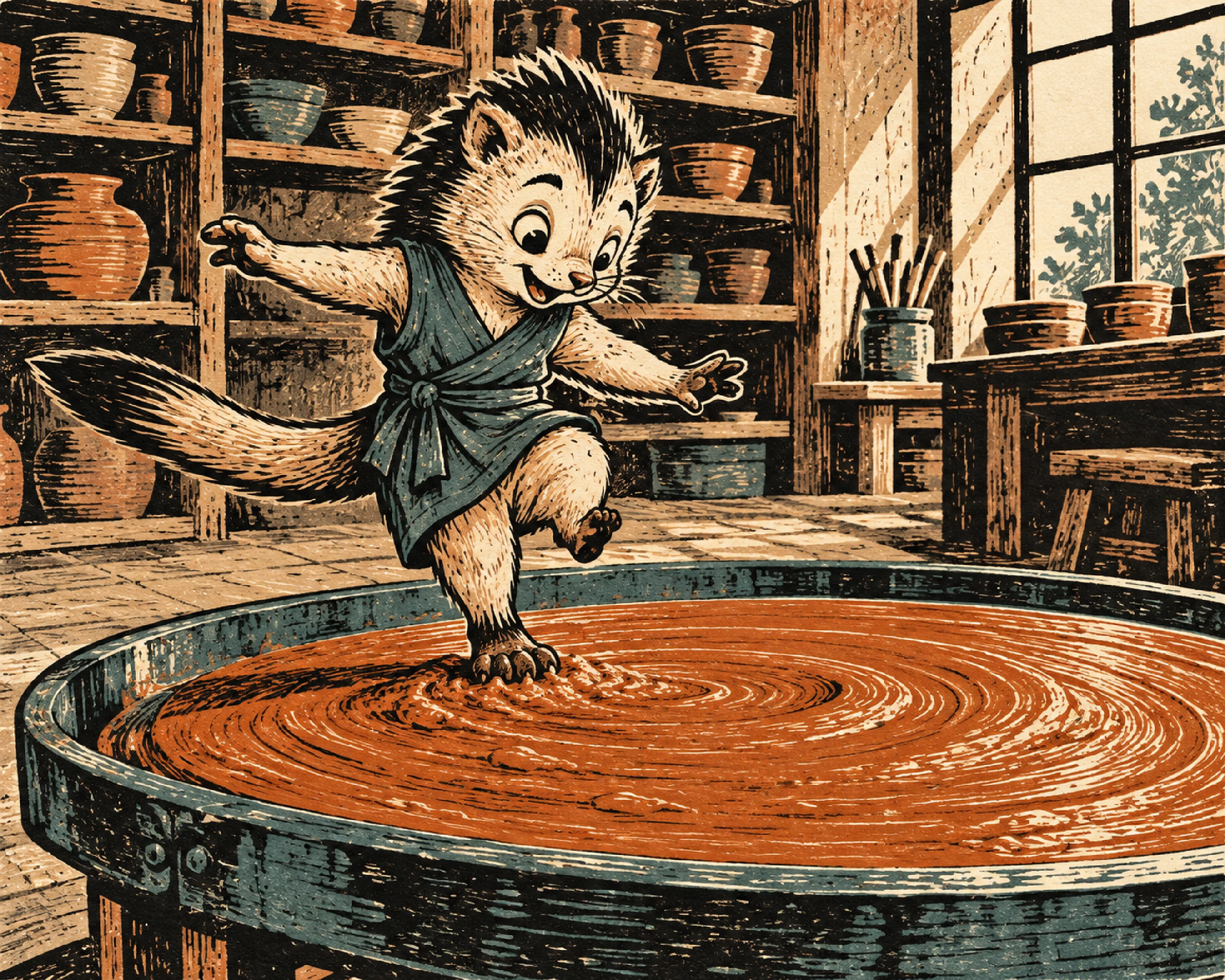
A palm-sized, maned creature balances on a turning pottery wheel. Sweeping carved marks turn its little dance into an expansive rotation in this bold linocut illustration.
Remix this referenceA Tiny Dancer on a Pottery Wheel
- Form language
- Use bold linocut masses with elastic curves and compact angular interruptions; simplify secondary forms freely.
- Contour
- Let thick ink boundaries break into chisel-shaped notches; vary edge pressure instead of enclosing everything uniformly.
- Mark-making
- Sweep rhythmic gouge cuts through curved passages and use shorter crosscuts on firmer planes; spacing may vary by hand.
- Surface rendering
- Build tone from ink masses, exposed paper and changing cut density; retain patchy ink pressure and slightly imperfect block registration.
Priority
Keep rhythmic carved marks visibly integral to the bold linocut treatment.
What to avoid & what to check
Exact prompt for this example
MODULE OWNERSHIP
subject: Subject count, type, stable proportions and landmarks, resting face geometry, hair shape, physical materials, garment construction and permanent marks. No emotion, movement, color assignment or rendering recipe.
expression: Facial soft-tissue displacement and pupil direction, muscle coordination, regional intensity, asymmetry and onset/peak/release. No head/body pose, stable appearance, skin color or rendering.
gesture: Head/neck/body/limb orientation, joint movement, support, contact and pose-caused occlusion using existing anatomy. No eye/pupil movement, emotion, identity, props inventory or camera.
props: Prop count, type, construction, physical material and scale relative to the subject. Holding/contact belongs to gesture, position to composition, color to palette.
scene: Environment elements, terrain, backdrop/floor presence and structural detail. No canvas positions, camera, lighting, assigned colors or render texture.
camera: Projection, focal-length impression, camera elevation/yaw/roll, viewing distance and crop. No actor pose, world placement, lighting or canvas aspect ratio.
composition: Normalized 0-100% canvas positions, scale in frame, depth/overlap, focal hierarchy and margins. No joint pose, camera projection, rendering, subject/prop inventory or emotion.
palette: Color anchors, hue/saturation/value ranges, colors assigned to parts and approximate color coverage. No illumination direction, shading algorithm, physical material or layout.
lighting: Light-source direction/softness/intensity, ambient illumination, physical shadow direction/length and highlight position. Absence of directional illumination is allowed. No shading technique, palette or material changes.
style: Reusable form abstraction, contour weight/taper/edge quality, medium and mark scale/density/direction, surface rendering and tonal transition technique. No fixed subject proportions, anatomy, identity, expression, pose, palette, light-source direction, camera or layout.
output: Image count, aspect ratio, size, file/alpha requirements and global lettering/logo/watermark restrictions. No background scenery, crop, style, identity or pose.

SUBJECT
inventory: A is one original palm-sized, upright mammal-like creature.
geometry: A compact pear-shaped body, wedge-shaped head, broad padded feet and a long tapering tail.
resting-face: Wide-set round eyes, a blunt triangular nose and a short broad muzzle.
appearance: Short fur with a stiff mane along the crown and nape; a sleeveless wrap tunic tied at the waist.

PRIORITY


AVOID


CHECK


EXPRESSION — ACTOR A
brows: Both brows rise, with one slightly ahead of the other.
lids: Upper lids open while the lower lids lift slightly.
cheeks: Cheeks begin lifting outward from the muzzle.
nose: The nose stays smooth with no visible flare.
mouth: A spreading open smile lifts one corner a little higher.
jaw: The jaw releases just enough to open the smile.
gaze: Pupils look down toward the wheel surface beside the supporting foot.
coordination: Lifted cheeks and widening eyes catch pleasure arriving before full laughter.
timing: Catch the onset as the creature discovers it can keep its balance.

PRIORITY


AVOID


CHECK


GESTURE
head: The neck bends forward slightly and the head turns toward the supporting foot.
torso: The torso tilts into the turn, with the tail extending outward as a counterbalance.
limbs: Both arms spread unevenly; one knee lifts while the other leg carries the body.
contact: One padded foot presses into the wet clay; the lifted foot and open hands touch nothing.

PRIORITY


AVOID


CHECK


PROPS
inventory: One full-size pottery wheel and one low mound of wet clay, expansive beside the tiny actor.
construction: A circular metal wheelhead on a spindle and timber frame; the clay forms a soft, shallow disc.

PRIORITY


AVOID


CHECK


SCENE
inventory: A working pottery studio with drying shelves, stored bowls and a tall window.
structure: Open shelving against a plaster wall establishes the workshop; a plain floor continues beneath it.

PRIORITY


AVOID


CHECK


CAMERA
projection: Moderately wide perspective makes the nearby wheelhead feel expansive.
viewpoint: Look diagonally down across the wheelhead from slightly above the creature, without roll.
crop: Include the entire creature and most of the wheelhead; crop the lower wheel frame.

PRIORITY


AVOID


CHECK


COMPOSITION
placement: The wheelhead sweeps across the lower frame; the dancer rises left of center.
depth: The near rim overlaps the studio floor; the dancer leads, with workshop shelves receding behind.
spacing: Give the dancer roughly a third of the image height and leave room around the tail.

PRIORITY


AVOID


CHECK


PALETTE
colors: Soot black, warm bone, rust orange and subdued blue-green.
assignment: Bone fur with a black mane; blue-green tunic and wheel; rust clay; bone and black studio.
balance: Black and bone dominate; rust provides the broad warm accent and blue-green a cooler counterpoint.

PRIORITY


AVOID


CHECK


LIGHTING
sources: Broad window light enters from the upper right with modest ambient fill.
shadows: The creature casts a short shadow toward the lower left; shelves hold deeper recess shadows.
highlights: Small highlights gather on the wet clay ridges and the upper wheel rim.

PRIORITY


AVOID


CHECK


STYLE GUIDE
form-language: Use bold linocut masses with elastic curves and compact angular interruptions; simplify secondary forms freely.
contour: Let thick ink boundaries break into chisel-shaped notches; vary edge pressure instead of enclosing everything uniformly.
mark-making: Sweep rhythmic gouge cuts through curved passages and use shorter crosscuts on firmer planes; spacing may vary by hand.
surface-rendering: Build tone from ink masses, exposed paper and changing cut density; retain patchy ink pressure and slightly imperfect block registration.

PRIORITY
Keep rhythmic carved marks visibly integral to the bold linocut treatment.

AVOID


CHECK


OUTPUT
format: One finished image, landscape 5:4 aspect ratio, 2560 × 2048 pixels, opaque PNG.
restrictions: No lettering, logos or watermarks.

PRIORITY


AVOID


CHECK


FINAL INTEGRATION
props + scene + composition: Let familiar workshop context make the character's unexpected scale immediately legible.
gesture + style: Let the carved rhythms reinforce the movement established by the pose.
Model information comes from image provenance. The same prompt may produce a different result.