Text to imageLandscapeStyle guide
Waterfall at the Headland
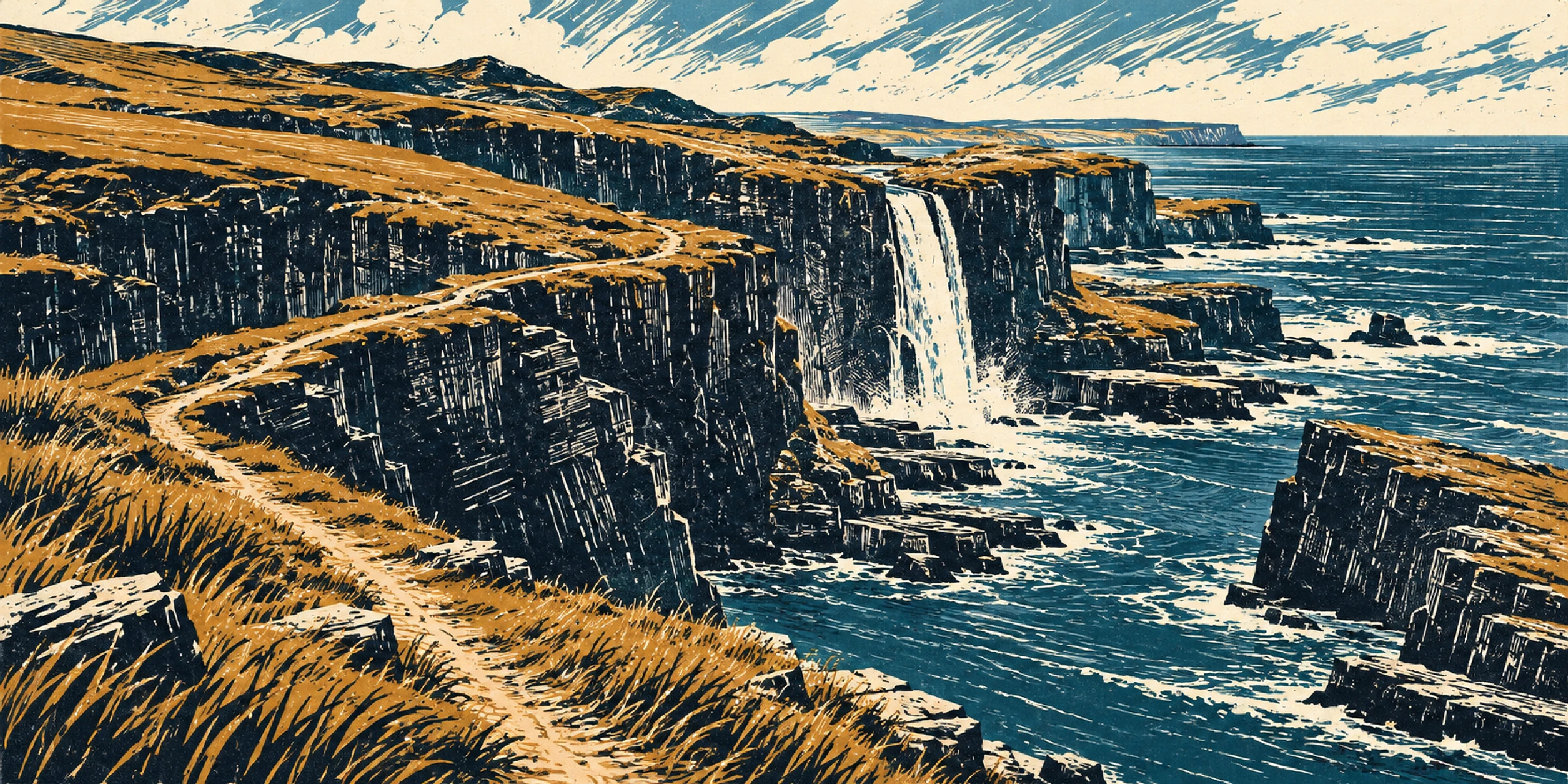
A panoramic coastal path leads the eye toward a cliff waterfall and the open sea beyond. Bold linocut masses and rhythmic gouges distinguish the grain of land from water.
Remix this referenceWaterfall at the Headland
- Form language
- Reduce complex forms to interlocking wedges, broad ribbons and irregular stepped masses; retain a few telling breaks.
- Contour
- Use weighty cut silhouettes with blunt corners and occasional tapered bites; avoid a uniform enclosing outline.
- Mark-making
- Carve rhythmic gouges in uneven clusters, alternating long sweeping cuts with short broken notches; let spacing vary naturally.
- Surface rendering
- Build tone from inked masses and widening unprinted cuts; preserve slight ink drag and broken transfer at selected edges.
Priority
The finished image must visibly read as bold linocut with carved rhythmic marks.
What to avoid & what to check
Exact prompt for this example
MODULE OWNERSHIP
subject: Subject count, type, stable proportions and landmarks, resting face geometry, hair shape, physical materials, garment construction and permanent marks. No emotion, movement, color assignment or rendering recipe.
expression: Facial soft-tissue displacement and pupil direction, muscle coordination, regional intensity, asymmetry and onset/peak/release. No head/body pose, stable appearance, skin color or rendering.
gesture: Head/neck/body/limb orientation, joint movement, support, contact and pose-caused occlusion using existing anatomy. No eye/pupil movement, emotion, identity, props inventory or camera.
props: Prop count, type, construction, physical material and scale relative to the subject. Holding/contact belongs to gesture, position to composition, color to palette.
scene: Environment elements, terrain, backdrop/floor presence and structural detail. No canvas positions, camera, lighting, assigned colors or render texture.
camera: Projection, focal-length impression, camera elevation/yaw/roll, viewing distance and crop. No actor pose, world placement, lighting or canvas aspect ratio.
composition: Normalized 0-100% canvas positions, scale in frame, depth/overlap, focal hierarchy and margins. No joint pose, camera projection, rendering, subject/prop inventory or emotion.
palette: Color anchors, hue/saturation/value ranges, colors assigned to parts and approximate color coverage. No illumination direction, shading algorithm, physical material or layout.
lighting: Light-source direction/softness/intensity, ambient illumination, physical shadow direction/length and highlight position. Absence of directional illumination is allowed. No shading technique, palette or material changes.
style: Reusable form abstraction, contour weight/taper/edge quality, medium and mark scale/density/direction, surface rendering and tonal transition technique. No fixed subject proportions, anatomy, identity, expression, pose, palette, light-source direction, camera or layout.
output: Image count, aspect ratio, size, file/alpha requirements and global lettering/logo/watermark restrictions. No background scenery, crop, style, identity or pose.

SUBJECT
inventory: No discrete characters or hero objects.
geometry: No character proportions or anatomical landmarks apply.
resting-face: No faces are present.
appearance: No character appearance, garments or permanent marks apply.

PRIORITY


AVOID


CHECK


PROPS
inventory: No separate props.
construction: No prop construction applies.

PRIORITY


AVOID


CHECK


SCENE
inventory: A grassy coastal plateau, a cliff waterfall, a narrow tidal inlet, a footpath and an open sea horizon.
structure: A stream cuts a notch through layered cliffs and drops onto tidal shelves; the path follows the scalloped headland.

PRIORITY


AVOID


CHECK


CAMERA
projection: Natural perspective with a moderately wide lens impression and restrained edge expansion.
viewpoint: An elevated oblique view across the inlet, looking slightly downward with a level horizon.
crop: A distant environmental view includes the cliff top, waterfall foot and a generous stretch of sea; the foreground bluff is partially cropped.

PRIORITY


AVOID


CHECK


COMPOSITION
placement: The path enters at lower left and curls toward the waterfall right of center; the bay opens toward upper right.
depth: A foreground bluff overlaps the path; successive headlands lead past the waterfall to the distant sea.
spacing: Make the waterfall the decisive interruption in broad land masses; reserve spacious sea and sky beyond it.

PRIORITY


AVOID


CHECK


PALETTE
colors: Soot indigo, deep petrol, muted ochre and warm chalk form a restrained, strongly separated palette.
assignment: Indigo anchors cliffs, petrol carries the sea, ochre marks grass and path, and chalk defines falling water and sky.
balance: Broad dark passages dominate; pale openings provide relief, with ochre acting as a quieter connecting accent.

PRIORITY


AVOID


CHECK


LIGHTING
sources: Broad daylight enters from upper left through thin cloud, with open coastal ambient light.
shadows: Soft shadows fall toward lower right; cliff recesses retain deeper shade without sharp projected edges.
highlights: Broad highlights catch exposed upper ledges and the outer face of the falling water.

PRIORITY


AVOID


CHECK


STYLE GUIDE
form-language: Reduce complex forms to interlocking wedges, broad ribbons and irregular stepped masses; retain a few telling breaks.
contour: Use weighty cut silhouettes with blunt corners and occasional tapered bites; avoid a uniform enclosing outline.
mark-making: Carve rhythmic gouges in uneven clusters, alternating long sweeping cuts with short broken notches; let spacing vary naturally.
surface-rendering: Build tone from inked masses and widening unprinted cuts; preserve slight ink drag and broken transfer at selected edges.

PRIORITY
The finished image must visibly read as bold linocut with carved rhythmic marks.

AVOID


CHECK


OUTPUT
format: One finished image, panoramic 2:1 aspect ratio, 2400 × 1200 pixels, opaque PNG.
restrictions: No lettering, logos, signatures or watermarks.

PRIORITY


AVOID


CHECK
Model information comes from image provenance. The same prompt may produce a different result.