Text to imageAnimationStyle guide
A Flower in the Keyhole
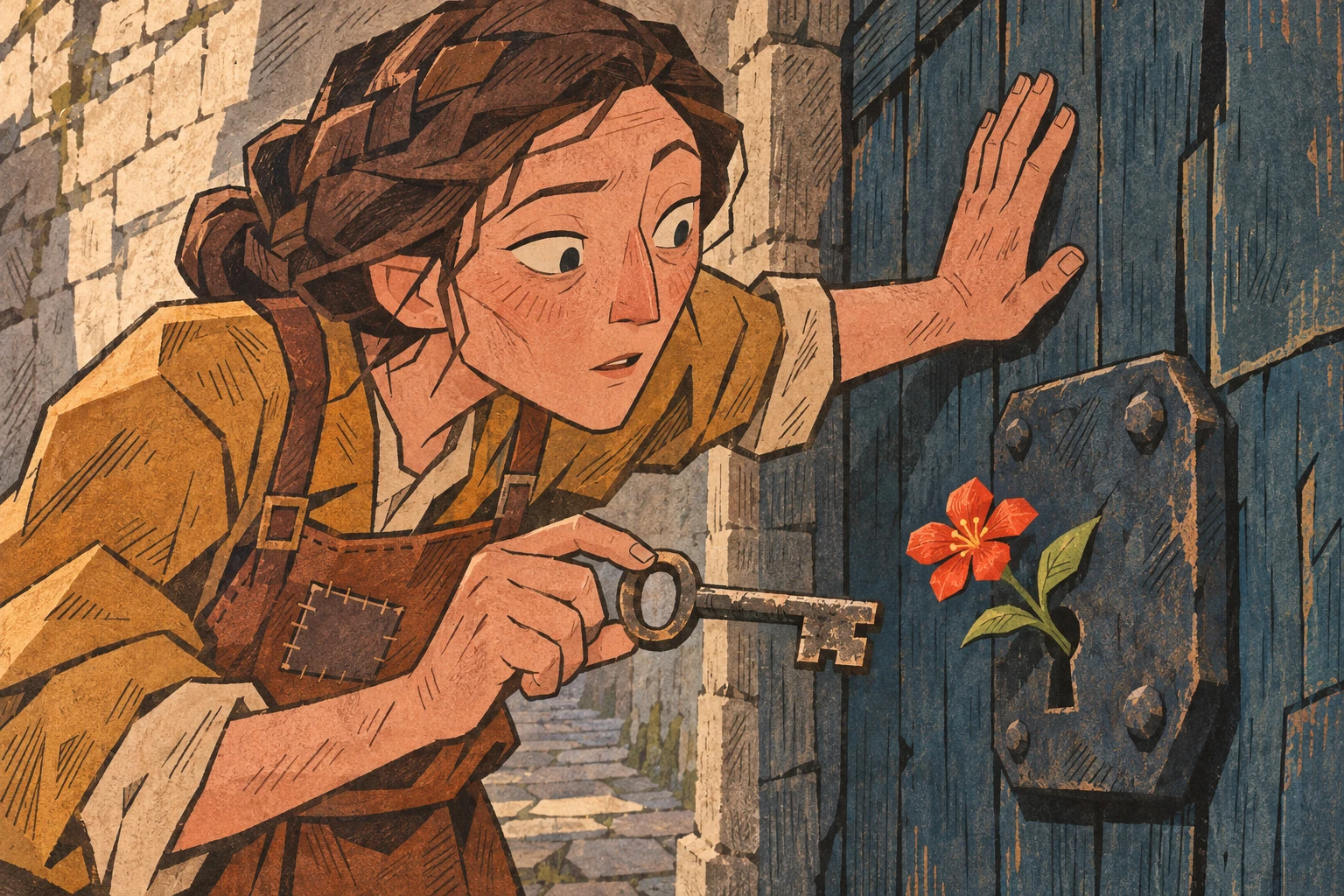
A locksmith pauses before unlocking a door: a small flower has grown from its keyhole. Her suspended hand and approaching face frame an unexpected garden within the door’s carved angular forms.
Remix this referenceA Flower in the Keyhole
- Form language
- Translate volumes into interlocking angular planes; let broad irregular shapes carry detail through economical internal divisions.
- Contour
- Use slightly uneven carved-looking straight and angular contours, with tapered breaks and occasional blunt joins.
- Mark-making
- Place short parallel hatch groups and sparse scratches in selected passages; vary their spacing naturally within the same carved vocabulary.
- Surface rendering
- Use flat printed planes, lightly broken paper texture and discrete hatched tonal regions; omit continuous volumetric modeling.
Priority
Rendering medium: 2D woodcut-print animated-film illustration; formal rendering reference: Cartoon Saloon · 2020s · Wolfwalkers (2020), town sequences
What to avoid & what to check
Exact prompt for this example
MODULE OWNERSHIP
subject: Subject count, type, stable proportions and landmarks, resting face geometry, hair shape, physical materials, garment construction and permanent marks. No emotion, movement, color assignment or rendering recipe.
expression: Facial soft-tissue displacement and pupil direction, muscle coordination, regional intensity, asymmetry and onset/peak/release. No head/body pose, stable appearance, skin color or rendering.
gesture: Head/neck/body/limb orientation, joint movement, support, contact and pose-caused occlusion using existing anatomy. No eye/pupil movement, emotion, identity, props inventory or camera.
props: Prop count, type, construction, physical material and scale relative to the subject. Holding/contact belongs to gesture, position to composition, color to palette.
scene: Environment elements, terrain, backdrop/floor presence and structural detail. No canvas positions, camera, lighting, assigned colors or render texture.
camera: Projection, focal-length impression, camera elevation/yaw/roll, viewing distance and crop. No actor pose, world placement, lighting or canvas aspect ratio.
composition: Normalized 0-100% canvas positions, scale in frame, depth/overlap, focal hierarchy and margins. No joint pose, camera projection, rendering, subject/prop inventory or emotion.
palette: Color anchors, hue/saturation/value ranges, colors assigned to parts and approximate color coverage. No illumination direction, shading algorithm, physical material or layout.
lighting: Light-source direction/softness/intensity, ambient illumination, physical shadow direction/length and highlight position. Absence of directional illumination is allowed. No shading technique, palette or material changes.
style: Reusable form abstraction, contour weight/taper/edge quality, medium and mark scale/density/direction, surface rendering and tonal transition technique. No fixed subject proportions, anatomy, identity, expression, pose, palette, light-source direction, camera or layout.
output: Image count, aspect ratio, size, file/alpha requirements and global lettering/logo/watermark restrictions. No background scenery, crop, style, identity or pose.

SUBJECT
inventory: One adult woman, A, and one small flowering plant; both are original designs.
geometry: A has a compact build, broad palms and a tapered chin; the plant has a short stem, two pointed leaves and a five-petaled flower.
resting-face: A has widely spaced eyes, low resting brows and a short mouth; the plant has no face.
appearance: A has a braid tucked into a nape loop, weathered skin, a cotton work coat and a leather apron with a patched pocket.

PRIORITY


AVOID


CHECK


EXPRESSION — ACTOR A
brows: Both inner brows lift slightly, with the left a little higher.
lids: Upper lids open a little wider; lower lids remain relaxed.
cheeks: Cheeks remain loose, without a pronounced lift.
nose: Nostrils and the nasal bridge remain relaxed.
mouth: Lips part softly, with the corners nearly level.
jaw: The jaw releases just enough to support the small lip opening.
gaze: Both pupils settle on the flower.
coordination: Brow and lid opening lead; the mouth follows with a quieter response.
timing: Catch the onset of recognition, before the expression fully develops.

PRIORITY


AVOID


CHECK


GESTURE
head: A extends her neck slightly and inclines her head toward the lock.
torso: Her torso hinges forward from the hips while her shoulders remain uneven and loose.
limbs: Her right elbow stays bent with the wrist suspended; her left arm reaches toward the door.
contact: Right thumb and forefinger pinch the key bow without inserting it; the left palm rests against the door.

PRIORITY


AVOID


CHECK


PROPS
inventory: One metal door key, approximately the length of A's palm.
construction: The key has an open oval bow, a solid shaft and a broad notched bit, with visibly worn edges.

PRIORITY


AVOID


CHECK


SCENE
inventory: A recessed timber doorway in a narrow masonry passage, with a stone threshold and a glimpse of the passage floor.
structure: Uneven door planks surround a large fixed iron lock plate; the plant grows through its keyhole beside a fine split.

PRIORITY


AVOID


CHECK


CAMERA
projection: Gentle perspective with a normal focal-length impression and restrained depth exaggeration.
viewpoint: View at A's shoulder height, obliquely toward the doorway, with a level camera roll.
crop: A waist-up medium view retains the full face, both hands and the entire key.

PRIORITY


AVOID


CHECK


COMPOSITION
placement: A fills the left half; the flower sits near 65% canvas width, below mid-height, with the key between face and bloom.
depth: The door overlaps the passage; hand and key overlap its lock plate while the flower's silhouette remains open.
spacing: The flower leads, then the face and hand; leave breathing room around the bloom and tighter margins at the door edge.

PRIORITY


AVOID


CHECK


PALETTE
colors: Use deep petrol blue, muted ochre, warm rose, leaf green and a small vermilion accent, supported by parchment ivory.
assignment: Door and ironwork use petrol blue; coat uses ochre, apron deep ochre, skin rose, foliage green and petals vermilion.
balance: Blue and ochre occupy most of the image; reserve the strongest saturation for the small flower.

PRIORITY


AVOID


CHECK


LIGHTING
sources: Broad soft daylight enters from upper left, with subdued ambient light within the doorway.
shadows: Soft shadows fall down and right; the projecting lock plate casts a short shadow against the door.
highlights: Restrained highlights touch the upper-left edges of the key and the raised petals.

PRIORITY


AVOID


CHECK


STYLE GUIDE
form-language: Translate volumes into interlocking angular planes; let broad irregular shapes carry detail through economical internal divisions.
contour: Use slightly uneven carved-looking straight and angular contours, with tapered breaks and occasional blunt joins.
mark-making: Place short parallel hatch groups and sparse scratches in selected passages; vary their spacing naturally within the same carved vocabulary.
surface-rendering: Use flat printed planes, lightly broken paper texture and discrete hatched tonal regions; omit continuous volumetric modeling.

PRIORITY
Rendering medium: 2D woodcut-print animated-film illustration; formal rendering reference: Cartoon Saloon · 2020s · Wolfwalkers (2020), town sequences

AVOID


CHECK


OUTPUT
format: One finished image, 3:2 landscape, 1536 × 1024 pixels, opaque PNG.
restrictions: No lettering, logos or watermarks.

PRIORITY


AVOID


CHECK


FINAL INTEGRATION
expression + gesture: Let facial recognition arrive just as the interrupted unlocking gesture becomes still.
composition + palette + style: Let placement, restrained saturation and economical marks cooperate so the small discovery holds the larger image.
Art direction
카툰 살롱 / Cartoon Saloon · 2020s · 울프워커스(2020)의 도시 장면 / Wolfwalkers (2020), town sequences ↗- Transfer the angular planar abstraction of the town sequences to generic form surfaces
- Slightly irregular straight and angular contours resembling carved lines
- Short parallel hatch groups and restrained scratched marks
- Flat planes with limited paper texture and hatched tonal regions, without continuous modeling
Model information comes from image provenance. The same prompt may produce a different result.