Text to imageLandscapeStyle guide
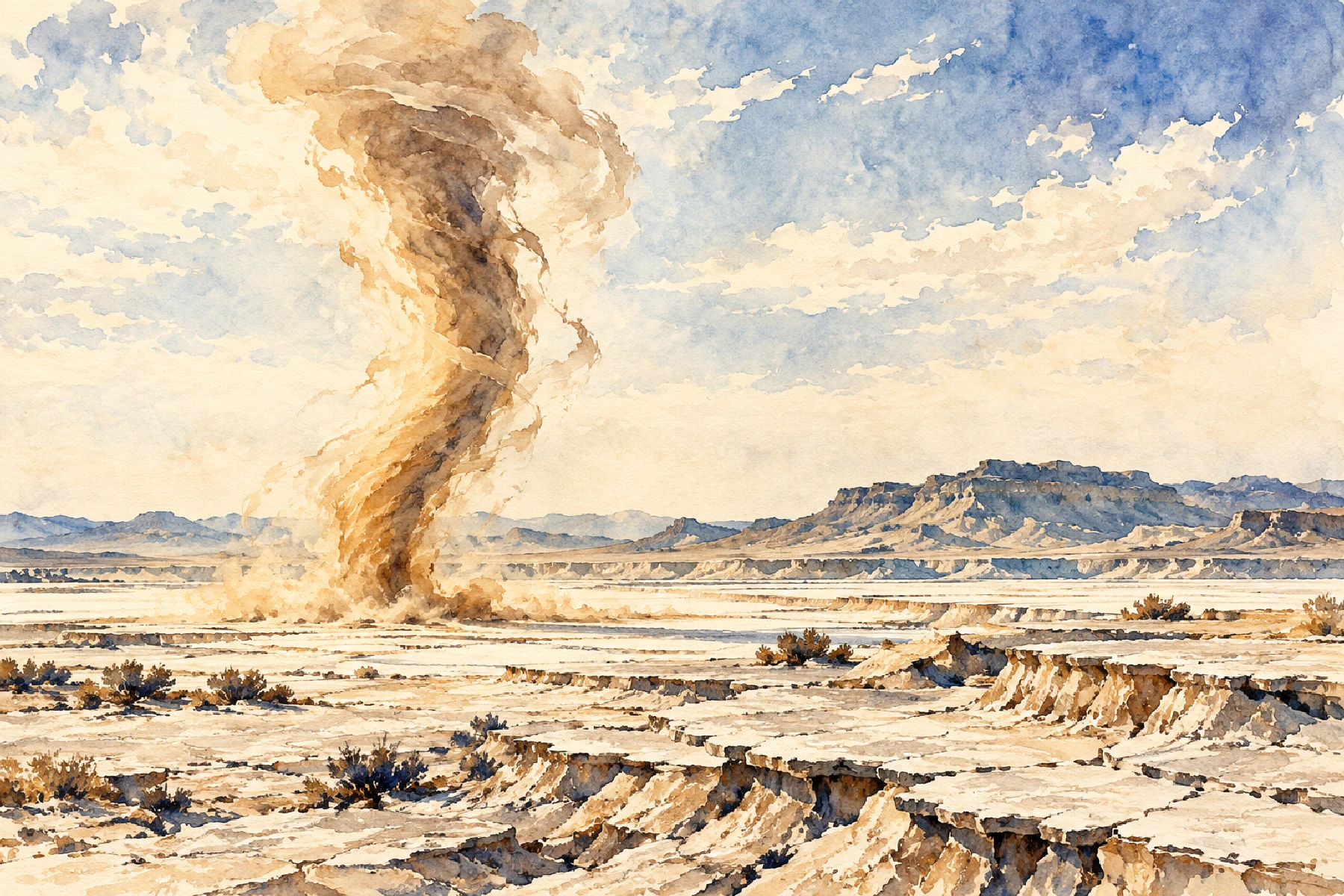
A Dust Devil Among Salt Ridges
A dust devil rises among overlapping salt ridges. Blooming ink and interrupted brushwork give the dry terrain substance beneath an expansive, nearly empty sky.
Remix this referenceA Dust Devil Among Salt Ridges
- Form language
- Reduce complex forms to unequal wedges, broad ribbons and interrupted masses; let minor shapes vary naturally.
- Contour
- Use selective brush contours that swell, taper and disappear; leave some boundaries to adjacent washes.
- Mark-making
- Alternate long diluted strokes with scratchy dry-brush catches; retain accidental skips and uneven brush pressure.
- Surface rendering
- Build tone through transparent ink-wash overlaps, soft blooms and occasional pooled edges, allowing paper to remain exposed.
Priority
Make the editorial ink wash visibly depend on brush pressure, dilution and exposed paper.
What to avoid & what to check
Exact prompt for this example
MODULE OWNERSHIP
subject: Subject count, type, stable proportions and landmarks, resting face geometry, hair shape, physical materials, garment construction and permanent marks. No emotion, movement, color assignment or rendering recipe.
expression: Facial soft-tissue displacement and pupil direction, muscle coordination, regional intensity, asymmetry and onset/peak/release. No head/body pose, stable appearance, skin color or rendering.
gesture: Head/neck/body/limb orientation, joint movement, support, contact and pose-caused occlusion using existing anatomy. No eye/pupil movement, emotion, identity, props inventory or camera.
props: Prop count, type, construction, physical material and scale relative to the subject. Holding/contact belongs to gesture, position to composition, color to palette.
scene: Environment elements, terrain, backdrop/floor presence and structural detail. No canvas positions, camera, lighting, assigned colors or render texture.
camera: Projection, focal-length impression, camera elevation/yaw/roll, viewing distance and crop. No actor pose, world placement, lighting or canvas aspect ratio.
composition: Normalized 0-100% canvas positions, scale in frame, depth/overlap, focal hierarchy and margins. No joint pose, camera projection, rendering, subject/prop inventory or emotion.
palette: Color anchors, hue/saturation/value ranges, colors assigned to parts and approximate color coverage. No illumination direction, shading algorithm, physical material or layout.
lighting: Light-source direction/softness/intensity, ambient illumination, physical shadow direction/length and highlight position. Absence of directional illumination is allowed. No shading technique, palette or material changes.
style: Reusable form abstraction, contour weight/taper/edge quality, medium and mark scale/density/direction, surface rendering and tonal transition technique. No fixed subject proportions, anatomy, identity, expression, pose, palette, light-source direction, camera or layout.
output: Image count, aspect ratio, size, file/alpha requirements and global lettering/logo/watermark restrictions. No background scenery, crop, style, identity or pose.

SUBJECT
inventory: One dust devil is the principal natural subject; no people or animals.
geometry: A pinched foot broadens into an irregular funnel with broken outer ribbons and a partly open core.
resting-face: No face or facial geometry applies.
appearance: Fine mineral dust forms translucent outer veils around denser suspended bands.

PRIORITY


AVOID


CHECK


PROPS
inventory: No separate props.
construction: No prop construction applies.

PRIORITY


AVOID


CHECK


SCENE
inventory: A dry salt basin contains low mineral ridges, cracked crust, sparse scrub and a distant eroded plateau.
structure: Salt shelves form uneven nested arcs; fractured crust exposes shallow seams between their raised edges.

PRIORITY


AVOID


CHECK


CAMERA
projection: Use natural perspective with a moderately wide lens impression and restrained edge expansion.
viewpoint: Look across the basin from a low rise, slightly downward, with a level horizon.
crop: Keep the complete dust funnel visible while cropping through the nearest salt shelves.

PRIORITY


AVOID


CHECK


COMPOSITION
placement: Place the funnel near 35% canvas width; let the nearest ridge enter broadly from the lower right.
depth: Overlap the funnel's foot with a middle ridge; successive shelves lead toward the small plateau silhouette.
spacing: Reserve almost half the image for open sky; the funnel leads, followed by the jagged foreground crust.

PRIORITY


AVOID


CHECK


PALETTE
colors: Use warm paper ivory, smoky indigo and muted ochre, with a narrow range of dusty intermediate hues.
assignment: Ivory belongs to sky and salt, ochre to dust and exposed earth, indigo to scrub and the deepest fissures.
balance: Let pale values dominate, with sparse dark accents and a modest concentration of ochre.

PRIORITY


AVOID


CHECK


LIGHTING
sources: Broad, hazy daylight arrives from the upper left with generous ambient illumination.
shadows: Low ridges cast short, soft shadows toward the right; the airborne dust has no hard cast silhouette.
highlights: Gentle highlights catch the left-facing salt lips and the exposed outer edge of the dust.

PRIORITY


AVOID


CHECK


STYLE GUIDE
form-language: Reduce complex forms to unequal wedges, broad ribbons and interrupted masses; let minor shapes vary naturally.
contour: Use selective brush contours that swell, taper and disappear; leave some boundaries to adjacent washes.
mark-making: Alternate long diluted strokes with scratchy dry-brush catches; retain accidental skips and uneven brush pressure.
surface-rendering: Build tone through transparent ink-wash overlaps, soft blooms and occasional pooled edges, allowing paper to remain exposed.

PRIORITY
Make the editorial ink wash visibly depend on brush pressure, dilution and exposed paper.

AVOID


CHECK


OUTPUT
format: One finished image, landscape 3:2, 1800 × 1200 pixels, opaque PNG; no lettering, logos or watermarks.
restrictions: One finished image, landscape 3:2, 1800 × 1200 pixels, opaque PNG; no lettering, logos or watermarks.

PRIORITY


AVOID


CHECK
Model information comes from image provenance. The same prompt may produce a different result.