Text to imageCafe & brandStyle guide
Cork Harvest on the Ridge
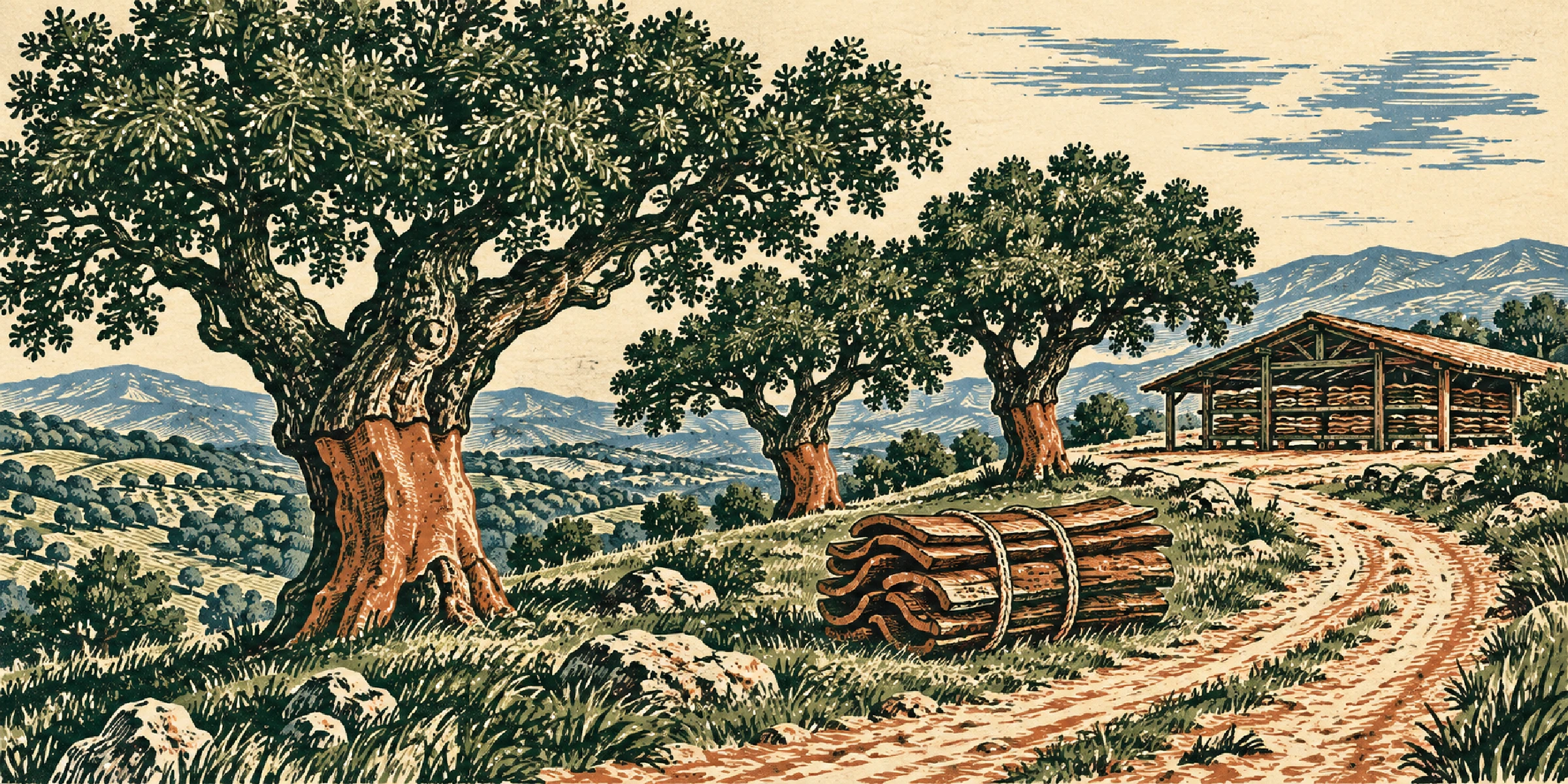
A ridge journey from stripped cork oaks to bundled bark and a drying shelter. Bold linocut masses and rhythmic carved marks create a packaging illustration for an original cork cooperative.
Remix this referenceCork Harvest on the Ridge
- Form language
- Reduce complex forms to bold interlocking masses, with irregular wedges and broad arcs retaining their handmade character.
- Contour
- Use blunt, weighty boundaries broken by occasional carved bites; taper cut ends rather than outlining every interior edge.
- Mark-making
- Carve rhythmic gouge strokes in loose directional families; vary their length and pressure so dense passages breathe.
- Surface rendering
- Print solid ink fields against exposed paper, with slight edge squeeze and uneven ink bite; cut reserves carry tonal transitions.
Priority
The defining treatment is bold linocut with visibly carved rhythmic marks.
What to avoid & what to check
Exact prompt for this example
MODULE OWNERSHIP
subject: Subject count, type, stable proportions and landmarks, resting face geometry, hair shape, physical materials, garment construction and permanent marks. No emotion, movement, color assignment or rendering recipe.
expression: Facial soft-tissue displacement and pupil direction, muscle coordination, regional intensity, asymmetry and onset/peak/release. No head/body pose, stable appearance, skin color or rendering.
gesture: Head/neck/body/limb orientation, joint movement, support, contact and pose-caused occlusion using existing anatomy. No eye/pupil movement, emotion, identity, props inventory or camera.
props: Prop count, type, construction, physical material and scale relative to the subject. Holding/contact belongs to gesture, position to composition, color to palette.
scene: Environment elements, terrain, backdrop/floor presence and structural detail. No canvas positions, camera, lighting, assigned colors or render texture.
camera: Projection, focal-length impression, camera elevation/yaw/roll, viewing distance and crop. No actor pose, world placement, lighting or canvas aspect ratio.
composition: Normalized 0-100% canvas positions, scale in frame, depth/overlap, focal hierarchy and margins. No joint pose, camera projection, rendering, subject/prop inventory or emotion.
palette: Color anchors, hue/saturation/value ranges, colors assigned to parts and approximate color coverage. No illumination direction, shading algorithm, physical material or layout.
lighting: Light-source direction/softness/intensity, ambient illumination, physical shadow direction/length and highlight position. Absence of directional illumination is allowed. No shading technique, palette or material changes.
style: Reusable form abstraction, contour weight/taper/edge quality, medium and mark scale/density/direction, surface rendering and tonal transition technique. No fixed subject proportions, anatomy, identity, expression, pose, palette, light-source direction, camera or layout.
output: Image count, aspect ratio, size, file/alpha requirements and global lettering/logo/watermark restrictions. No background scenery, crop, style, identity or pose.

SUBJECT
inventory: Three mature cork oaks are the principal subjects; no people or animals.
geometry: Low, spreading crowns rest on stout, crooked trunks with a clear cuff where the lower bark was harvested.
resting-face: No facial anatomy applies.
appearance: Thick fissured bark surrounds exposed living wood; harvest scars vary naturally between trees.

PRIORITY


AVOID


CHECK


PROPS
inventory: One tied bundle of harvested cork slabs, approximately as wide as a principal tree trunk.
construction: Curved bark sheets retain their cylindrical memory and rough edges; a simple fiber cord binds the bundle.

PRIORITY


AVOID


CHECK


SCENE
inventory: A grassy ridge, a winding earth track, scattered stones, a roofed drying shelter, and folded hills.
structure: The track connects the grove to an open timber shelter with slatted drying bays; the ridge drops into a shallow valley.

PRIORITY


AVOID


CHECK


CAMERA
projection: A gently compressed perspective with a moderate wide-lens impression.
viewpoint: View from slightly above the ridge, looking obliquely along its length with a level horizon.
crop: A distant environmental view includes complete crowns, the harvest bundle, and the shelter.

PRIORITY


AVOID


CHECK


COMPOSITION
placement: The largest oak anchors roughly 30% of the canvas width; the bundle near 55% leads toward the shelter near 80%.
depth: The nearest trunk leads the hierarchy; smaller trees overlap the ridge, the shelter recedes, and hills overlap in the distance.
spacing: An open upper band and generous gaps between crowns keep the winding journey legible across the panorama.

PRIORITY


AVOID


CHECK


PALETTE
colors: Warm parchment, deep pine green, burnt terracotta, and a restrained dusty blue.
assignment: Pine green defines crowns and intact bark; terracotta marks exposed trunks and cork; dusty blue belongs to distant hills.
balance: Parchment and green occupy broad areas; terracotta forms a recurring accent, with blue confined to the distance.

PRIORITY


AVOID


CHECK


LIGHTING
sources: Broad daylight arrives from the upper left, with enough ambient light to reveal the shelter interior.
shadows: Tree and shelter shadows extend moderately toward the lower right with softened boundaries.
highlights: Exposed trunk faces and the upper rims of cork slabs receive the strongest light.

PRIORITY


AVOID


CHECK


STYLE GUIDE
form-language: Reduce complex forms to bold interlocking masses, with irregular wedges and broad arcs retaining their handmade character.
contour: Use blunt, weighty boundaries broken by occasional carved bites; taper cut ends rather than outlining every interior edge.
mark-making: Carve rhythmic gouge strokes in loose directional families; vary their length and pressure so dense passages breathe.
surface-rendering: Print solid ink fields against exposed paper, with slight edge squeeze and uneven ink bite; cut reserves carry tonal transitions.

PRIORITY
The defining treatment is bold linocut with visibly carved rhythmic marks.

AVOID


CHECK


OUTPUT
format: One finished image, 2:1 aspect ratio, 2400 × 1200 pixels, opaque PNG.
restrictions: No lettering, logos, signatures, or watermarks.

PRIORITY


AVOID


CHECK


FINAL INTEGRATION
composition + scene + style: The environmental route and the print's alternating dense and open passages should cooperate as one continuous visual journey.
Model information comes from image provenance. The same prompt may produce a different result.