Text to imageCharacterStyle guide
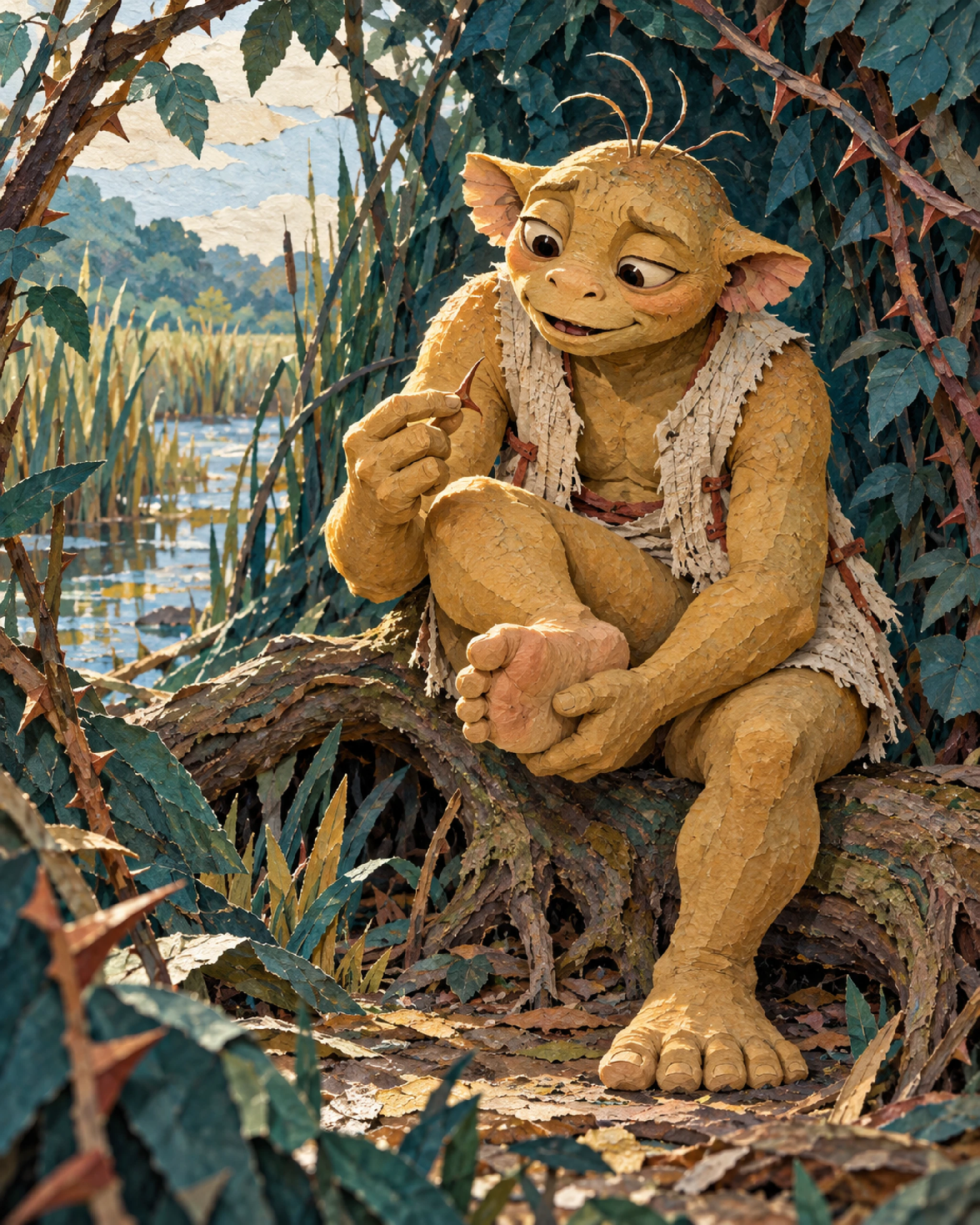
A Creature Pulling a Thorn from Its Heel
Seated on a root inside a thorn thicket, a marsh creature pulls a thorn from its heel. Thick paper overlaps and rough cut edges give tactile intimacy to this small moment of relief.
Remix this referenceA Creature Pulling a Thorn from Its Heel
- Form language
- Build forms from interlocking rounded cutouts and long irregular strips; simplify interior detail while keeping useful silhouette breaks.
- Contour
- Alternate crisp scissor edges with softly torn recesses; retain slight cutting wobbles and let paper edges carry the contour.
- Mark-making
- Use dry gouache sweeps and occasional blunt pencil flecks on the papers; vary their pressure and spacing naturally between pieces.
- Surface rendering
- Stack visibly separate paper layers with a few curled edges; create tonal changes through overlapping papers and rubbed paint veils.
Priority
The defining medium is layered cut-paper collage with tactile overlaps.
What to avoid & what to check
Exact prompt for this example
MODULE OWNERSHIP
subject: Subject count, type, stable proportions and landmarks, resting face geometry, hair shape, physical materials, garment construction and permanent marks. No emotion, movement, color assignment or rendering recipe.
expression: Facial soft-tissue displacement and pupil direction, muscle coordination, regional intensity, asymmetry and onset/peak/release. No head/body pose, stable appearance, skin color or rendering.
gesture: Head/neck/body/limb orientation, joint movement, support, contact and pose-caused occlusion using existing anatomy. No eye/pupil movement, emotion, identity, props inventory or camera.
props: Prop count, type, construction, physical material and scale relative to the subject. Holding/contact belongs to gesture, position to composition, color to palette.
scene: Environment elements, terrain, backdrop/floor presence and structural detail. No canvas positions, camera, lighting, assigned colors or render texture.
camera: Projection, focal-length impression, camera elevation/yaw/roll, viewing distance and crop. No actor pose, world placement, lighting or canvas aspect ratio.
composition: Normalized 0-100% canvas positions, scale in frame, depth/overlap, focal hierarchy and margins. No joint pose, camera projection, rendering, subject/prop inventory or emotion.
palette: Color anchors, hue/saturation/value ranges, colors assigned to parts and approximate color coverage. No illumination direction, shading algorithm, physical material or layout.
lighting: Light-source direction/softness/intensity, ambient illumination, physical shadow direction/length and highlight position. Absence of directional illumination is allowed. No shading technique, palette or material changes.
style: Reusable form abstraction, contour weight/taper/edge quality, medium and mark scale/density/direction, surface rendering and tonal transition technique. No fixed subject proportions, anatomy, identity, expression, pose, palette, light-source direction, camera or layout.
output: Image count, aspect ratio, size, file/alpha requirements and global lettering/logo/watermark restrictions. No background scenery, crop, style, identity or pose.

SUBJECT
inventory: One original adult marsh creature, actor A, with bare feet and a woven sleeveless wrap vest.
geometry: A compact barrel torso, long supple arms, broad feet, a short muzzle and small fan-shaped ears define its construction.
resting-face: The resting face has shallow brow ridges, broad oval eye openings, a blunt nose and a wide, softly curved mouth.
appearance: Fine pebbled skin, three wiry crown hairs and a frayed vest hem distinguish it; minor surface details may vary.

PRIORITY


AVOID


CHECK


EXPRESSION — ACTOR A
brows: The inner brows begin to loosen from a slight upward pinch.
lids: Upper lids settle lower while the eyes remain visibly open.
cheeks: Cheek tension softens, with a faint lift on one side.
nose: The nostrils relax without a nose wrinkle.
mouth: Lips part for a small exhale; one corner begins to rise.
jaw: The jaw releases slightly from its previous clench.
gaze: Both pupils look down toward the newly extracted thorn.
coordination: Residual brow tension and the emerging uneven smile coexist.
timing: Capture relief at onset, just as the first held breath escapes.

PRIORITY


AVOID


CHECK


GESTURE
head: A lowers its chin toward the raised foot, keeping the face clear of its forearms.
torso: Seated on the root, A folds forward in a loose curve with its weight settled through the hips.
limbs: One knee lifts across the lap; the other foot rests on the ground as both elbows open around the raised heel.
contact: One hand cups the heel while the other pinches the thorn just clear of the skin, completing the pull.

PRIORITY


AVOID


CHECK


PROPS
inventory: One detached woody thorn, approximately the length of A's fingertip.
construction: The thorn has a gently hooked point, a thick broken base and a rigid woody surface.

PRIORITY


AVOID


CHECK


SCENE
inventory: A sheltered marsh thicket contains an exposed root seat, arching thorn canes, reed beds and damp ground.
structure: Interlaced canes form a partial natural enclosure; a break in the reeds opens onto a narrow marsh channel.

PRIORITY


AVOID


CHECK


CAMERA
projection: Use natural perspective with a normal-lens impression and restrained foreshortening.
viewpoint: View from seated eye height at a gentle three-quarter yaw, with no camera roll.
crop: A medium-wide full-figure view includes the feet and enough surrounding thicket to feel enclosed.

PRIORITY


AVOID


CHECK


COMPOSITION
placement: Place A right of center; the face, hands and raised heel form a descending diagonal across the open interior.
depth: Cropped foreground canes overlap the root; A occupies the middle layer, with the channel receding beyond.
spacing: Make the hand–thorn–heel cluster the focal point and the face secondary; preserve open gaps around both.

PRIORITY


AVOID


CHECK


PALETTE
colors: Use deep petrol teal, earthy ochre, warm ivory and restrained rusty red as the principal anchors.
assignment: Assign ochre to A's skin, ivory to the vest, teal to the thicket and rusty red to the thorn and vest binding.
balance: Let subdued teal dominate, with a broad warm character mass and small red accents; allow related paper-tone variations.

PRIORITY


AVOID


CHECK


LIGHTING
sources: Broad soft daylight enters from the upper left, supported by gentle ambient light inside the thicket.
shadows: Short soft shadows fall toward the lower right; narrow contact shadows reveal lifted paper edges and overlaps.
highlights: Keep highlights broad and quiet on upper-left-facing surfaces, without sharp glints.

PRIORITY


AVOID


CHECK


STYLE GUIDE
form-language: Build forms from interlocking rounded cutouts and long irregular strips; simplify interior detail while keeping useful silhouette breaks.
contour: Alternate crisp scissor edges with softly torn recesses; retain slight cutting wobbles and let paper edges carry the contour.
mark-making: Use dry gouache sweeps and occasional blunt pencil flecks on the papers; vary their pressure and spacing naturally between pieces.
surface-rendering: Stack visibly separate paper layers with a few curled edges; create tonal changes through overlapping papers and rubbed paint veils.

PRIORITY
The defining medium is layered cut-paper collage with tactile overlaps.

AVOID


CHECK


OUTPUT
format: Deliver one finished image in a portrait 4:5 aspect ratio, 2048 × 2560 pixels, as an opaque PNG.
restrictions: No lettering, logos or watermarks.

PRIORITY


AVOID


CHECK


FINAL INTEGRATION
expression + gesture: Synchronize the facial transition with the completed extraction so the moment reads as one continuous action.
composition + style + lighting: Let layer separation support spatial readability while preserving the composition's hierarchy.
Model information comes from image provenance. The same prompt may produce a different result.