Text to imageAnimationStyle guide
Her Hand Beside the Small Handprint
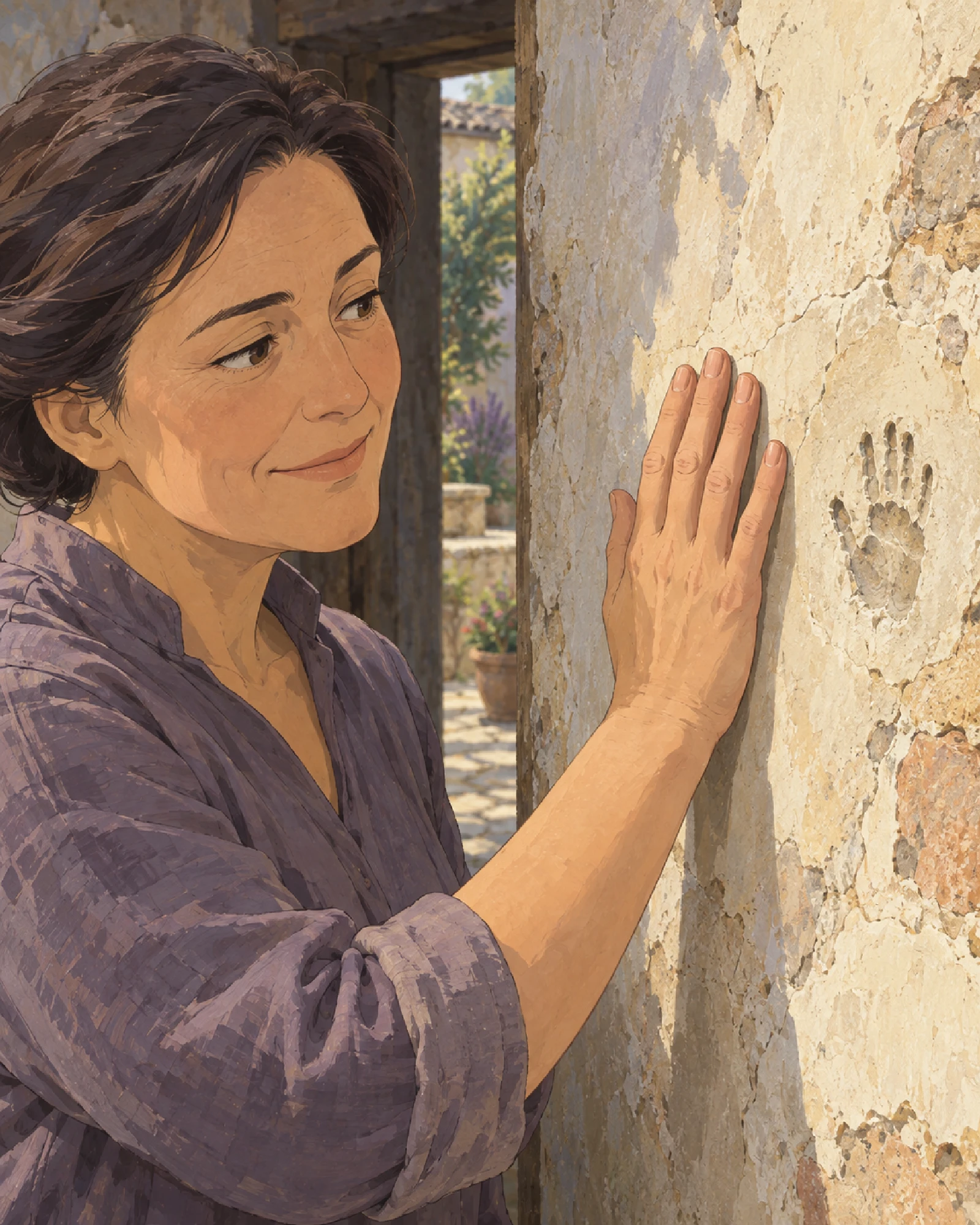
A woman rests her palm beside a small handprint in an old courtyard wall, a faint smile settling across her face. The intimate view pairs hand and face with painted plaster that carries the feeling of elapsed time.
Remix this referenceHer Hand Beside the Small Handprint
- Form language
- Establish broad interlocking form planes, then describe smaller surface changes with irregular painted patches; simplify minor detail freely.
- Contour
- Use alternating firm and softened painted boundaries, with occasional lost edges instead of a continuous enclosing outline.
- Mark-making
- Overlap broad brush traces along surface planes, adding sparse dry-brush breaks; let stroke width and pressure vary naturally.
- Surface rendering
- Build opaque hand-painted layers over shallow paper-and-pigment grain; blend tonal transitions unevenly while retaining patches of visible brushwork.
Priority
Rendering medium: 2D hand-painted animated-film background illustration; formal rendering reference: Studio Ghibli · 2020s · The Boy and the Heron (2023), background art
What to avoid & what to check
Exact prompt for this example
MODULE OWNERSHIP
subject: Subject count, type, stable proportions and landmarks, resting face geometry, hair shape, physical materials, garment construction and permanent marks. No emotion, movement, color assignment or rendering recipe.
expression: Facial soft-tissue displacement and pupil direction, muscle coordination, regional intensity, asymmetry and onset/peak/release. No head/body pose, stable appearance, skin color or rendering.
gesture: Head/neck/body/limb orientation, joint movement, support, contact and pose-caused occlusion using existing anatomy. No eye/pupil movement, emotion, identity, props inventory or camera.
props: Prop count, type, construction, physical material and scale relative to the subject. Holding/contact belongs to gesture, position to composition, color to palette.
scene: Environment elements, terrain, backdrop/floor presence and structural detail. No canvas positions, camera, lighting, assigned colors or render texture.
camera: Projection, focal-length impression, camera elevation/yaw/roll, viewing distance and crop. No actor pose, world placement, lighting or canvas aspect ratio.
composition: Normalized 0-100% canvas positions, scale in frame, depth/overlap, focal hierarchy and margins. No joint pose, camera projection, rendering, subject/prop inventory or emotion.
palette: Color anchors, hue/saturation/value ranges, colors assigned to parts and approximate color coverage. No illumination direction, shading algorithm, physical material or layout.
lighting: Light-source direction/softness/intensity, ambient illumination, physical shadow direction/length and highlight position. Absence of directional illumination is allowed. No shading technique, palette or material changes.
style: Reusable form abstraction, contour weight/taper/edge quality, medium and mark scale/density/direction, surface rendering and tonal transition technique. No fixed subject proportions, anatomy, identity, expression, pose, palette, light-source direction, camera or layout.
output: Image count, aspect ratio, size, file/alpha requirements and global lettering/logo/watermark restrictions. No background scenery, crop, style, identity or pose.

SUBJECT
inventory: One original middle-aged human woman, actor A; no other figures.
geometry: Sturdy adult build, a long oval face, broad palms and a slightly prominent bridge of the nose.
resting-face: Straight brows, softly hooded eyes, a broad lower lip and shallow creases beside the mouth.
appearance: Short hair swept behind the ears; a linen work shirt with a soft standing collar and rolled cuffs.

PRIORITY


AVOID


CHECK


EXPRESSION — ACTOR A
brows: Brows ease into nearly level arcs without a central pinch.
lids: Upper lids soften downward; lower lids rise only slightly.
cheeks: A small cheek lift gathers the creases beside the mouth.
nose: Nostrils remain relaxed, with no wrinkling at the bridge.
mouth: Closed lips form a faint smile, one corner slightly higher.
jaw: Jaw tension releases while the lips remain together.
gaze: Pupils turn toward the small handprint.
coordination: The slight mouth asymmetry leads; the upper face stays quiet.
timing: Catch the release as the smile settles rather than expands.

PRIORITY


AVOID


CHECK


GESTURE
head: Her head inclines gently toward the raised hand, with the neck comfortably extended.
torso: The torso turns toward the wall with a slight forward lean.
limbs: One elbow bends to bring the open hand upward; fingers spread loosely with a relaxed wrist.
contact: The palm and fingertips rest against the plaster beside the smaller impression without covering it.

PRIORITY


AVOID


CHECK


PROPS
inventory: No separate props.
construction: No prop construction applies.

PRIORITY


AVOID


CHECK


SCENE
inventory: An enclosed courtyard with an aged lime-plaster wall, a small recessed handprint and a narrow doorway.
structure: The handprint belongs to an older plaster patch; worn edges reveal underlying masonry, with courtyard paving below.

PRIORITY


AVOID


CHECK


CAMERA
projection: Natural perspective with a mild long-lens impression and little near-to-far enlargement.
viewpoint: An intimate eye-level view oblique to the wall, showing the woman's face in three-quarter view.
crop: Frame from the crown to the upper chest, retaining the complete raised hand; crop through the outer shoulder.

PRIORITY


AVOID


CHECK


COMPOSITION
placement: Face in the left third; palm and smaller handprint share the right half, with the handprint as the first focal accent.
depth: The large face and hand lead into the wall plane; a slim glimpse through the doorway supplies a deeper interval.
spacing: Keep a clear strip of plaster between the two hand shapes and quiet breathing room above the small impression.

PRIORITY


AVOID


CHECK


PALETTE
colors: Chalk cream, muted apricot, dusty violet and deep aubergine; restrained saturation with a broad middle-value range.
assignment: Cream plaster, apricot skin, dusty-violet shirt and aubergine hair; the old patch shifts toward pale clay.
balance: Pale neutrals occupy most of the image; muted violet forms the secondary color mass and deep accents stay sparse.

PRIORITY


AVOID


CHECK


LIGHTING
sources: Soft daylight enters from the upper right, with generous ambient light returning from the courtyard.
shadows: The hand casts a short, soft shadow down-left; shallow recesses retain enough shade to reveal the old impression.
highlights: Broad highlights touch the upper-right cheek, finger ridges and raised plaster edges.

PRIORITY


AVOID


CHECK


STYLE GUIDE
form-language: Establish broad interlocking form planes, then describe smaller surface changes with irregular painted patches; simplify minor detail freely.
contour: Use alternating firm and softened painted boundaries, with occasional lost edges instead of a continuous enclosing outline.
mark-making: Overlap broad brush traces along surface planes, adding sparse dry-brush breaks; let stroke width and pressure vary naturally.
surface-rendering: Build opaque hand-painted layers over shallow paper-and-pigment grain; blend tonal transitions unevenly while retaining patches of visible brushwork.

PRIORITY
Rendering medium: 2D hand-painted animated-film background illustration; formal rendering reference: Studio Ghibli · 2020s · The Boy and the Heron (2023), background art

AVOID


CHECK


OUTPUT
format: One finished image, portrait 4:5 aspect ratio, 1600 × 2000 pixels, opaque PNG.
restrictions: No lettering, logos, signatures or watermarks.

PRIORITY


AVOID


CHECK


FINAL INTEGRATION
gesture + scene + lighting: Contact and the wall relief should agree with the cast shadow so the touch reads immediately.
Art direction
스튜디오 지브리 / Studio Ghibli · 2020s · 그대들은 어떻게 살 것인가(2023)의 배경 미술 / The Boy and the Heron (2023), background art ↗- Establish broad form planes before describing smaller surface variations with painted patches
- Use hard and soft painted boundaries rather than strong continuous outlines
- Overlapping brush traces following the plane direction with sparse dry-brush marks
- Shallow paper-and-pigment texture, uneven painted planes and blended tonal transitions
Model information comes from image provenance. The same prompt may produce a different result.