Text to imageCafe & brandStyle guide
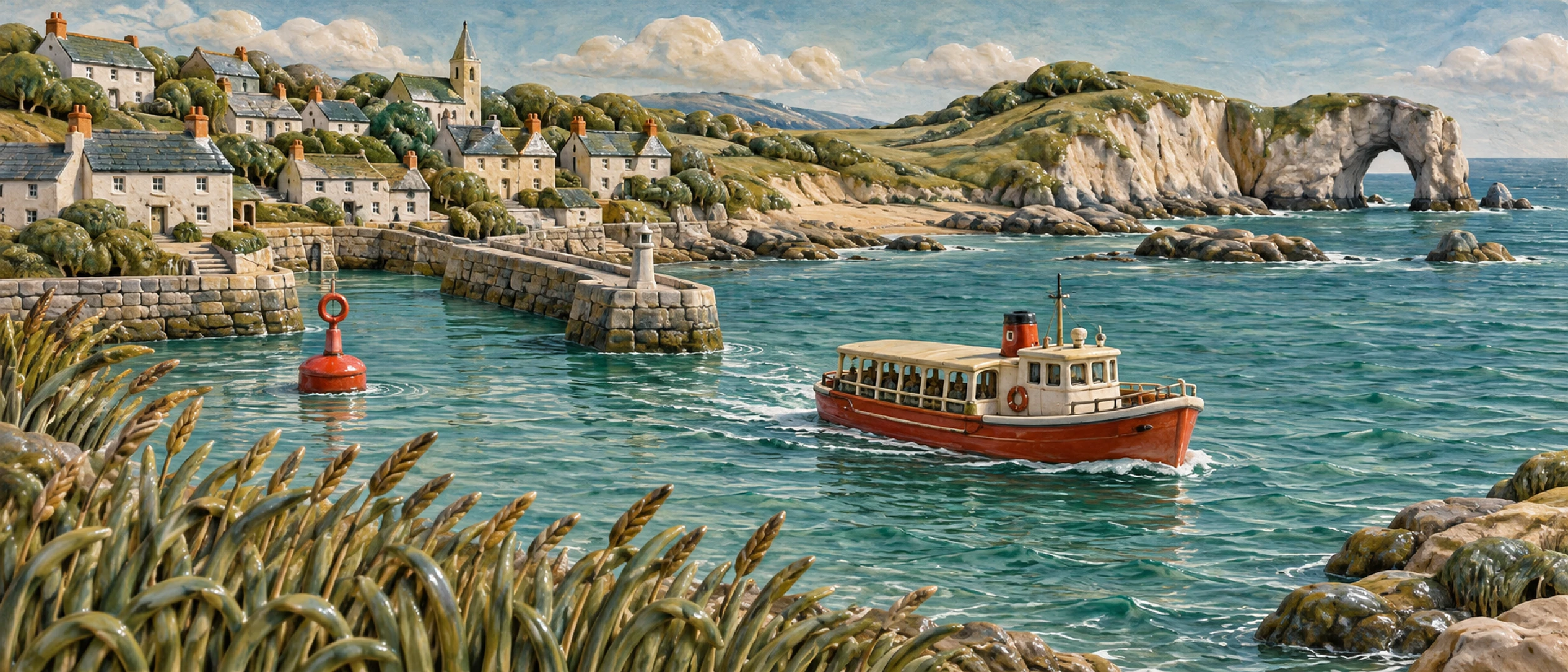
Ferry Through a Reed Harbor
A panoramic brand illustration for an original coastal ferry cooperative. A journey through reed channels, a harbor and a sea arch unfolds in rounded ceramic relief with deeply pooled glaze.
Remix this referenceFerry Through a Reed Harbor
- Form language
- Abstract forms as hand-modeled ceramic relief: rounded masses, shallow nested recesses and swollen connecting bands with handmade variation, rather than miniature realism in every secondary detail.
- Contour
- Use rolled irregular rims and occasional incised separations; edges feel pressed and rounded, with naturally changing thickness, leaving the silhouette softly handmade instead of mechanically uniform.
- Mark-making
- Sparse thumb depressions and sweeping tool grooves follow broad surfaces; let their rhythm and depth vary without blanket decoration, keeping expressive making traces subordinate to the modeled masses.
- Surface rendering
- Use curved continuous modeling, translucent glaze pooling in recesses and occasional cloudy glaze shifts; retain tactile body beneath the sheen, with gentle variations in opacity and surface fullness.
Priority
Let pooled glaze and modeled rims define the medium.
What to avoid & what to check
Avoid uniform plastic gloss.
Does the treatment visibly feel hand-modeled and glazed?
Exact prompt for this example
MODULE OWNERSHIP
subject: Subject count, type, stable proportions and landmarks, resting face geometry, hair shape, physical materials, garment construction and permanent marks. No emotion, movement, color assignment or rendering recipe.
expression: Facial soft-tissue displacement and pupil direction, muscle coordination, regional intensity, asymmetry and onset/peak/release. No head/body pose, stable appearance, skin color or rendering.
gesture: Head/neck/body/limb orientation, joint movement, support, contact and pose-caused occlusion using existing anatomy. No eye/pupil movement, emotion, identity, props inventory or camera.
props: Prop count, type, construction, physical material and scale relative to the subject. Holding/contact belongs to gesture, position to composition, color to palette.
scene: Environment elements, terrain, backdrop/floor presence and structural detail. No canvas positions, camera, lighting, assigned colors or render texture.
camera: Projection, focal-length impression, camera elevation/yaw/roll, viewing distance and crop. No actor pose, world placement, lighting or canvas aspect ratio.
composition: Normalized 0-100% canvas positions, scale in frame, depth/overlap, focal hierarchy and margins. No joint pose, camera projection, rendering, subject/prop inventory or emotion.
palette: Color anchors, hue/saturation/value ranges, colors assigned to parts and approximate color coverage. No illumination direction, shading algorithm, physical material or layout.
lighting: Light-source direction/softness/intensity, ambient illumination, physical shadow direction/length and highlight position. Absence of directional illumination is allowed. No shading technique, palette or material changes.
style: Reusable form abstraction, contour weight/taper/edge quality, medium and mark scale/density/direction, surface rendering and tonal transition technique. No fixed subject proportions, anatomy, identity, expression, pose, palette, light-source direction, camera or layout.
output: Image count, aspect ratio, size, file/alpha requirements and global lettering/logo/watermark restrictions. No background scenery, crop, style, identity or pose.

SUBJECT
inventory: One original small passenger ferry, recognizable as an everyday coastal service vessel.
geometry: A broad shallow hull carries a compact cabin, sheltered passenger deck and short upright funnel; the bow has a rounded shoulder.
appearance: Painted timber hull, metal cabin roof and continuous deck rail; small fittings may vary within sturdy working-vessel construction.

PRIORITY
Keep the broad hull and sheltered deck recognizable.

AVOID
Avoid luxury-yacht proportions.

CHECK
Does the vessel read as an everyday passenger ferry?

PROPS
inventory: One navigation buoy, substantially smaller than the ferry cabin; retain a compact working-harbor scale.
construction: A squat metal float supports a narrow stem and hollow circular top marker, joined with simple robust connections.

PRIORITY
Keep the open circular marker distinctive.

AVOID
Avoid elaborate navigation equipment.

CHECK
Is the buoy recognizable through its simple construction?

SCENE
inventory: A reed-lined tidal channel, modest harbor village, stone landing and headland with a natural sea arch form a continuous coast.
structure: The channel opens through the harbor into the sea; hillside cottages, low quay walls and branching passages articulate the route.

PRIORITY
Connect the sheltered channel to the open coast.

AVOID
Avoid disconnected scenic symbols.

CHECK
Do harbor and arch belong to one continuous shoreline?

CAMERA
projection: Use gently compressed perspective with a moderate long-lens impression, retaining depth and restrained convergence.
viewpoint: Look across the bay from a slightly elevated oblique viewpoint that reveals the channel connections.
crop: Take a broad environmental view with the entire ferry included; shoreline extensions may continue beyond the lateral crop.

PRIORITY
Reveal the route through an inviting view across the bay.

AVOID
Avoid steep aerial mapping.

CHECK
Are channel connections visible without flattening the bay?

COMPOSITION
placement: Set the ferry near 65% canvas width, below the middle, as the main focal accent; the buoy is a smaller secondary counterpoint on the harbor side.
depth: Foreground reeds overlap the water entrance, the village forms a middle layer, and the distant arch concludes the visual journey.
spacing: A spacious water ribbon connects denser land clusters; generous breathing room around the ferry keeps the panorama open.

PRIORITY
Lead attention along the passage to the ferry and arch.

AVOID
Avoid equally weighted landmarks arranged like icons.

CHECK
Does one ferry accent anchor the panoramic journey?

PALETTE
colors: Use sea-glass teal, warm chalk, muted reed olive and persimmon red, with deep petrol for the darkest accents.
assignment: Give water teal, cottages and cliffs chalk, reeds olive, and the ferry hull and buoy marker persimmon.
balance: Cool water forms the broadest color area; limited warm accents establish recognition within the restrained coastal range.

PRIORITY
Make the persimmon ferry the memorable warm anchor.

AVOID
Avoid saturated accents on every landmark.

CHECK
Is the ferry the strongest warm color signal?

LIGHTING
sources: Broad soft daylight enters from the upper left, supported by gentle ambient illumination.
shadows: Short softened shadows fall toward the lower right, revealing raised edges without deep theatrical darkness.
highlights: Broad highlights catch upper-left ridges, with brighter glints on the ferry roof and water crests.

PRIORITY
Keep the daylight soft and gently grazing.

AVOID
Avoid hard spotlight pools.

CHECK
Are raised edges readable under one daylight direction?

STYLE GUIDE
form-language: Abstract forms as hand-modeled ceramic relief: rounded masses, shallow nested recesses and swollen connecting bands with handmade variation, rather than miniature realism in every secondary detail.
contour: Use rolled irregular rims and occasional incised separations; edges feel pressed and rounded, with naturally changing thickness, leaving the silhouette softly handmade instead of mechanically uniform.
mark-making: Sparse thumb depressions and sweeping tool grooves follow broad surfaces; let their rhythm and depth vary without blanket decoration, keeping expressive making traces subordinate to the modeled masses.
surface-rendering: Use curved continuous modeling, translucent glaze pooling in recesses and occasional cloudy glaze shifts; retain tactile body beneath the sheen, with gentle variations in opacity and surface fullness.

PRIORITY
Let pooled glaze and modeled rims define the medium.

AVOID
Avoid uniform plastic gloss.

CHECK
Does the treatment visibly feel hand-modeled and glazed?

OUTPUT
format: One finished opaque PNG, 21:9 aspect ratio, 2520 × 1080 pixels‚ suitable as a standalone panoramic brand artwork without supplementary delivery panels.
restrictions: No lettering, logos, watermarks or presentation mockups; deliver the illustration as the finished brand asset.

PRIORITY
Deliver one complete panoramic PNG.

AVOID
Avoid supplementary application mockups.

CHECK
Is the single PNG ready for use as artwork?

FINAL INTEGRATION
scene + camera + composition: Environmental continuity and viewing relationships cooperate with focal hierarchy to make the journey readable.
style + lighting + palette: Soft grazing daylight and ceramic surface treatment cooperate to reveal relief depth, while the color hierarchy preserves brand recognition.
Model information comes from image provenance. The same prompt may produce a different result.