Text to imageCafe & brandStyle guide
Unrolling Cork Through the Studio
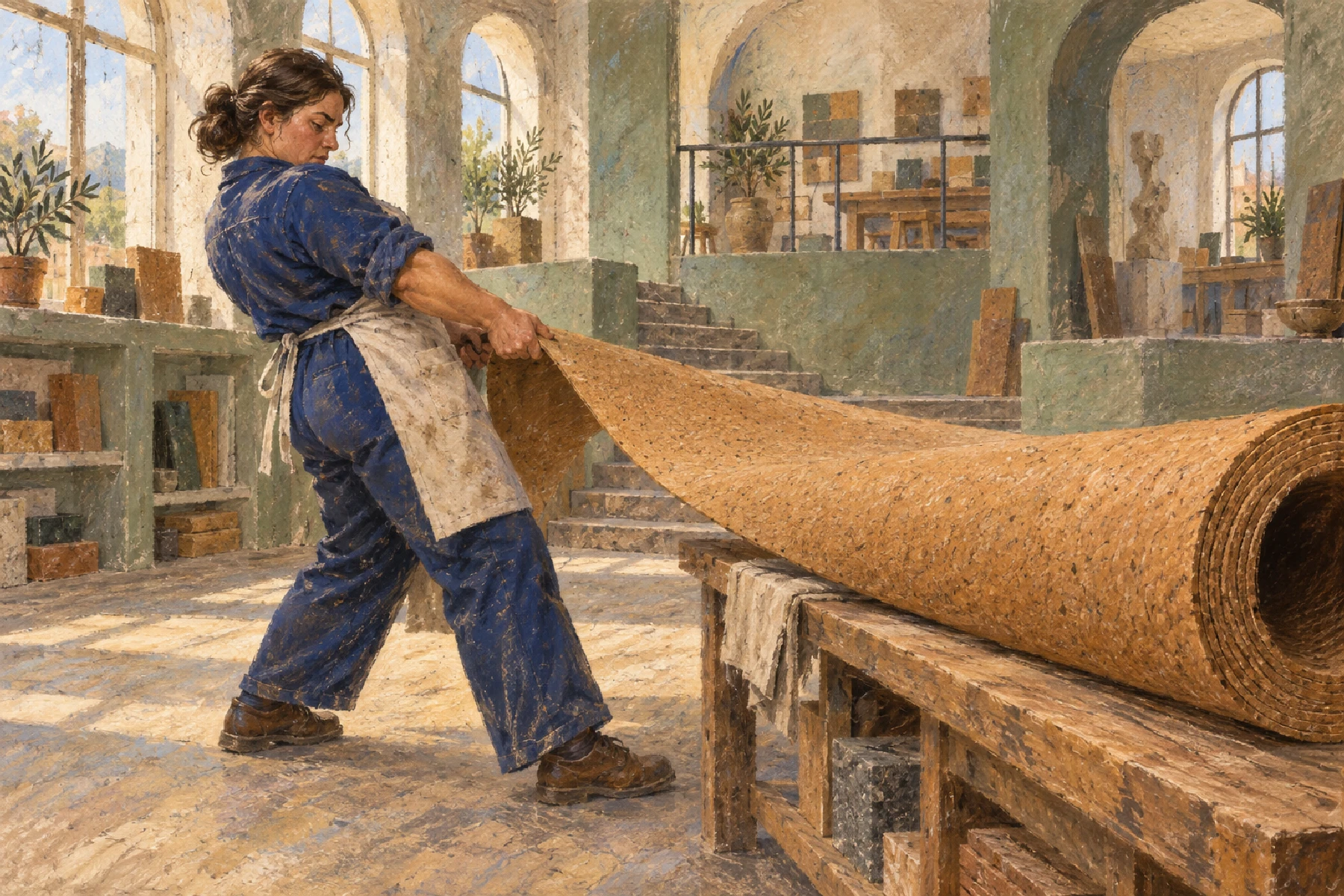
A craftswoman pulls a cork sheet through a layered studio. Rubbed and scratched oil pastel makes the material's flexibility tangible in a flooring brand illustration.
Remix this referenceUnrolling Cork Through the Studio
- Form language
- Simplify forms into swelling planes and gently bowed masses; let minor details vary within this broad, tactile language.
- Contour
- Use broken, waxy contours that thicken at turns and disappear into rubbed edges, leaving some boundaries open.
- Mark-making
- Drag oil pastel in broad overlapping strokes, rub selected passages, then scratch sparse wandering lines through the deposits.
- Surface rendering
- Build dreamy tonal transitions from smeared veils and dense wax islands, allowing underlayers to emerge unevenly.
Priority
Keep rubbed wax and scratched-through marks visibly integral to the oil-pastel image.
What to avoid & what to check
Exact prompt for this example
MODULE OWNERSHIP
subject: Subject count, type, stable proportions and landmarks, resting face geometry, hair shape, physical materials, garment construction and permanent marks. No emotion, movement, color assignment or rendering recipe.
expression: Facial soft-tissue displacement and pupil direction, muscle coordination, regional intensity, asymmetry and onset/peak/release. No head/body pose, stable appearance, skin color or rendering.
gesture: Head/neck/body/limb orientation, joint movement, support, contact and pose-caused occlusion using existing anatomy. No eye/pupil movement, emotion, identity, props inventory or camera.
props: Prop count, type, construction, physical material and scale relative to the subject. Holding/contact belongs to gesture, position to composition, color to palette.
scene: Environment elements, terrain, backdrop/floor presence and structural detail. No canvas positions, camera, lighting, assigned colors or render texture.
camera: Projection, focal-length impression, camera elevation/yaw/roll, viewing distance and crop. No actor pose, world placement, lighting or canvas aspect ratio.
composition: Normalized 0-100% canvas positions, scale in frame, depth/overlap, focal hierarchy and margins. No joint pose, camera projection, rendering, subject/prop inventory or emotion.
palette: Color anchors, hue/saturation/value ranges, colors assigned to parts and approximate color coverage. No illumination direction, shading algorithm, physical material or layout.
lighting: Light-source direction/softness/intensity, ambient illumination, physical shadow direction/length and highlight position. Absence of directional illumination is allowed. No shading technique, palette or material changes.
style: Reusable form abstraction, contour weight/taper/edge quality, medium and mark scale/density/direction, surface rendering and tonal transition technique. No fixed subject proportions, anatomy, identity, expression, pose, palette, light-source direction, camera or layout.
output: Image count, aspect ratio, size, file/alpha requirements and global lettering/logo/watermark restrictions. No background scenery, crop, style, identity or pose.

SUBJECT
inventory: One adult craftswoman, actor A; no other people or animals.
geometry: A has a sturdy build, broad shoulders and large, square-ended hands.
resting-face: Her resting features have straight brows, heavy upper lids, a rounded nose tip and a broad chin.
appearance: Hair forms a low coiled knot; a canvas apron overlaps loose work trousers and plain leather shoes.

PRIORITY


AVOID


CHECK


EXPRESSION — ACTOR A
brows: The visible brow draws slightly inward and down; the hidden brow remains unprescribed.
lids: The visible upper lid lowers slightly, with a small tightening of the lower lid.
cheeks: The visible cheek firms subtly beside the mouth without lifting into a smile.
nose: The visible nostril stays relaxed and the nose bridge remains unwrinkled.
mouth: Lips meet lightly; the visible corner stays level with a trace of compression.
jaw: The jaw stays nearly closed without a pronounced clench.
gaze: The visible pupil angles down toward the lifted sheet edge.
coordination: The brow and lids carry the effort while the lower face stays comparatively relaxed.
timing: Hold the apex of mild facial effort, before it develops into a grimace.

PRIORITY


AVOID


CHECK


GESTURE
head: A turns her head toward the lifted sheet edge, revealing the near cheek and profile.
torso: Her torso leans backward against the pull, with a small twist through the shoulders.
limbs: Both arms draw toward her waist; one knee bends while the other leg braces behind her.
contact: Both hands grip the sheet's free edge; her feet bear weight while the remaining sheet rests over a bench.

PRIORITY


AVOID


CHECK


PROPS
inventory: One partially unfurled cork flooring roll, approximately as wide as A's outstretched arms.
construction: A thick, flexible cork sheet forms an open cylinder and a continuous broad tongue with a blunt cut edge.

PRIORITY


AVOID


CHECK


SCENE
inventory: A sunken materials studio contains a long workbench, shallow floor terraces, sample niches and arched windows.
structure: Open partitions connect the work area to a raised gallery; broad steps join the floor levels.

PRIORITY


AVOID


CHECK


CAMERA
projection: Moderately wide perspective with gentle spatial expansion and no fisheye distortion.
viewpoint: Look from slightly above waist height in a rear three-quarter view, with a level camera.
crop: Use an environmental full-body view; allow the nearest end of the roll to continue beyond the image.

PRIORITY


AVOID


CHECK


COMPOSITION
placement: Place A left of center and the roll at the lower right; the sheet sweeps diagonally between them.
depth: The near roll overlaps the bench; A occupies the middle layer, with partitions and the gallery receding behind.
spacing: Make the gripping hands and lifted sheet edge the focus; leave generous open floor beside the diagonal.

PRIORITY


AVOID


CHECK


PALETTE
colors: Use toasted ochre, deep ultramarine, dusty celery and warm chalk, with restrained saturation.
assignment: Cork is ochre; workwear is ultramarine; partitions are celery; window openings and apron are warm chalk.
balance: Let muted architectural colors dominate, with the ochre sheet forming the broadest saturated passage.

PRIORITY


AVOID


CHECK


LIGHTING
sources: Broad, soft daylight enters from the upper left, supported by gentle ambient illumination.
shadows: Broad, soft-edged shadows fall toward the lower right, gathering beneath the bench and sheet folds.
highlights: Broad highlights follow the sheet's lifted crest and the upper edges of the shoulders.

PRIORITY


AVOID


CHECK


STYLE GUIDE
form-language: Simplify forms into swelling planes and gently bowed masses; let minor details vary within this broad, tactile language.
contour: Use broken, waxy contours that thicken at turns and disappear into rubbed edges, leaving some boundaries open.
mark-making: Drag oil pastel in broad overlapping strokes, rub selected passages, then scratch sparse wandering lines through the deposits.
surface-rendering: Build dreamy tonal transitions from smeared veils and dense wax islands, allowing underlayers to emerge unevenly.

PRIORITY
Keep rubbed wax and scratched-through marks visibly integral to the oil-pastel image.

AVOID


CHECK


OUTPUT
format: One finished image, landscape 3:2, 1800 × 1200 pixels, opaque PNG.
restrictions: No lettering, logos, slogans or watermarks.

PRIORITY


AVOID


CHECK


FINAL INTEGRATION
expression + gesture: Coordinate the restrained facial effort with the larger physical exertion.
gesture + props + composition: Let the material's continuity connect the action to the layered arrangement.
style + lighting: Preserve the broad illumination beneath the freely worked pastel surface.
Model information comes from image provenance. The same prompt may produce a different result.