Text to imageCharacterStyle guide
A Long-Armed Creature Taking a Bow
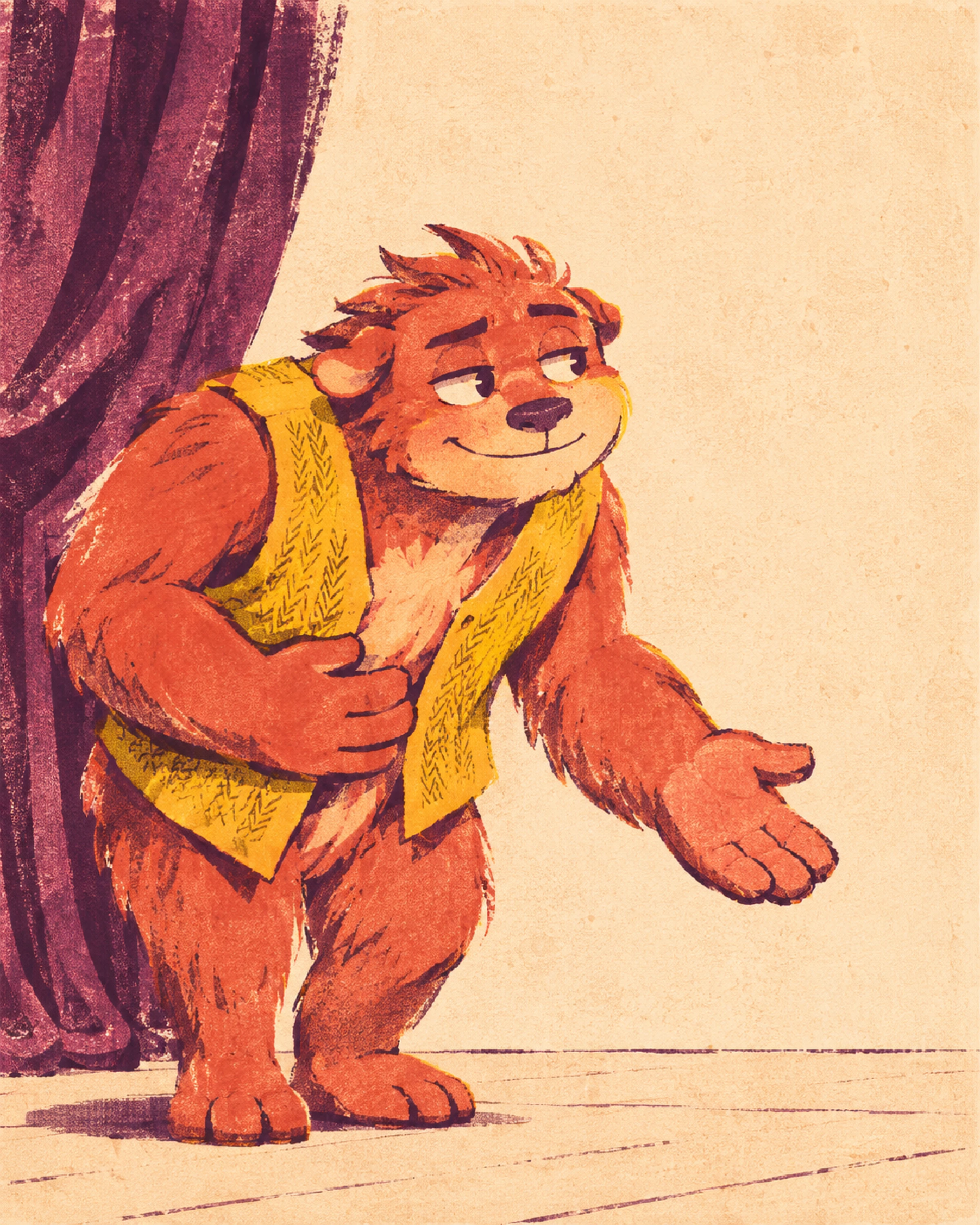
A long-armed creature makes an awkward bow beside a stage curtain. Ragged ink strokes and offset spot-color impressions give the shy moment a lively printed presence.
Remix this referenceA Long-Armed Creature Taking a Bow
- Form language
- Simplify forms into elastic lobes and blunt wedges, allowing irregular silhouettes and uneven interior shapes.
- Contour
- Use loaded brush contours that swell, taper, and occasionally break into dry bristles; leave selected edges unclosed.
- Mark-making
- Combine broad ink sweeps with sparse scratchy hatch clusters; let pressure and stroke length vary naturally.
- Surface rendering
- Layer translucent screenprinted shapes over absorbent ink, with slight registration drift, broken deposits, and pooled tonal edges.
Priority
Make the friction between spontaneous brush ink and imperfect print impressions visibly defining.
What to avoid & what to check
Exact prompt for this example
MODULE OWNERSHIP
subject: Subject count, type, stable proportions and landmarks, resting face geometry, hair shape, physical materials, garment construction and permanent marks. No emotion, movement, color assignment or rendering recipe.
expression: Facial soft-tissue displacement and pupil direction, muscle coordination, regional intensity, asymmetry and onset/peak/release. No head/body pose, stable appearance, skin color or rendering.
gesture: Head/neck/body/limb orientation, joint movement, support, contact and pose-caused occlusion using existing anatomy. No eye/pupil movement, emotion, identity, props inventory or camera.
props: Prop count, type, construction, physical material and scale relative to the subject. Holding/contact belongs to gesture, position to composition, color to palette.
scene: Environment elements, terrain, backdrop/floor presence and structural detail. No canvas positions, camera, lighting, assigned colors or render texture.
camera: Projection, focal-length impression, camera elevation/yaw/roll, viewing distance and crop. No actor pose, world placement, lighting or canvas aspect ratio.
composition: Normalized 0-100% canvas positions, scale in frame, depth/overlap, focal hierarchy and margins. No joint pose, camera projection, rendering, subject/prop inventory or emotion.
palette: Color anchors, hue/saturation/value ranges, colors assigned to parts and approximate color coverage. No illumination direction, shading algorithm, physical material or layout.
lighting: Light-source direction/softness/intensity, ambient illumination, physical shadow direction/length and highlight position. Absence of directional illumination is allowed. No shading technique, palette or material changes.
style: Reusable form abstraction, contour weight/taper/edge quality, medium and mark scale/density/direction, surface rendering and tonal transition technique. No fixed subject proportions, anatomy, identity, expression, pose, palette, light-source direction, camera or layout.
output: Image count, aspect ratio, size, file/alpha requirements and global lettering/logo/watermark restrictions. No background scenery, crop, style, identity or pose.

SUBJECT
inventory: One original anthropomorphic creature, A, wearing a sleeveless waistcoat.
geometry: A has a barrel chest, long forearms, short sturdy legs, paddle-shaped hands, and small folded ears.
resting-face: Oval eyes sit beneath low straight brows; a broad short muzzle ends in a horizontal resting mouth.
appearance: Short fur, a swept-back crown tuft, and an open-front woven waistcoat; minor fur and garment details may vary.

PRIORITY


AVOID


CHECK


EXPRESSION — ACTOR A
brows: The inner brows remain faintly raised as their tension subsides.
lids: Upper lids soften downward; lower lids lift only slightly.
cheeks: A small cheek lift persists more strongly on one side.
nose: The nose stays relaxed without wrinkling or nostril flare.
mouth: Closed lips form a restrained smile, with one corner recovering sooner.
jaw: The jaw loosens while the lips remain together.
gaze: Pupils glance sideways toward the open stage.
coordination: Keep the upper face subdued and let the uneven mouth carry the embarrassment.
timing: Capture the release after the initial fluster, before the smile becomes easy.

PRIORITY


AVOID


CHECK


GESTURE
head: The neck extends gently from the bow, with the face turned outward enough to remain visible.
torso: The torso inclines forward in an uneven bow, with one shoulder lower than the other.
limbs: One palm rests across the abdomen; the other arm opens low and outward, while one knee bends softly.
contact: Both feet bear weight on the stage; the abdominal hand lies lightly against the waistcoat.

PRIORITY


AVOID


CHECK


PROPS
inventory: No separate props.
construction: No prop construction applies.

PRIORITY


AVOID


CHECK


SCENE
inventory: A small rehearsal stage with a hanging curtain, a bare floor, and an unadorned backdrop.
structure: Broad curtain folds meet a simple plank stage; only a few floorboard divisions are visible.

PRIORITY


AVOID


CHECK


CAMERA
projection: Use a long-lens perspective impression with restrained foreshortening.
viewpoint: View from standing chest height at a modest front three-quarter angle, with no camera roll.
crop: Show the full figure and enough surrounding stage to establish the setting.

PRIORITY


AVOID


CHECK


COMPOSITION
placement: Place A left of center and compress the curtain against the left edge; leave the right half spacious.
depth: A overlaps the curtain edge, with the backdrop well behind; the face leads and the hand follows.
spacing: Keep clear gaps around the hands and generous headroom; retain a narrow strip of floor below the feet.

PRIORITY


AVOID


CHECK


PALETTE
colors: Use dusty vermilion, acid yellow, deep aubergine, and warm ivory as the small set of anchors.
assignment: Assign vermilion to fur, yellow to the waistcoat, aubergine to curtain and dark marks, and ivory to the stage.
balance: Let ivory dominate, keep aubergine concentrated, and reserve the sharpest saturation for the waistcoat.

PRIORITY


AVOID


CHECK


LIGHTING
sources: A broad, soft stage light arrives from the upper right with gentle ambient fill.
shadows: A short, soft floor shadow falls toward the lower left; curtain recesses remain gently shaded.
highlights: Broad highlights rest on the upper-right muzzle and shoulder, without sharp gleams.

PRIORITY


AVOID


CHECK


STYLE GUIDE
form-language: Simplify forms into elastic lobes and blunt wedges, allowing irregular silhouettes and uneven interior shapes.
contour: Use loaded brush contours that swell, taper, and occasionally break into dry bristles; leave selected edges unclosed.
mark-making: Combine broad ink sweeps with sparse scratchy hatch clusters; let pressure and stroke length vary naturally.
surface-rendering: Layer translucent screenprinted shapes over absorbent ink, with slight registration drift, broken deposits, and pooled tonal edges.

PRIORITY
Make the friction between spontaneous brush ink and imperfect print impressions visibly defining.

AVOID


CHECK


OUTPUT
format: Deliver one finished image in a 4:5 portrait aspect ratio, 2400 × 3000 pixels, as an opaque PNG.
restrictions: No lettering, logos, signatures, or watermarks.

PRIORITY


AVOID


CHECK


FINAL INTEGRATION
expression + gesture + camera: Keep the facial acting readable through the bow without exaggerating either performance.
style + composition: Let print irregularity enrich the image while preserving the intended visual hierarchy and breathing room.
Model information comes from image provenance. The same prompt may produce a different result.