Text to imageSpace & architectureStyle guide
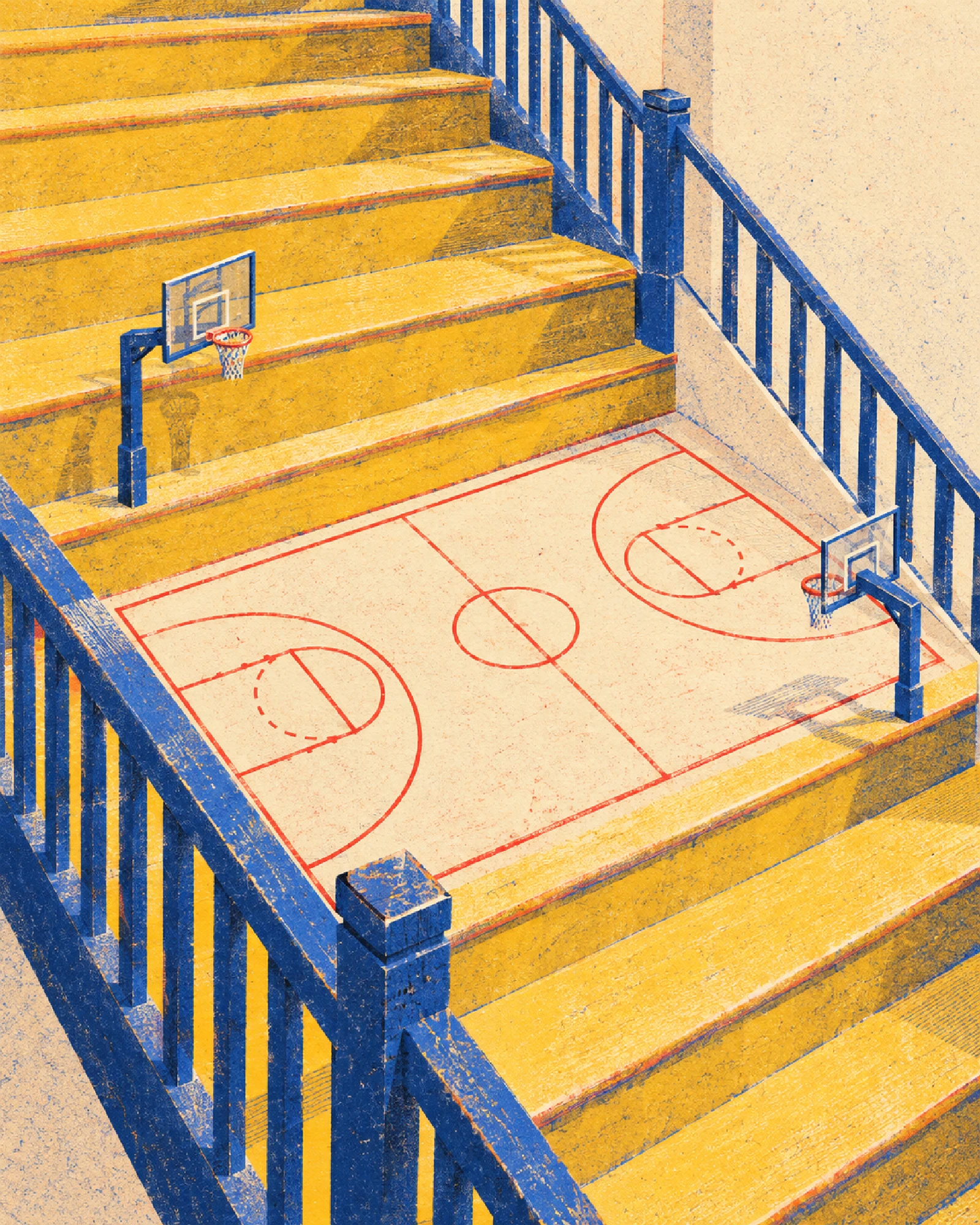
A Basketball Court on a Giant Step
One tread of an enormous indoor staircase becomes a complete basketball court. Familiar hoops reveal the startling scale, rendered through grainy riso layers and playful registration offsets.
Remix this referenceA Basketball Court on a Giant Step
- Form language
- Build forms from blunt geometric masses with slightly irregular cuts; simplify small details into legible signs.
- Contour
- Use interrupted stencil edges and occasional blunt outline fragments, with playful offsets between ink layers.
- Mark-making
- Let riso grain break broad ink deposits unevenly; sparse hand-drawn hatching interrupts otherwise solid passages.
- Surface rendering
- Use porous ink fields and translucent overprints; shift tone through broken screens rather than smooth blending.
Priority
Make the grain and imperfect registration visibly characteristic of riso printing.
What to avoid & what to check
Exact prompt for this example
MODULE OWNERSHIP
subject: Subject count, type, stable proportions and landmarks, resting face geometry, hair shape, physical materials, garment construction and permanent marks. No emotion, movement, color assignment or rendering recipe.
expression: Facial soft-tissue displacement and pupil direction, muscle coordination, regional intensity, asymmetry and onset/peak/release. No head/body pose, stable appearance, skin color or rendering.
gesture: Head/neck/body/limb orientation, joint movement, support, contact and pose-caused occlusion using existing anatomy. No eye/pupil movement, emotion, identity, props inventory or camera.
props: Prop count, type, construction, physical material and scale relative to the subject. Holding/contact belongs to gesture, position to composition, color to palette.
scene: Environment elements, terrain, backdrop/floor presence and structural detail. No canvas positions, camera, lighting, assigned colors or render texture.
camera: Projection, focal-length impression, camera elevation/yaw/roll, viewing distance and crop. No actor pose, world placement, lighting or canvas aspect ratio.
composition: Normalized 0-100% canvas positions, scale in frame, depth/overlap, focal hierarchy and margins. No joint pose, camera projection, rendering, subject/prop inventory or emotion.
palette: Color anchors, hue/saturation/value ranges, colors assigned to parts and approximate color coverage. No illumination direction, shading algorithm, physical material or layout.
lighting: Light-source direction/softness/intensity, ambient illumination, physical shadow direction/length and highlight position. Absence of directional illumination is allowed. No shading technique, palette or material changes.
style: Reusable form abstraction, contour weight/taper/edge quality, medium and mark scale/density/direction, surface rendering and tonal transition technique. No fixed subject proportions, anatomy, identity, expression, pose, palette, light-source direction, camera or layout.
output: Image count, aspect ratio, size, file/alpha requirements and global lettering/logo/watermark restrictions. No background scenery, crop, style, identity or pose.

SUBJECT
inventory: One monumental domestic staircase; no people or animals.
geometry: A broad straight flight has deep treads, tall closed risers and a continuous square-baluster rail.
resting-face: No facial features apply.
appearance: Solid timber steps and a timber balustrade retain simple joinery and worn tread noses.

PRIORITY


AVOID


CHECK


PROPS
inventory: Two standard basketball hoops, minute beside the monumental staircase.
construction: Each hoop has a tubular steel support, rectangular acrylic backboard, metal ring and woven cord net.

PRIORITY


AVOID


CHECK


SCENE
inventory: An enclosed domestic stairwell and an empty basketball court with boundary lines and semicircular markings.
structure: One tread accommodates the complete court; further steps continue above and below within the stairwell.

PRIORITY


AVOID


CHECK


CAMERA
projection: Architectural perspective with a moderate wide-angle impression and straight verticals.
viewpoint: Look diagonally down into the stairwell from an elevated three-quarter viewpoint, without roll.
crop: Show the complete court while allowing the outer staircase to continue beyond the top and bottom edges.

PRIORITY


AVOID


CHECK


COMPOSITION
placement: The court sits below and right of center; colossal risers step toward the upper left.
depth: The near rail overlaps the court's outer edge; hoops occupy opposite ends and higher treads recede behind.
spacing: The court leads the reading; broad risers and an open wall interval make its familiar scale unmistakable.

PRIORITY


AVOID


CHECK


PALETTE
colors: Sunflower yellow, cobalt blue, tomato red and warm paper cream; lively but limited inks.
assignment: Yellow steps, cream court and walls, cobalt rails and hoops, and tomato-red court markings.
balance: Cream and yellow form the broad fields; cobalt provides weight and red remains a crisp accent.

PRIORITY


AVOID


CHECK


LIGHTING
sources: Broad, moderately soft overhead light enters from the upper right with gentle ambient fill.
shadows: Rails and hoops cast readable shadows toward the lower left; riser recesses remain softly shaded.
highlights: Broad highlights sit on upper tread surfaces and upper-right rail edges.

PRIORITY


AVOID


CHECK


STYLE GUIDE
form-language: Build forms from blunt geometric masses with slightly irregular cuts; simplify small details into legible signs.
contour: Use interrupted stencil edges and occasional blunt outline fragments, with playful offsets between ink layers.
mark-making: Let riso grain break broad ink deposits unevenly; sparse hand-drawn hatching interrupts otherwise solid passages.
surface-rendering: Use porous ink fields and translucent overprints; shift tone through broken screens rather than smooth blending.

PRIORITY
Make the grain and imperfect registration visibly characteristic of riso printing.

AVOID


CHECK


OUTPUT
format: One finished image, portrait 4:5, 1600 × 2000 pixels, opaque PNG.
restrictions: No lettering, logos or watermarks.

PRIORITY


AVOID


CHECK


FINAL INTEGRATION
scene + props + composition: Keep the spatial premise legible through the relationship between architecture and familiar sporting equipment.
Model information comes from image provenance. The same prompt may produce a different result.