Text to imageAnimationStyle guide
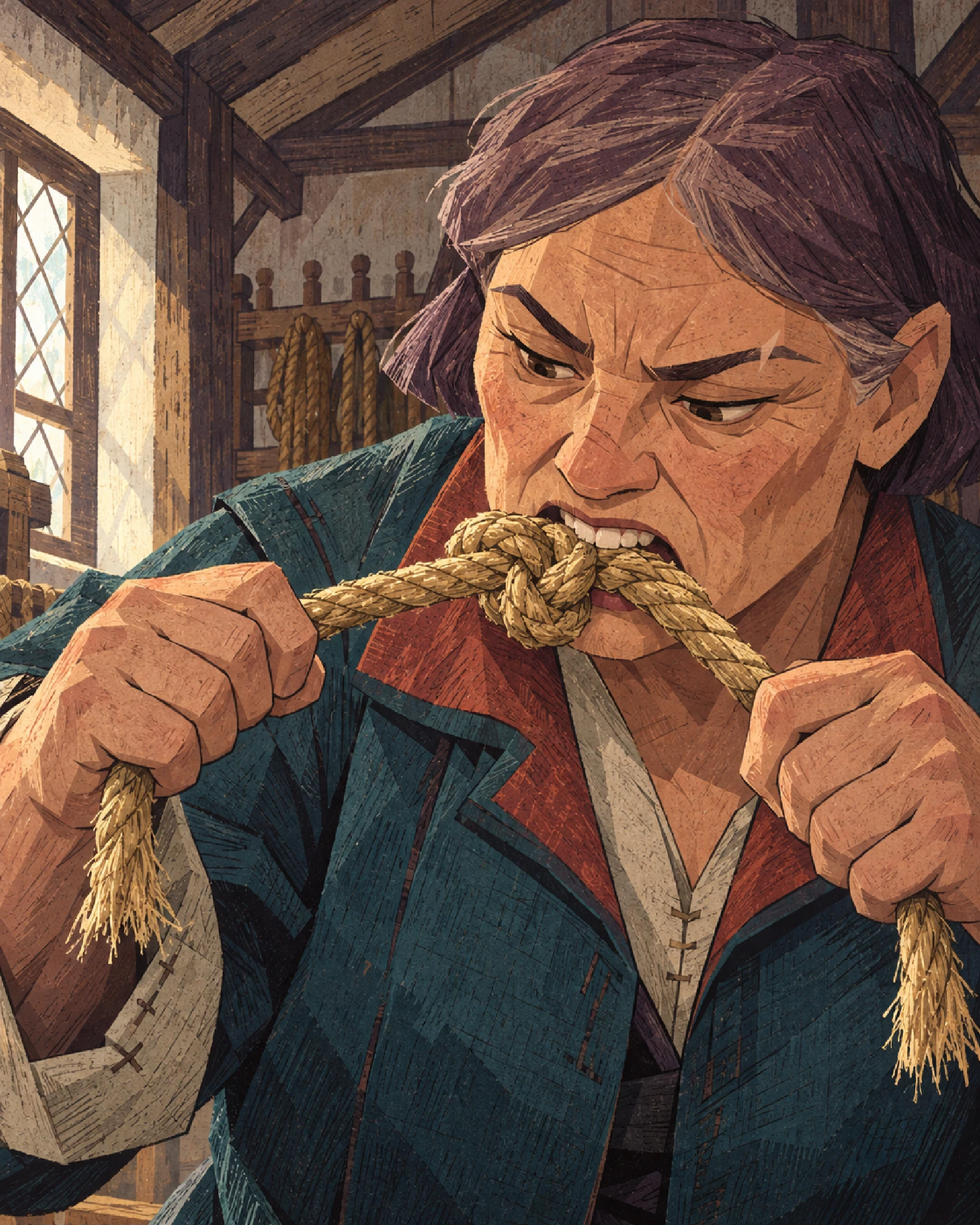
A Rope Maker Biting a Knot
An older rope maker braces a stubborn knot between her teeth and pulls its ends apart. Angular carved lines and rough hatching capture the close interplay of face and hands.
Remix this referenceA Rope Maker Biting a Knot
- Form language
- Translate forms into interlocking angular planes with selective simplification; allow small irregularities within the shared shape language.
- Contour
- Use slightly wavering straight and angular contours like carved cuts, with blunt weight changes and occasional broken edges.
- Mark-making
- Cluster short parallel hatches along plane changes; let restrained scratches vary naturally in spacing and length.
- Surface rendering
- Build flat printed planes with lightly broken ink and limited paper grain; hatch tonal regions instead of continuously modeling volume.
Priority
Rendering medium: 2D woodcut-print animated-film illustration; formal rendering reference: Cartoon Saloon · 2020s · Wolfwalkers (2020), town sequences
What to avoid & what to check
Exact prompt for this example
MODULE OWNERSHIP
subject: Subject count, type, stable proportions and landmarks, resting face geometry, hair shape, physical materials, garment construction and permanent marks. No emotion, movement, color assignment or rendering recipe.
expression: Facial soft-tissue displacement and pupil direction, muscle coordination, regional intensity, asymmetry and onset/peak/release. No head/body pose, stable appearance, skin color or rendering.
gesture: Head/neck/body/limb orientation, joint movement, support, contact and pose-caused occlusion using existing anatomy. No eye/pupil movement, emotion, identity, props inventory or camera.
props: Prop count, type, construction, physical material and scale relative to the subject. Holding/contact belongs to gesture, position to composition, color to palette.
scene: Environment elements, terrain, backdrop/floor presence and structural detail. No canvas positions, camera, lighting, assigned colors or render texture.
camera: Projection, focal-length impression, camera elevation/yaw/roll, viewing distance and crop. No actor pose, world placement, lighting or canvas aspect ratio.
composition: Normalized 0-100% canvas positions, scale in frame, depth/overlap, focal hierarchy and margins. No joint pose, camera projection, rendering, subject/prop inventory or emotion.
palette: Color anchors, hue/saturation/value ranges, colors assigned to parts and approximate color coverage. No illumination direction, shading algorithm, physical material or layout.
lighting: Light-source direction/softness/intensity, ambient illumination, physical shadow direction/length and highlight position. Absence of directional illumination is allowed. No shading technique, palette or material changes.
style: Reusable form abstraction, contour weight/taper/edge quality, medium and mark scale/density/direction, surface rendering and tonal transition technique. No fixed subject proportions, anatomy, identity, expression, pose, palette, light-source direction, camera or layout.
output: Image count, aspect ratio, size, file/alpha requirements and global lettering/logo/watermark restrictions. No background scenery, crop, style, identity or pose.

SUBJECT
inventory: One older woman, a rope maker; no other figures.
geometry: A broad, compact build, square face, substantial hands and a short wedge-shaped haircut tucked behind the ears.
resting-face: Low straight brows, hooded eyes, a broad nose and a wide mouth with a slightly uneven upper lip.
appearance: Weathered skin, a small notch in one eyebrow, and a heavy twill jacket with a split collar and turned-back cuffs.

PRIORITY


AVOID


CHECK


EXPRESSION — ACTOR A
brows: Brows draw inward, with one inner end slightly lower.
lids: Upper lids lower; lower lids tighten without closing the eyes.
cheeks: Cheeks tense subtly beside the mouth, without a smile lift.
nose: Nostrils widen slightly; the bridge remains unwrinkled.
mouth: Lips retract around a narrow central opening, exposing the front teeth.
jaw: Jaw stays nearly closed with visible tension along its lower edge.
gaze: Pupils aim downward toward the knot.
coordination: The concentrated upper face carries more tension than the restrained mouth.
timing: Hold the apex of sustained effort, before the mouth relaxes.

PRIORITY


AVOID


CHECK


GESTURE
head: She dips her chin and turns her head slightly toward her raised right hand.
torso: Her upper body bends forward, with one shoulder advanced farther than the other.
limbs: Both elbows bend outward as her hands pull the rope ends apart at unequal heights.
contact: Her front teeth brace the loose knot while each hand grips one tail; the rope partly covers her lower lip.

PRIORITY


AVOID


CHECK


PROPS
inventory: One short length of hemp rope, thumb-thick, with a loose knot roughly the size of her palm.
construction: Twisted fiber strands form one continuous rope with two frayed ends and an open, bulky knot.

PRIORITY


AVOID


CHECK


SCENE
inventory: A rope-making loft with timber framing, a narrow window and a fixed wall rack of wooden pegs.
structure: Uneven plaster meets exposed beams beneath a low sloping roof.

PRIORITY


AVOID


CHECK


CAMERA
projection: Perspective with a normal-lens impression and gentle near-to-far size differences.
viewpoint: An intimate three-quarter view at mouth height, with a level camera.
crop: Close portrait from the crown to the upper chest; both wrists meet the frame edges, and the floor remains outside the image.

PRIORITY


AVOID


CHECK


COMPOSITION
placement: The face fills the upper-right area; the knot sits near the middle, between hands spread across the lower frame.
depth: The nearer hand overlaps the jacket; the knot overlaps the mouth, with loft structures receding behind.
spacing: Face and knot lead, hands follow; leave an open wedge at upper left and clear gaps around the rope tails.

PRIORITY


AVOID


CHECK


PALETTE
colors: A small palette of smoky plum, muted teal, straw ochre and warm chalk, with a restrained rust accent.
assignment: Teal jacket, ochre rope, warm chalk skin and plaster, plum hair and beams, and a rust collar facing.
balance: Muted middle values dominate; pale skin and rope separate from deeper jacket and timber colors.

PRIORITY


AVOID


CHECK


LIGHTING
sources: Broad, softly edged daylight enters from the left window, supported by modest room ambience.
shadows: Short shadows fall rightward and beneath the chin; contact shadows remain narrow.
highlights: Restrained highlights touch the left cheek ridge, knuckles and upper rope strands.

PRIORITY


AVOID


CHECK


STYLE GUIDE
form-language: Translate forms into interlocking angular planes with selective simplification; allow small irregularities within the shared shape language.
contour: Use slightly wavering straight and angular contours like carved cuts, with blunt weight changes and occasional broken edges.
mark-making: Cluster short parallel hatches along plane changes; let restrained scratches vary naturally in spacing and length.
surface-rendering: Build flat printed planes with lightly broken ink and limited paper grain; hatch tonal regions instead of continuously modeling volume.

PRIORITY
Rendering medium: 2D woodcut-print animated-film illustration; formal rendering reference: Cartoon Saloon · 2020s · Wolfwalkers (2020), town sequences

AVOID


CHECK


OUTPUT
format: One finished image, portrait 4:5, 1600 × 2000 pixels, opaque PNG.
restrictions: No lettering, logos, watermarks or signature.

PRIORITY


AVOID


CHECK


FINAL INTEGRATION
expression + gesture + props: Coordinate facial tension with the established contact so the action remains immediately readable.
style + lighting + palette: Let printed tonal regions carry the specified illumination while preserving the palette distinctions.
Art direction
카툰 살롱 / Cartoon Saloon · 2020s · 울프워커스(2020)의 도시 장면 / Wolfwalkers (2020), town sequences ↗- Transfer the angular planar abstraction of the town sequences to generic form surfaces
- Slightly irregular straight and angular contours resembling carved lines
- Short parallel hatch groups and restrained scratched marks
- Flat planes with limited paper texture and hatched tonal regions, without continuous modeling
Model information comes from image provenance. The same prompt may produce a different result.