Text to imageAnimationStyle guide
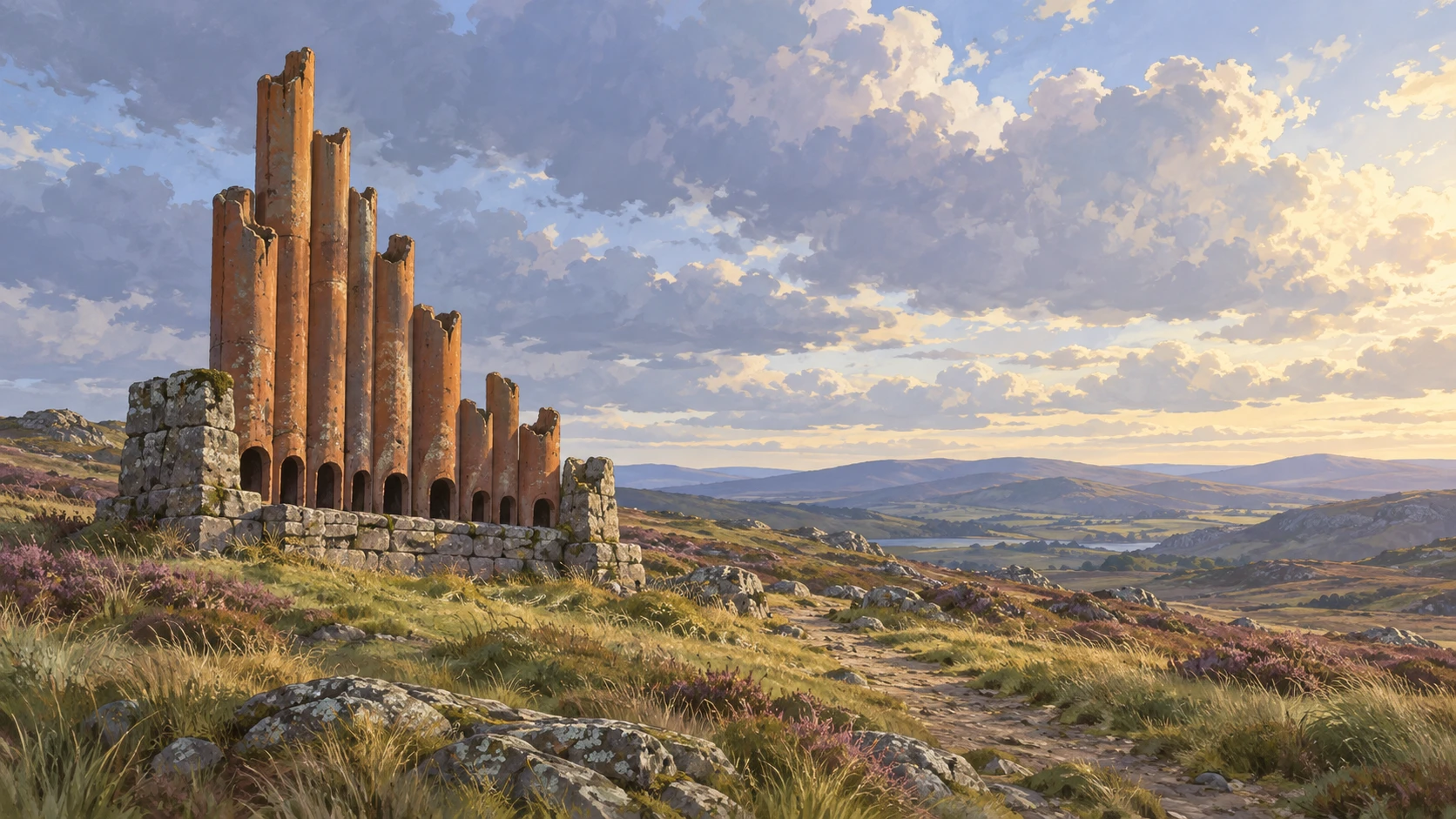
A Broken Wind Organ on the Moor
A ceramic-pipe wind organ stands on a rough moor. Broken pipe rims and windswept grass meet a wide opening of sky in a hand-painted environmental illustration.
Remix this referenceA Broken Wind Organ on the Moor
- Form language
- Establish broad interlocking planes before adding smaller painted patches; simplify irregular detail into readable clustered shapes.
- Contour
- Build contours from alternating firm and softened painted boundaries, allowing occasional lost edges instead of continuous outlines.
- Mark-making
- Overlap brush traces along each plane, varying stroke width naturally; use sparse dry-brush breaks for lively interruptions.
- Surface rendering
- Let shallow paper-and-pigment tooth show through uneven paint; blend broad tonal transitions while retaining local brush patches.
Priority
Rendering medium: 2D hand-painted animated-film background illustration; formal rendering reference: Studio Ghibli · 2020s · The Boy and the Heron (2023), background art
What to avoid & what to check
Exact prompt for this example
MODULE OWNERSHIP
subject: Subject count, type, stable proportions and landmarks, resting face geometry, hair shape, physical materials, garment construction and permanent marks. No emotion, movement, color assignment or rendering recipe.
expression: Facial soft-tissue displacement and pupil direction, muscle coordination, regional intensity, asymmetry and onset/peak/release. No head/body pose, stable appearance, skin color or rendering.
gesture: Head/neck/body/limb orientation, joint movement, support, contact and pose-caused occlusion using existing anatomy. No eye/pupil movement, emotion, identity, props inventory or camera.
props: Prop count, type, construction, physical material and scale relative to the subject. Holding/contact belongs to gesture, position to composition, color to palette.
scene: Environment elements, terrain, backdrop/floor presence and structural detail. No canvas positions, camera, lighting, assigned colors or render texture.
camera: Projection, focal-length impression, camera elevation/yaw/roll, viewing distance and crop. No actor pose, world placement, lighting or canvas aspect ratio.
composition: Normalized 0-100% canvas positions, scale in frame, depth/overlap, focal hierarchy and margins. No joint pose, camera projection, rendering, subject/prop inventory or emotion.
palette: Color anchors, hue/saturation/value ranges, colors assigned to parts and approximate color coverage. No illumination direction, shading algorithm, physical material or layout.
lighting: Light-source direction/softness/intensity, ambient illumination, physical shadow direction/length and highlight position. Absence of directional illumination is allowed. No shading technique, palette or material changes.
style: Reusable form abstraction, contour weight/taper/edge quality, medium and mark scale/density/direction, surface rendering and tonal transition technique. No fixed subject proportions, anatomy, identity, expression, pose, palette, light-source direction, camera or layout.
output: Image count, aspect ratio, size, file/alpha requirements and global lettering/logo/watermark restrictions. No background scenery, crop, style, identity or pose.

SUBJECT
inventory: One abandoned architectural wind organ; no people or animals.
geometry: A stepped bank of upright resonator pipes rises from a low masonry base, with broad sound openings near its foot.
resting-face: No face or facial landmarks apply.
appearance: Rough stone masonry and thick fired-clay pipes with several broken rims; minor weathering may vary naturally.

PRIORITY


AVOID


CHECK


PROPS
inventory: No separate props.
construction: No prop construction applies.

PRIORITY


AVOID


CHECK


SCENE
inventory: An open heather moor with coarse grass, exposed rocks, a faint footpath, distant rounded hills and an expansive cloudy sky.
structure: The ground swells gently around a shallow rocky hollow; grass bends in broad wind-combed swathes beside the path.

PRIORITY


AVOID


CHECK


CAMERA
projection: Natural perspective with a moderately wide, approximately 35 mm lens impression.
viewpoint: View from standing height, slightly uphill and oblique to the organ's front.
crop: A wide environmental view includes the complete organ and a generous sweep of surrounding ground and sky.

PRIORITY


AVOID


CHECK


COMPOSITION
placement: Keep the organ within the left 40% of the canvas; let its tallest pipes interrupt the sky above a low horizon.
depth: Foreground grass overlaps the base; the path recedes past it toward the distant hills.
spacing: The broken pipe silhouette is the primary focus; broad quiet sky on the right gives its irregular rhythm room to breathe.

PRIORITY


AVOID


CHECK


PALETTE
colors: Use muted terracotta, dusty olive, slate lavender and chalk cream, with restrained saturation and a broad value range.
assignment: Terracotta belongs to the pipes, olive to grass, slate lavender to stone and clouds, and chalk cream to open sky.
balance: Cool pale colors occupy the largest area; earthy middle values support a concentrated warm accent and sparse faded-rose heather.

PRIORITY


AVOID


CHECK


LIGHTING
sources: Broad late-afternoon light enters from the upper right through a cloud opening, with soft ambient fill.
shadows: Soft-edged shadows extend leftward across the ground; the pipe mouths retain deeper interior shadow.
highlights: Restrained highlights catch right-facing pipe rims and the upper faces of exposed rocks.

PRIORITY


AVOID


CHECK


STYLE GUIDE
form-language: Establish broad interlocking planes before adding smaller painted patches; simplify irregular detail into readable clustered shapes.
contour: Build contours from alternating firm and softened painted boundaries, allowing occasional lost edges instead of continuous outlines.
mark-making: Overlap brush traces along each plane, varying stroke width naturally; use sparse dry-brush breaks for lively interruptions.
surface-rendering: Let shallow paper-and-pigment tooth show through uneven paint; blend broad tonal transitions while retaining local brush patches.

PRIORITY
Rendering medium: 2D hand-painted animated-film background illustration; formal rendering reference: Studio Ghibli · 2020s · The Boy and the Heron (2023), background art

AVOID


CHECK


OUTPUT
format: One finished image.
restrictions: Deliver one 1920×1080 image, 16:9, opaque PNG; no lettering, logos or watermarks.

PRIORITY


AVOID


CHECK
Art direction
스튜디오 지브리 / Studio Ghibli · 2020s · 그대들은 어떻게 살 것인가(2023)의 배경 미술 / The Boy and the Heron (2023), background art ↗- Establish broad form planes before describing smaller surface variations with painted patches
- Use hard and soft painted boundaries rather than strong continuous outlines
- Overlapping brush traces following the plane direction with sparse dry-brush marks
- Shallow paper-and-pigment texture, uneven painted planes and blended tonal transitions
Model information comes from image provenance. The same prompt may produce a different result.