Text to imageLandscapeStyle guide
Rice Terraces in a Giant Hoofprint
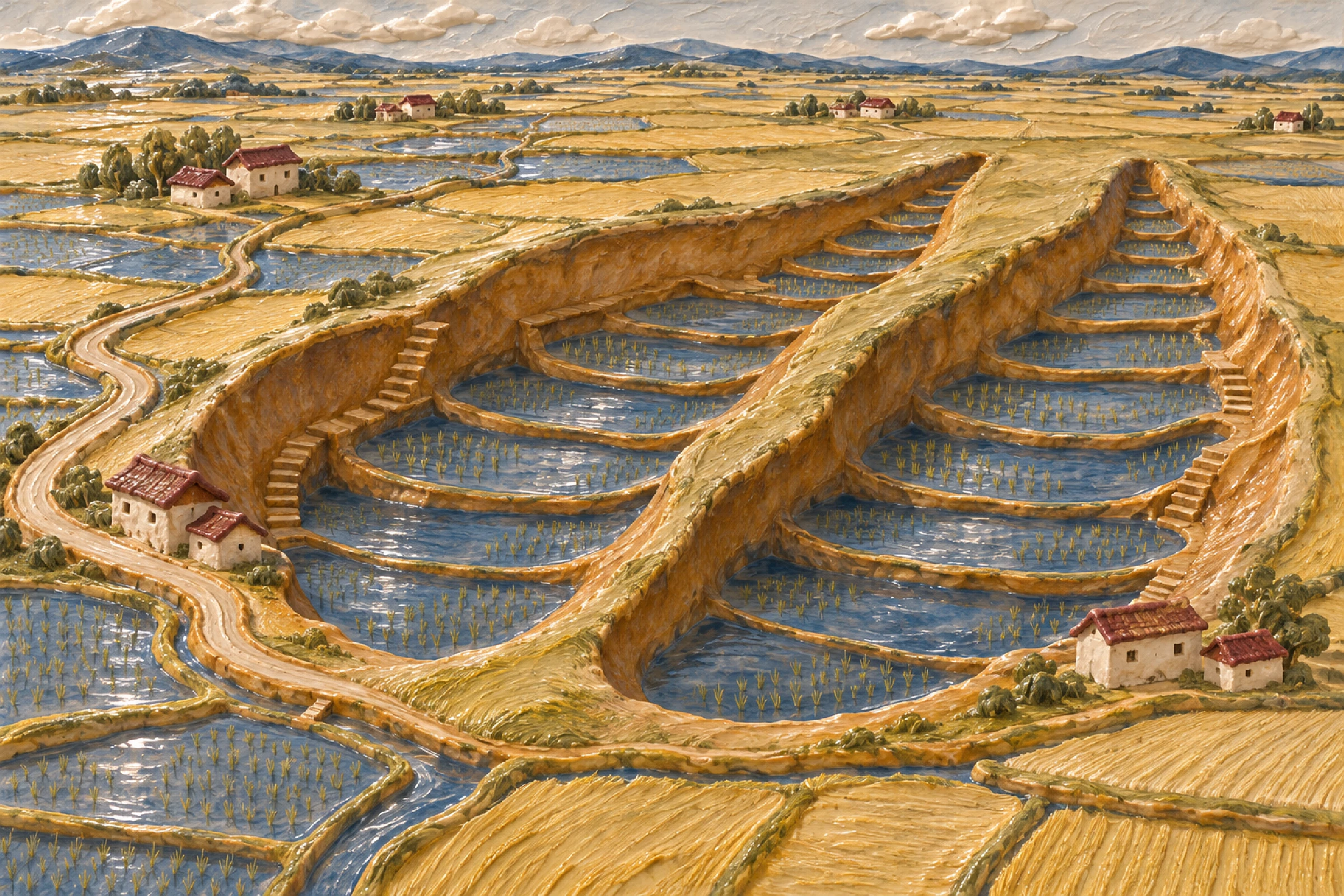
Rice terraces descend into a colossal cloven hoofprint amid ordinary farmland. Small farmhouses and lanes reveal its extraordinary scale, while pooled glaze gives the ceramic relief deep, gleaming water surfaces.
Remix this referenceRice Terraces in a Giant Hoofprint
- Form language
- Build a ceramic relief from broad nested shelves and shallow scooped hollows; simplify minor structures into irregular, hand-modeled blocks.
- Contour
- Use rounded, slightly wavering clay edges and occasional incised boundaries; let edge thickness vary naturally instead of outlining every form.
- Mark-making
- Retain broad thumb sweeps and sparse curved tool grooves that follow each modeled surface; allow local marks to vary within this vocabulary.
- Surface rendering
- Let translucent glaze pool in recesses and thin across raised edges, with softly mottled transitions and a contrast between glossy hollows and satin ridges.
Priority
The modeled glaze surfaces must visibly define the ceramic relief treatment.
What to avoid & what to check
Exact prompt for this example
MODULE OWNERSHIP
subject: Subject count, type, stable proportions and landmarks, resting face geometry, hair shape, physical materials, garment construction and permanent marks. No emotion, movement, color assignment or rendering recipe.
expression: Facial soft-tissue displacement and pupil direction, muscle coordination, regional intensity, asymmetry and onset/peak/release. No head/body pose, stable appearance, skin color or rendering.
gesture: Head/neck/body/limb orientation, joint movement, support, contact and pose-caused occlusion using existing anatomy. No eye/pupil movement, emotion, identity, props inventory or camera.
props: Prop count, type, construction, physical material and scale relative to the subject. Holding/contact belongs to gesture, position to composition, color to palette.
scene: Environment elements, terrain, backdrop/floor presence and structural detail. No canvas positions, camera, lighting, assigned colors or render texture.
camera: Projection, focal-length impression, camera elevation/yaw/roll, viewing distance and crop. No actor pose, world placement, lighting or canvas aspect ratio.
composition: Normalized 0-100% canvas positions, scale in frame, depth/overlap, focal hierarchy and margins. No joint pose, camera projection, rendering, subject/prop inventory or emotion.
palette: Color anchors, hue/saturation/value ranges, colors assigned to parts and approximate color coverage. No illumination direction, shading algorithm, physical material or layout.
lighting: Light-source direction/softness/intensity, ambient illumination, physical shadow direction/length and highlight position. Absence of directional illumination is allowed. No shading technique, palette or material changes.
style: Reusable form abstraction, contour weight/taper/edge quality, medium and mark scale/density/direction, surface rendering and tonal transition technique. No fixed subject proportions, anatomy, identity, expression, pose, palette, light-source direction, camera or layout.
output: Image count, aspect ratio, size, file/alpha requirements and global lettering/logo/watermark restrictions. No background scenery, crop, style, identity or pose.

SUBJECT
inventory: No discrete character subjects.
geometry: No character proportions or anatomical landmarks apply.
resting-face: No faces are present.
appearance: No character appearance, garments or permanent marks apply.

PRIORITY


AVOID


CHECK


PROPS
inventory: No separate props.
construction: No prop construction applies.

PRIORITY


AVOID


CHECK


SCENE
inventory: An ordinary farming plain contains a colossal cloven hoofprint, flooded rice terraces, irrigation channels, an approach lane and a few small farmhouses.
structure: Two tapering depressions share a raised central ridge; earthen steps descend inside them, regular fields continue beyond the rim, and the approach lane winds through the fields.

PRIORITY


AVOID


CHECK
The paired depressions read as one cloven hoofprint within a functioning agricultural landscape.

CAMERA
projection: Use a gently compressed perspective with the spacious impression of a moderate telephoto landscape view.
viewpoint: Look obliquely down from high above, across the open ends of the depressions toward their tapered tips; keep the camera level.
crop: Frame the complete hoofprint with surrounding farmland and a slender distant horizon; retain enough context to establish scale.

PRIORITY


AVOID


CHECK


COMPOSITION
placement: Set the paired basins slightly right of center across the lower two-thirds, with the approach lane entering from the left.
depth: Overlap broad foreground fields with the descending terraces; arrange flooded plots in a visually connected sequence leading toward smaller distant field divisions.
spacing: Make the hoofprint the dominant read; tiny rim buildings establish scale, and generous plain around the tips keeps its silhouette legible.

PRIORITY


AVOID


CHECK


PALETTE
colors: Use ink blue, honey ochre, pale straw, chalk ivory and a restrained oxblood accent, with mostly muted saturation.
assignment: Assign ink blue to flooded plots, honey ochre to terrace banks, pale straw to the plain, ivory to buildings and oxblood to roofs.
balance: Let straw and ochre occupy broad areas, blue occupy substantial areas, and ivory and oxblood remain small accents.

PRIORITY


AVOID


CHECK


LIGHTING
sources: Broad, soft light arrives from the upper left, with gentle ambient fill preserving detail inside the depressions.
shadows: Short shadows fall toward the lower right beneath terrace lips and buildings, gently revealing the relief height.
highlights: Soft highlights follow upper-left-facing ridges and gather as small reflections on the flooded plots.

PRIORITY


AVOID


CHECK


STYLE GUIDE
form-language: Build a ceramic relief from broad nested shelves and shallow scooped hollows; simplify minor structures into irregular, hand-modeled blocks.
contour: Use rounded, slightly wavering clay edges and occasional incised boundaries; let edge thickness vary naturally instead of outlining every form.
mark-making: Retain broad thumb sweeps and sparse curved tool grooves that follow each modeled surface; allow local marks to vary within this vocabulary.
surface-rendering: Let translucent glaze pool in recesses and thin across raised edges, with softly mottled transitions and a contrast between glossy hollows and satin ridges.

PRIORITY
The modeled glaze surfaces must visibly define the ceramic relief treatment.

AVOID


CHECK


OUTPUT
format: One finished image, landscape 3:2 aspect ratio, 2400 × 1600 pixels, opaque PNG.
restrictions: No lettering, logos, signatures or watermarks.

PRIORITY


AVOID


CHECK


FINAL INTEGRATION
scene + camera + composition: The view and spacing should make the unusual landform immediately understandable through its relationship to ordinary agriculture.
style + lighting + palette: Let glaze depth, illumination and color separation cooperate so neighboring terraces remain distinct without losing their handmade continuity.
Model information comes from image provenance. The same prompt may produce a different result.