Text to imageArt stylesStyle guide
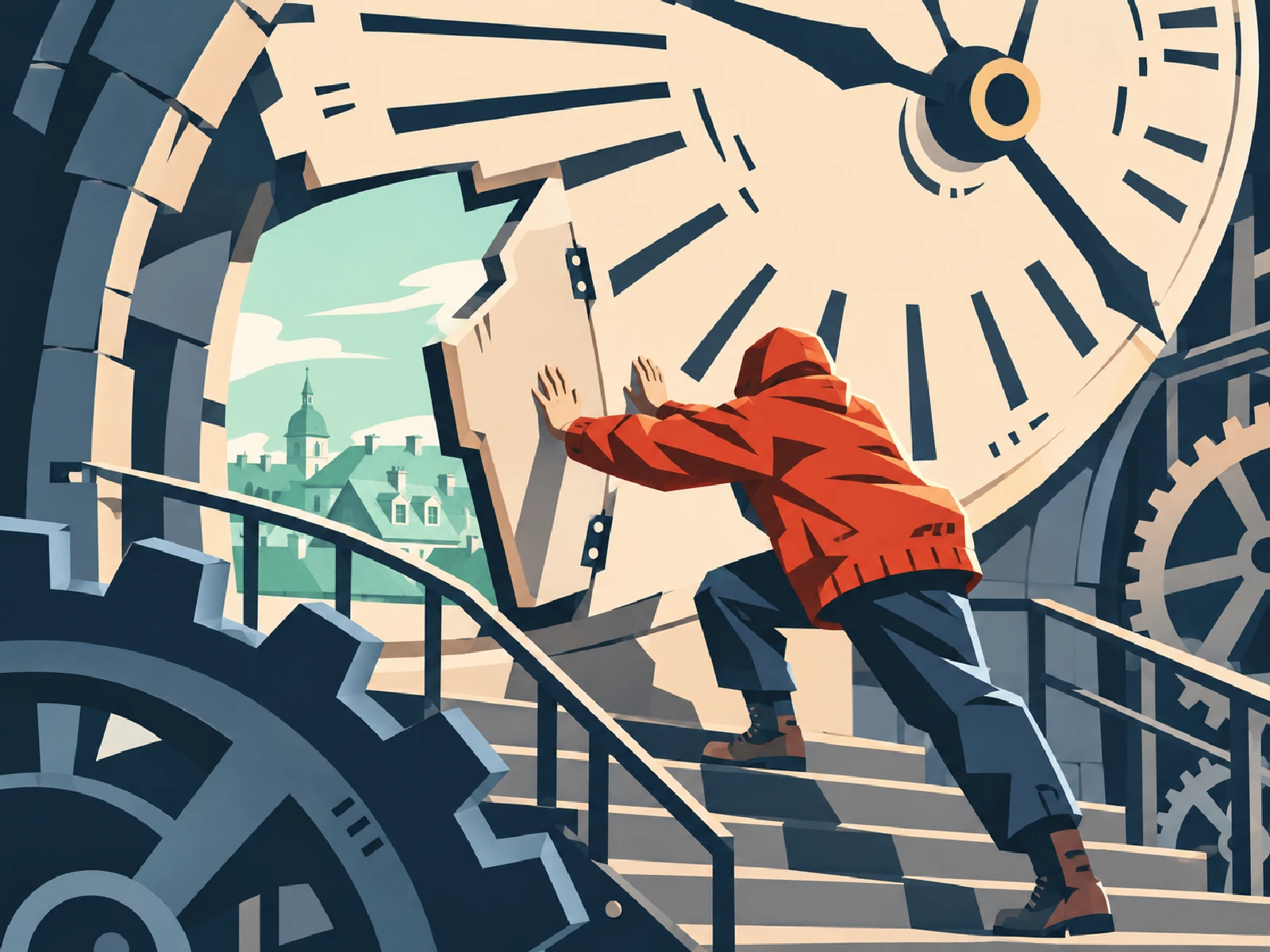
A Worker Opening a Giant Clock Face
Inside a clock tower, a worker pushes open part of the immense dial. Crisp vector shapes and asymmetric gaps connect stairs, gears, and rooftops beyond.
Remix this referenceA Worker Opening a Giant Clock Face
- Form language
- Reduce forms to interlocking arcs, blunt wedges, and unexpected cutouts; vary secondary shapes within this vocabulary.
- Contour
- Use crisp vector boundaries, mostly without outlines; occasional short tapered strokes clarify small separations.
- Mark-making
- Add sparse groups of unequal dashes and offset notches; let their spacing feel deliberately playful.
- Surface rendering
- Build tone from decisive flat shapes and occasional nested bands, with asymmetric edge accents and abrupt tonal steps.
Priority
Make crisp vector abstraction and playful asymmetry visibly define the image.
What to avoid & what to check
Exact prompt for this example
MODULE OWNERSHIP
subject: Subject count, type, stable proportions and landmarks, resting face geometry, hair shape, physical materials, garment construction and permanent marks. No emotion, movement, color assignment or rendering recipe.
expression: Facial soft-tissue displacement and pupil direction, muscle coordination, regional intensity, asymmetry and onset/peak/release. No head/body pose, stable appearance, skin color or rendering.
gesture: Head/neck/body/limb orientation, joint movement, support, contact and pose-caused occlusion using existing anatomy. No eye/pupil movement, emotion, identity, props inventory or camera.
props: Prop count, type, construction, physical material and scale relative to the subject. Holding/contact belongs to gesture, position to composition, color to palette.
scene: Environment elements, terrain, backdrop/floor presence and structural detail. No canvas positions, camera, lighting, assigned colors or render texture.
camera: Projection, focal-length impression, camera elevation/yaw/roll, viewing distance and crop. No actor pose, world placement, lighting or canvas aspect ratio.
composition: Normalized 0-100% canvas positions, scale in frame, depth/overlap, focal hierarchy and margins. No joint pose, camera projection, rendering, subject/prop inventory or emotion.
palette: Color anchors, hue/saturation/value ranges, colors assigned to parts and approximate color coverage. No illumination direction, shading algorithm, physical material or layout.
lighting: Light-source direction/softness/intensity, ambient illumination, physical shadow direction/length and highlight position. Absence of directional illumination is allowed. No shading technique, palette or material changes.
style: Reusable form abstraction, contour weight/taper/edge quality, medium and mark scale/density/direction, surface rendering and tonal transition technique. No fixed subject proportions, anatomy, identity, expression, pose, palette, light-source direction, camera or layout.
output: Image count, aspect ratio, size, file/alpha requirements and global lettering/logo/watermark restrictions. No background scenery, crop, style, identity or pose.

SUBJECT
inventory: A is one adult clock-maintenance worker; no other people appear.
geometry: A has an ordinary adult build with broad shoulders and recognizably human proportions.
resting-face: Resting facial geometry is unspecified.
appearance: A wears a hooded cotton jacket with roomy sleeves, straight trousers, and leather ankle boots; minor details may vary.

PRIORITY


AVOID


CHECK


EXPRESSION — ACTOR A
brows: Leave brow displacement unspecified.
lids: Leave lid tension and opening unspecified.
cheeks: Leave cheek lift and compression unspecified.
nose: Leave nasal soft-tissue movement unspecified.
mouth: Leave lip shape and tension unspecified.
jaw: Leave jaw opening and tension unspecified.
gaze: No pupil direction is prescribed.
coordination: No readable facial performance is required; facial muscle coordination remains unspecified.
timing: The neutral apex label implies no visible facial change in this still.

PRIORITY


AVOID


CHECK


GESTURE
head: A turns the hooded head toward the opening, presenting the back of the head and concealing facial features.
torso: A leans forward from the hips, extending the torso into a long pushing diagonal.
limbs: Both arms extend toward the panel; one knee bends while the trailing leg braces on a lower step.
contact: Both palms press the hinged dial panel, and both boot soles remain supported by the stairs.

PRIORITY


AVOID


CHECK


PROPS
inventory: No separate props.
construction: No prop construction applies.

PRIORITY


AVOID


CHECK


SCENE
inventory: A clock-tower interior contains an immense dial, a maintenance stair, exposed gears, and views of surrounding roofs.
structure: A hinged section interrupts the dial's radial slots and has an irregular opening outline; masonry ribs enclose the stair and interlocking gear assemblies.

PRIORITY


AVOID


CHECK


CAMERA
projection: Use a gently compressed perspective with little wide-angle distortion.
viewpoint: Look from inside the tower, slightly below the worker and obliquely toward the dial.
crop: Show the worker's full body while cropping the immense dial and nearest gear beyond the frame.

PRIORITY


AVOID


CHECK


COMPOSITION
placement: Place A right of center in the lower field; the hands and opening form the primary focus.
depth: A foreground gear overlaps the stair; the worker separates the interior machinery from distant roofs.
spacing: Let the dial dominate the upper field, with generous space for the opening beside A's silhouette.

PRIORITY


AVOID


CHECK


PALETTE
colors: Use deep ink blue, chalk cream, muted mint, and a small vermilion accent.
assignment: Assign ink blue to machinery, cream to the dial, mint to exterior roofs, and vermilion to A's jacket.
balance: Keep broad quiet cream areas against connected dark masses; reserve the strongest saturation for the jacket.

PRIORITY


AVOID


CHECK


LIGHTING
sources: Broad daylight enters through the opened dial from the upper right, with subdued interior ambient light.
shadows: The panel and worker cast broad shadows toward the lower left across the stairs.
highlights: Keep highlights broad along the opening-facing edges of the jacket and dial rim.

PRIORITY


AVOID


CHECK


STYLE GUIDE
form-language: Reduce forms to interlocking arcs, blunt wedges, and unexpected cutouts; vary secondary shapes within this vocabulary.
contour: Use crisp vector boundaries, mostly without outlines; occasional short tapered strokes clarify small separations.
mark-making: Add sparse groups of unequal dashes and offset notches; let their spacing feel deliberately playful.
surface-rendering: Build tone from decisive flat shapes and occasional nested bands, with asymmetric edge accents and abrupt tonal steps.

PRIORITY
Make crisp vector abstraction and playful asymmetry visibly define the image.

AVOID


CHECK


OUTPUT
format: Deliver one image at 1600 × 1200 pixels, landscape 4:3, as an opaque PNG.
restrictions: No lettering, logos, signatures, or watermarks.

PRIORITY


AVOID


CHECK


FINAL INTEGRATION
gesture + composition + scene: Architectural structure and spatial layering support the readability of the worker's action.
style + lighting: Translate the established illumination through the chosen tonal vocabulary.
Model information comes from image provenance. The same prompt may produce a different result.