Text to imageArt stylesStyle guide
Giant Carp Beneath the Footbridge
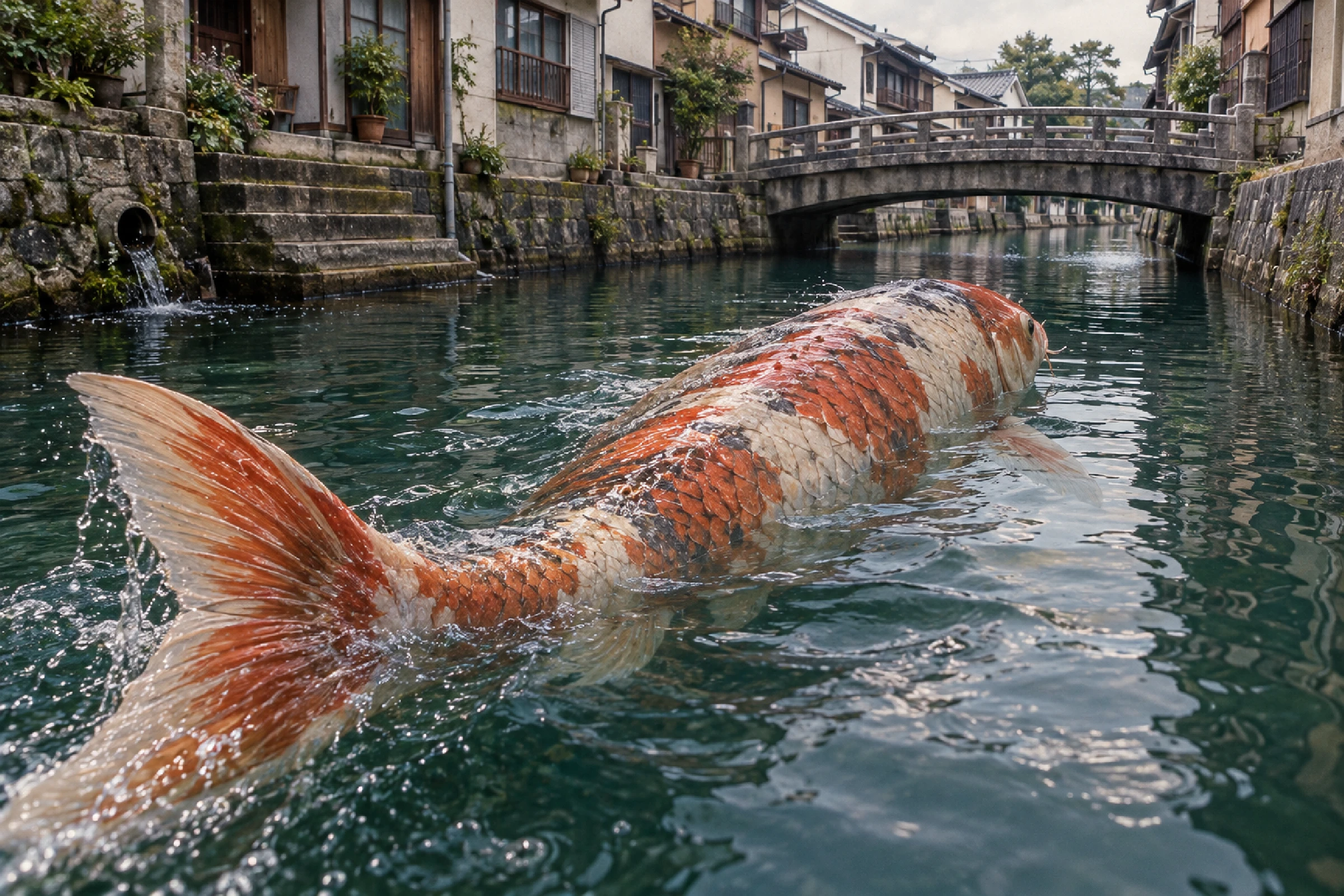
An enormous carp passes beneath a neighborhood footbridge. Its emerging tail and the receding houses share the expressive depth and soft grain of an analog photograph.
Remix this referenceGiant Carp Beneath the Footbridge
- Form language
- Use observational photographic forms with small natural irregularities rather than ornamental simplification.
- Contour
- Resolve boundaries through focus and tonal separation, allowing crisp edges to yield gradually to softer ones.
- Mark-making
- Fine irregular film grain remains visible in quiet passages; slight optical softness prevents brittle digital detail.
- Surface rendering
- Use analog print density, gentle highlight bloom, and continuous tonal transitions; let subtle surface variation arise naturally.
Priority
Make analog photographic depth and print character visibly integral to the image.
What to avoid & what to check
Exact prompt for this example
MODULE OWNERSHIP
subject: Subject count, type, stable proportions and landmarks, resting face geometry, hair shape, physical materials, garment construction and permanent marks. No emotion, movement, color assignment or rendering recipe.
expression: Facial soft-tissue displacement and pupil direction, muscle coordination, regional intensity, asymmetry and onset/peak/release. No head/body pose, stable appearance, skin color or rendering.
gesture: Head/neck/body/limb orientation, joint movement, support, contact and pose-caused occlusion using existing anatomy. No eye/pupil movement, emotion, identity, props inventory or camera.
props: Prop count, type, construction, physical material and scale relative to the subject. Holding/contact belongs to gesture, position to composition, color to palette.
scene: Environment elements, terrain, backdrop/floor presence and structural detail. No canvas positions, camera, lighting, assigned colors or render texture.
camera: Projection, focal-length impression, camera elevation/yaw/roll, viewing distance and crop. No actor pose, world placement, lighting or canvas aspect ratio.
composition: Normalized 0-100% canvas positions, scale in frame, depth/overlap, focal hierarchy and margins. No joint pose, camera projection, rendering, subject/prop inventory or emotion.
palette: Color anchors, hue/saturation/value ranges, colors assigned to parts and approximate color coverage. No illumination direction, shading algorithm, physical material or layout.
lighting: Light-source direction/softness/intensity, ambient illumination, physical shadow direction/length and highlight position. Absence of directional illumination is allowed. No shading technique, palette or material changes.
style: Reusable form abstraction, contour weight/taper/edge quality, medium and mark scale/density/direction, surface rendering and tonal transition technique. No fixed subject proportions, anatomy, identity, expression, pose, palette, light-source direction, camera or layout.
output: Image count, aspect ratio, size, file/alpha requirements and global lettering/logo/watermark restrictions. No background scenery, crop, style, identity or pose.

SUBJECT
inventory: One enormous living carp, A; no other animals or people.
geometry: Recognizable carp construction: a deep body, broad head, overlapping scales, and forked tail.
resting-face: Small lateral eyes and thick lips beneath a rounded snout define the resting face; short barbels flank the mouth.
appearance: Wet scales carry irregular pigment patches; thin fin membranes reveal their supporting rays.

PRIORITY


AVOID


CHECK


EXPRESSION — ACTOR A
brows: No separate brow action is prescribed for the carp.
lids: The visible eye aperture stays unchanged; no movable-lid action is prescribed.
cheeks: The mouth-side tissue stays relaxed without lifting or bunching.
nose: The snout remains relaxed, without visible nostril flare.
mouth: The thick lips part softly, with neither mouth corner pulled upward or downward.
jaw: The lower jaw opens slightly without a forceful drop.
gaze: The visible pupil is directed downstream along the canal.
coordination: The steady eye and relaxed mouth coordinate as quiet, neutral animal behavior.
timing: Hold the neutral apex between small mouth movements, without expressive escalation.

PRIORITY


AVOID


CHECK


GESTURE
head: A's head points forward along the canal, just beneath the surface.
torso: A's body bends in a broad lateral curve, with the back gently breaking the surface.
limbs: The tail sweeps left while the nearer pectoral fin fans outward beneath the water.
contact: Water supports the body; the lifted tail tip sheds a short sheet of water.

PRIORITY


AVOID


CHECK


PROPS
inventory: No separate props.
construction: No prop construction applies.

PRIORITY


AVOID


CHECK


SCENE
inventory: A narrow urban canal, one low pedestrian bridge, masonry embankments, and closely spaced houses.
structure: Steps descend to the water; drain outlets and ordinary domestic windows establish a familiar neighborhood.

PRIORITY


AVOID


CHECK


CAMERA
projection: Natural photographic perspective with a moderately wide lens impression.
viewpoint: Look downstream from a low embankment, obliquely behind the carp, with a level horizon.
crop: An environmental wide shot includes the entire tail and surrounding architecture for scale.

PRIORITY


AVOID


CHECK


COMPOSITION
placement: The tail fills the lower-left foreground; the body occupies the middle, with the bridge right of center.
depth: The bridge partly overlaps the head, leaving the near eye and lips legible; house fronts recede beyond.
spacing: Give the tail first attention and the bridge second; leave an open strip of water beside the body.

PRIORITY


AVOID


CHECK


PALETTE
colors: Anchor the image in petrol green, warm ivory, muted vermilion, and soot gray.
assignment: Water is petrol green; carp patches alternate ivory and vermilion; buildings use subdued gray and cream.
balance: Restrained surroundings dominate, allowing the carp's warmer patches to carry the color accent.

PRIORITY


AVOID


CHECK


LIGHTING
sources: Broad overcast daylight comes from the upper left, with generous ambient light.
shadows: Soft shadows fall rightward; the bridge casts the deepest shadow onto the water beneath it.
highlights: Broad highlights follow the upper back and tail edges, with smaller glints on disturbed water.

PRIORITY


AVOID


CHECK


STYLE GUIDE
form-language: Use observational photographic forms with small natural irregularities rather than ornamental simplification.
contour: Resolve boundaries through focus and tonal separation, allowing crisp edges to yield gradually to softer ones.
mark-making: Fine irregular film grain remains visible in quiet passages; slight optical softness prevents brittle digital detail.
surface-rendering: Use analog print density, gentle highlight bloom, and continuous tonal transitions; let subtle surface variation arise naturally.

PRIORITY
Make analog photographic depth and print character visibly integral to the image.

AVOID


CHECK


OUTPUT
format: One finished image, landscape 3:2, 2400 × 1600 pixels, opaque PNG; no lettering, logos, or watermarks.
restrictions: One finished image, landscape 3:2, 2400 × 1600 pixels, opaque PNG; no lettering, logos, or watermarks.

PRIORITY


AVOID


CHECK
Model information comes from image provenance. The same prompt may produce a different result.